Before the pandemic, paying an expense at School’s Out Washington involved a peculiar kind of office choreography. There were printed Excel sheets, paper receipts, physical signatures and journeys to the post office. A colleague could be found. A shoulder could be tapped. Then, in March 2020, the Seattle nonprofit went remote. Its process had depended on people being in the same place. Suddenly, that dependency was expensive.
- Corpay One connects invoices, approvals, payments and bookkeeping.
- Its customers include small businesses, nonprofits and accounting firms.
- Its software and card programs have different fees. Read the agreement.
The organization adopted Corpay One’s approval workflows for expenses and reimbursements. In the company’s account of the change, Assistant Controller Justin Tidwell-Davis describes fewer errors and less back-and-forth. There is no grand technological revelation here. The revealing detail is the shoulder tap. A payment system can look perfectly serviceable while quietly relying on someone walking across a room.
01 / The bill is only the beginning
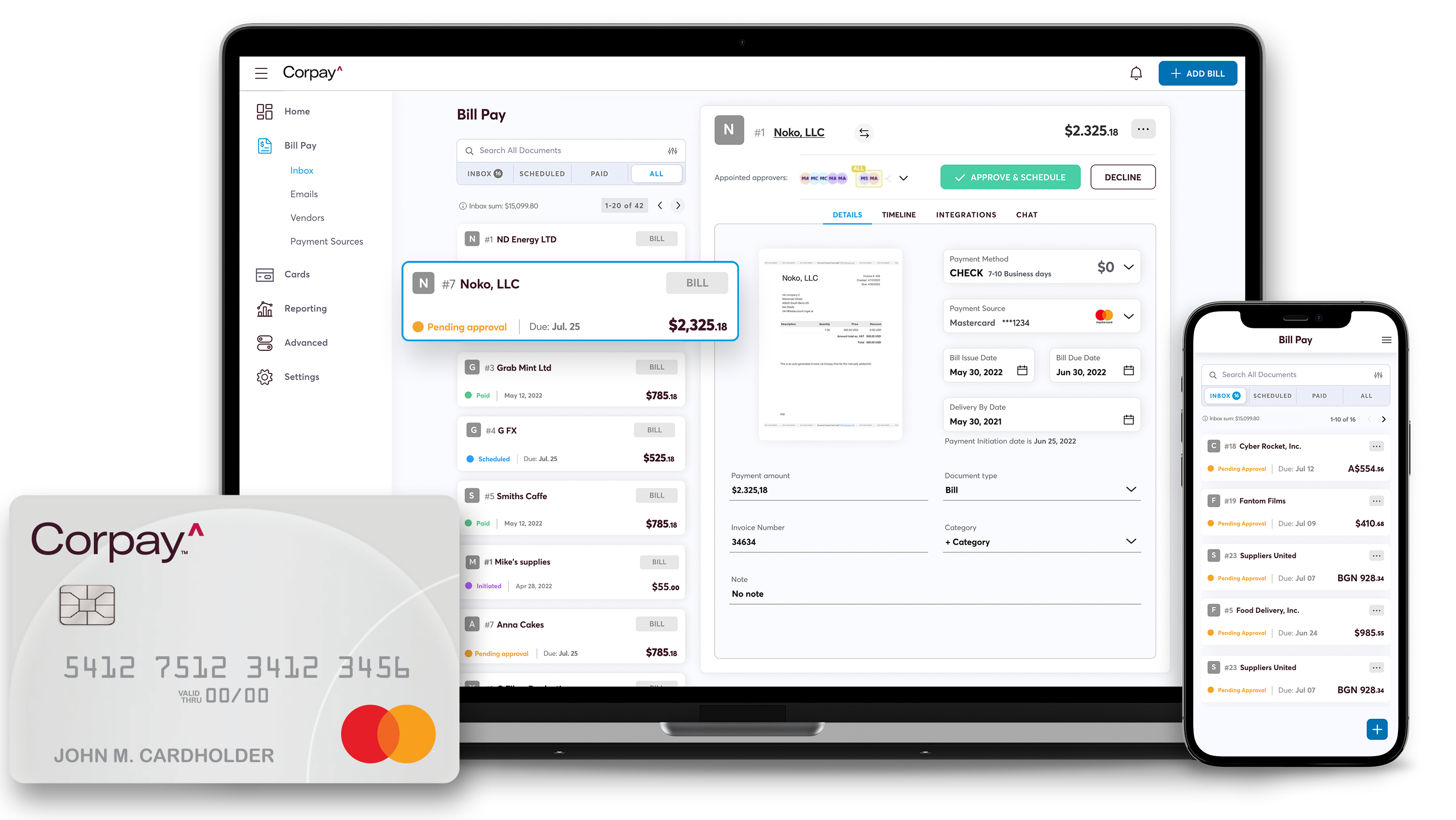
Corpay One occupies the space between receiving a financial document and getting the resulting payment into the books. Its accounts payable product scans invoices and receipts, routes documents through configured approvals, sends payments and synchronizes with accounting software. The expertise is in joining those steps. A bank can move money; an accounting ledger can record it. Getting the right person to authorize the right bill sits between those jobs.
The company offers no-code workflows for tasks such as expense coding and approval routing. Its QuickBooks Online integration includes duplicate-bill flags, document attachments and an audit trail. These are useful, unglamorous details. The invoice image and its payment record can travel together, so the person reconciling an account has something better than a number and a mystery.
02 / First came Roger
The business began in 2016 as Roger, founded by Cathrine Andersen and Christian Rasmussen. They had previously sold collaboration company Assemblage to Cisco. By May 2019, Roger reported thousands of paying customers and more than 100 accounting partners. It announced a $7.35 million Series A led by QED Investors, following a $2 million seed round.
The accounting partners matter. An accountant who helps several clients can bring a repeatable process into several businesses. Corpay One’s affiliate program also pays rewards after referred customers make an eligible first bill payment. Distribution grows around the people already trusted to sort out the books.
FLEETCOR completed its purchase of Roger in January 2021 for $39 million, net of acquired cash. Its announcement explained the appeal plainly: a modern bill-payment platform could be offered to its existing small-business fuel-card customers. Roger took the Corpay One name that March. In 2024, FLEETCOR itself became Corpay. The subsidiary had arrived at the name first.
Purchase price, net of cash acquired.
A software route into small-business payments.
03 / The card catches up with the bill
In December 2023, Corpay One introduced a Business Mastercard combining fuel, travel and business purchasing. The launch described vehicle and driver cards, fuel reporting and spending controls alongside accounts payable. Its current US site presents fuel cards, a Smart Business Mastercard and digital vendor payments together. That puts it at an intersection of office spending and vehicle expenses.
In a crowded market that includes BILL and Ramp, the useful comparison is the work a buyer needs done. A contractor buying fuel and paying suppliers has a different problem from an office team processing occasional reimbursements. Corpay One’s combination deserves a look when those jobs overlap. Product fit still depends on the accounting connection, payment methods and controls a particular business needs.

“It streamlines our review process for our finance team”Justin Tidwell-DavisAssistant Controller, School’s Out Washington. Portrait published with the company’s case study.
04 / “Free” needs a closer reading
Corpay One’s older homepage advertises no monthly subscription fees. Its published direct software terms list Plus at $69, Pro at $129 and Premium at $209 per month, with transaction charges. A separate fuel and business card agreement linked from its pricing page lists a $59 monthly account membership below ten active cards, and $0 at ten or more. These are different programs, not one interchangeable price list.
Published direct software terms. Subscription fees are separate; the applicable agreement determines your charges.
This is a business selling software and payment services, with several ways to charge for them. The sensible calculation uses your own bill volume and payment mix. Under those software terms, funding a $10,000 vendor payment by credit card adds $290 before other applicable costs. A useful workflow can still be an expensive payment method.
05 / Copy the map before the machinery
The lesson to borrow begins with one invoice. Write down who receives it, who approves it, who releases the money and who fixes an exception. Then test that route with a missing receipt, a duplicate bill and an absent approver. Those are practical checks a buyer can perform before trusting a workflow with a month’s expenses.
Compatibility deserves the same attention. Corpay One’s QuickBooks integration page excludes Simple Start; buyers should confirm their exact edition before committing. Card access is subject to credit approval. A virtual-card payment also needs a vendor able to receive it. Automation cannot settle an argument over who owns a decision. It becomes useful when the decision is clear enough to repeat.
Consider a simple approval rule: a bill above a chosen amount goes to a manager. The useful questions concern the edges. Does a substitute receive it when the manager is away? Can the person adding a vendor also release its payment? Who reviews a changed bank account? These are suggested checks, rather than claims about the nonprofit’s setup. They turn a demonstration of smooth software into a test of how the business will actually use it on a difficult Tuesday.
The card agreement adds another distinction: it describes the account as non-revolving, with the statement amount payable by its due date. Access to spending capacity should therefore be evaluated alongside the repayment schedule. For a business collecting customer invoices slowly, the timing can matter as much as the headline limit. A buyer should compare the dates money arrives with the dates money leaves, then ask whether the proposed card and bill-payment arrangement fits that calendar before moving recurring expenses onto it.
That is what makes the nonprofit’s experience instructive. The old process had worked because people supplied its missing connections. Corpay One gave those connections a place in software. The shoulder tap finally had somewhere else to go.
Website · Accounts payable · Customer story · Software terms · Card agreement
LinkedIn · X · Instagram · Facebook · YouTube
Watch: live product demonstration (Parkway Business Solutions, 2021) · Business Mastercard launch