Cristóbal Grinbergs Vidal wanted to pay a bill. His company’s card had run out of available credit, interrupting its advertising. He opened the bank’s website, tried to settle the balance and found that the amount available to pay was zero. A business could owe money and still be prevented from paying it. The bank had achieved a small feat of administrative imagination.
He described the episode in May 2021. It took two trips to a branch, conflicting instructions, queues and a call centre conversation before someone could complete the payment. The errand consumed 24 hours. With Cardda, the company he cofounded with Sebastián Hernández, he said adding funds took less than five minutes. The comparison had the force of experience: he had stood in those queues himself.
That encounter supplies a useful entrance to Grinbergs’s story. Before he was selling companies a way to manage their spending, he was trying to keep his own company moving. His route ran through Valdivia, industrial engineering, a machinery rental marketplace and a partnership formed through a university forum. The payment failure would become a business opportunity. First, there was a different business to build.
A comparison from Grinbergs’s May 2021 account, rather than a universal processing-time guarantee.
Before the cards, the machinery
Grinbergs was born and raised in Valdivia, in southern Chile. At the Universidad de Chile, he studied industrial civil engineering from 2013 to 2018. His early work included a placement at IBM involving cloud-computing prototypes and a finance and accounting internship at Procter & Gamble. These were practical introductions to the systems through which large organisations operate.
His next role put him in charge. From August 2018, he was CEO of Rentz, an online marketplace for renting heavy machinery. The proposition was tangible: connect people offering equipment with people needing to hire it. A university entrepreneurship course had helped push him toward starting a company, a beginning he later recalled when preparing to speak in his hometown.
He needed a technical partner. Hernández, who had studied computing at the same university, wanted a commercial direction for what he was programming. They connected through the university forum; Hernández joined Rentz in 2019. The partnership brought two different training paths into the same enterprise, with Grinbergs handling the CEO role and Hernández becoming the technical cofounder.
The machinery business then met an obstacle neither founder could code away. Construction work stopped, and sales fell. With advice from the Chilean accelerator Platanus Ventures, the pair changed course in 2020. Their experience running Rentz had exposed another operational difficulty: paying for the digital services a company needed.
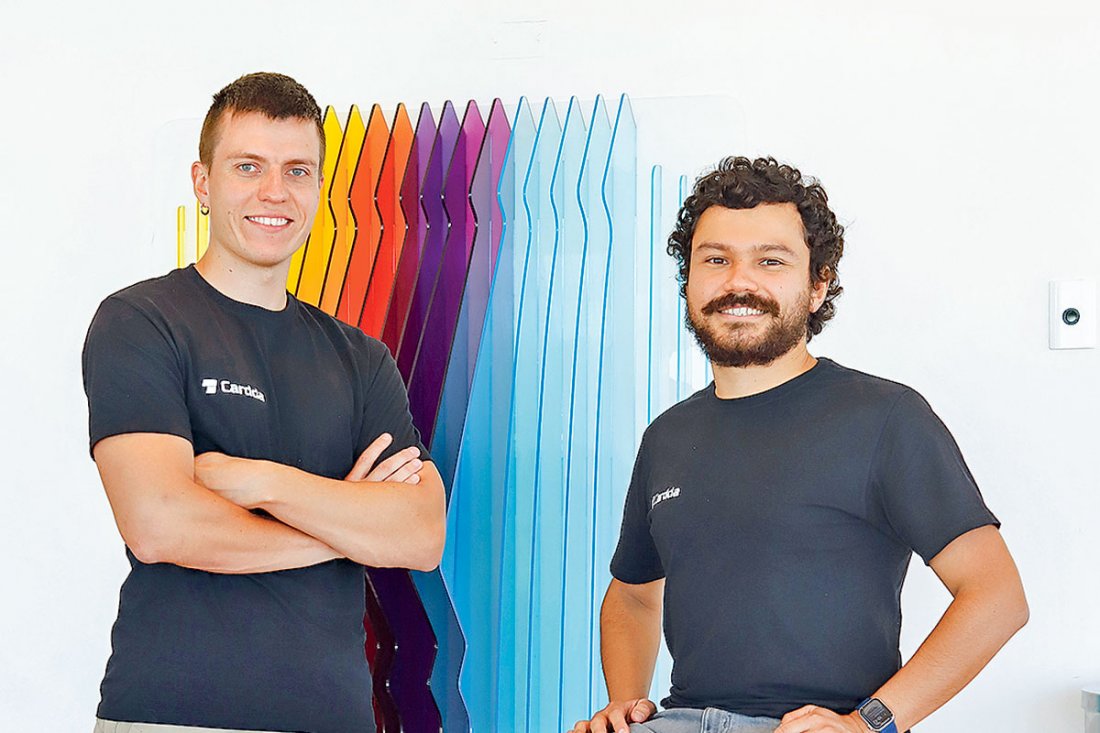
A forum introduction becomes a payments company
Cardda was founded in 2020. The early problem was specific. Companies needed to buy services from international providers, but their existing cards had inadequate limits or declined transactions. An advertising campaign or software subscription could be interrupted by the payment method behind it. For a company buying online, that interruption was part of the working day.
The first approach let businesses buy international digital services with a local invoice. The founders then moved toward virtual cards, giving customers a way to manage overseas payments and spending controls. By September 2021, Cardda had more than 60 clients, including Fintual, NotCo, Karum and wherEX. A frustration encountered in one startup was proving familiar to others.
The specificity matters. “Payments” is a large word, capable of concealing almost any financial product. Here, it meant being able to pay Google or Amazon, keep advertising running and decide how much a particular card could spend. Those are decisions a founder or finance employee can recognise without a diagram of the global financial system.
Grinbergs’s writing stayed close to that level of detail. He discussed the trouble with tying several subscriptions and employees to one card, and the convenience of cancelling an individual virtual card. The examples made his sales argument legible. Anyone who has inherited an unwanted recurring subscription can appreciate the appeal of an exit button.
The acceptance call he expected to be a rejection
The founders applied to Y Combinator in July 2021. Preparation involved other Chilean startups that had already been through the process: Fintual, Toku, Justo and Fintoc. Pedro Pineda, Fintual’s cofounder, had also taught them at university and was a mentor. Their application was an individual effort supported by people who understood the interview.
The first conversation was demanding. Then came a request for a second interview, with questions about competitors and what distinguished Cardda. Grinbergs later recalled being less optimistic than Hernández before the interviews. After the second, both thought their chances had shrunk dramatically. Their forecasts were about to have a rather bad evening.
In his later telling, Grinbergs spent the day expecting a rejection email. He went to bed with no answer. Then his phone rang: Cardda had been accepted. The company joined the Winter 2022 batch. For the founders, the admission arrived after rehearsal, questioning and a conclusion that turned out to be wrong.
It is a pleasingly unpolished episode. The story contains help from peers, an uncomfortable interview and a founder waiting beside his phone. Success came with an accurate memory of how uncertain it had felt. Grinbergs later discussed the experience with his friend Ignacio Ramírez on the Espresso Startup podcast.
“Poco a poco, todos los días.”
Cristóbal Grinbergs Vidal
Little by little, every day.
Eight people, a year of payments
At the end of 2023, Grinbergs offered a compact account of the company’s work. Cardda had eight people: five developers, two in sales and one in operations. During the year, 180 companies began using it in Chile and 30 in Mexico. He reported 60,000 card transactions and 100,000 bank transfers in Chile.
The product list was equally revealing. Cardda had launched reimbursements, accounts payable, cost centres, spending dashboards and different user roles. It also offered APIs for cards, accounts payable and transfers. A service that began with a company’s inability to make a purchase was extending into the paperwork and permissions surrounding that purchase.
Those additions changed what Grinbergs was asking customers to entrust to the business. Issuing a card addresses one part of a transaction. Tracking an invoice, its approval and its eventual payment brings the finance team’s ongoing work into view. Each added function involves a person who needs to know what happened and what to do next.
Back to the university, with a different card
One customer gave the story an unexpected return address. In November 2024, Grinbergs wrote about the Universidad de Chile’s technology operation. Staff had been paying for services with their own cards and seeking reimbursement afterward. His former university now had a use for the company he had helped create.
The university needed a payment arrangement compatible with its institutional requirements. Cardda’s prepaid approach allowed employees to make purchases without first using their own money. The account described configurable budgets, several cards and payment information available in one place. David Alvo, from the university’s technology vice-rectorate, emphasised the time gained by reducing bureaucracy.
For Grinbergs, this case connects his education with the subject of his work in a concrete way. The university had provided a course that encouraged entrepreneurship and the forum through which he met Hernández. Years later, part of that institution was using their product to handle its own everyday purchases.
Other customer conversations supplied different angles. At AFP Uno, finance executive Christian Brown discussed invoice approvals, supporting documents and connections to banks. At Kaufmann, ecommerce lead Álvaro Flores described difficulties making digital payments and the value of seeing transactions as they occurred. Grinbergs’s accounts make room for the people doing the work, with their particular responsibilities and irritations.
A year’s volume, inside a week
In August 2026, Grinbergs described a broader Cardda. The company’s first full operating year, 2021, had processed US$2 million across more than 8,000 transactions. By his August account, it was handling that volume in a week and serving more than 300 companies in Chile each month. The comparison is his measure of the distance travelled.
Company-reported payment volume. This graphic compares time windows; it does not show revenue or forecast annual volume.
Customers had asked for more than cards. The expanded product brought together expense submissions through WhatsApp, supplier payments connected to Chile’s tax authority and accounting synchronisation. The common thread remained the same: reduce the steps between making a purchase and knowing where it belongs in the company’s accounts.
That expansion explains the founder’s present occupation more precisely than a title alone. He is working on the surrounding tasks that made the original bank errand so cumbersome: information arriving late, several systems disagreeing, a person having to intervene. The product’s boundaries have widened as customers have brought the company further problems.
The hometown and the missing list
Valdivia remained part of the story. Ahead of a 9punto5 conference appearance in 2024, Grinbergs described it as the city where he was born and grew up. Hernández’s enthusiasm for the event encouraged him to present. His proposed subject followed the route from a university course to YC and the ongoing construction of Cardda.
His public voice also allows for a smaller joke. Before an America Digital event, he admitted that selfies were not his strength, then offered to explain how Cardda could help businesses with their payments. It was an approachable invitation: the photograph might need work; the conversation had a clear subject.
When Cardda failed to appear in an El Mercurio startup ranking, Grinbergs acknowledged his disappointment. Nine of the listed startups were Cardda customers, which made the omission an unusually pointed irony. He congratulated the companies included and returned to the ambition of building a durable business whose users valued the product. He closed with “Poco a poco, todos los días.”
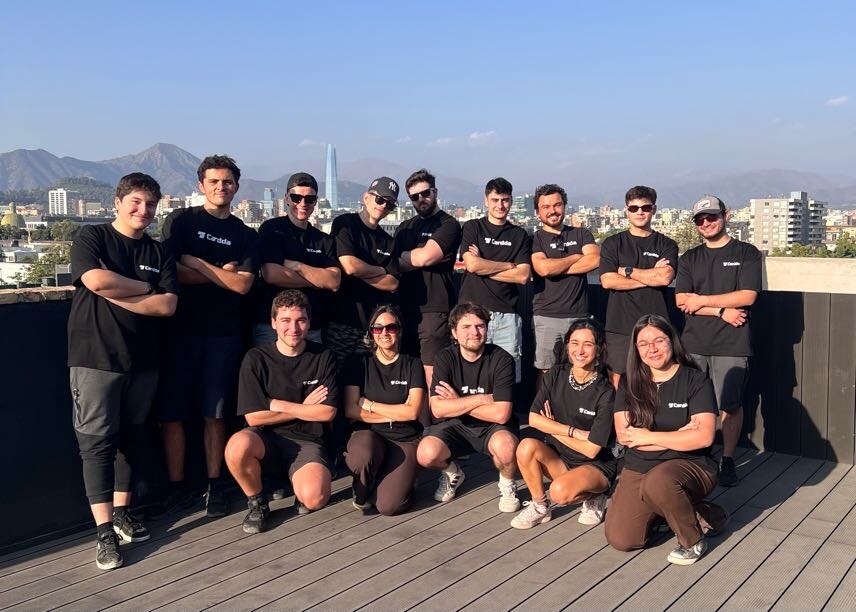
There is a useful continuity between that sign-off and the bank queue. A company must persuade people to use it, handle the transactions they entrust to it and keep improving the inconvenient details. A ranking can recognise those efforts; a customer encounters them directly. Grinbergs’s story keeps returning to that encounter: somebody has a bill to pay, and would prefer to get on with the rest of the day.