The useful clue was not hidden in a spreadsheet. It was sitting in a card decline. A Chilean company needed to pay for an ordinary digital service - Google Ads, Meta, another piece of software keeping the business awake - and its bank card could not be trusted to finish the job. Limits were low. Fraud rules were blunt. The payment failed, and somebody in finance inherited a fresh little emergency.
Cristóbal Grinbergs Vidal noticed that such emergencies were neither rare nor little once you added them together. He had already learned how quickly a business model could lose its footing. Rentz, the heavy-equipment rental marketplace he built with Sebastián Hernández, depended on construction activity. When the pandemic stopped projects, the marketplace stalled with them. The founders entered Platanus Ventures and confronted the unpleasant arithmetic: clever execution could not rescue demand that had disappeared.
So they changed industries. In 2020, with guidance from Platanus cofounder Agustín Feuerhake and conversations about the payment problems businesses faced, Rentz gave way to Cardda. The new company initially helped Chilean businesses pay international digital bills. Soon it issued virtual cards. Physical cards followed. A point solution began to acquire the outline of a finance operating system.
The art of taking paperwork personally
Grinbergs is an industrial engineer from Valdivia, educated at the Universidad de Chile. That training appears in how he describes Cardda: less as a glamorous financial object than as a sequence of operations waiting to be shortened. A payment begins before money moves. Someone requests it, someone approves it, a card or bank account executes it, a receipt proves it, and accounting eventually makes sense of it. Traditional business software scatters those moments across portals, inboxes, chats and spreadsheets.
Cardda’s strategy has been to gather them around the payment itself. A company can create physical and virtual Mastercard cards, set budgets by person, team or project, and connect each transaction to its document. An employee with a lunch receipt can send a photo through WhatsApp. Cardda reads the amount and merchant, routes the expense for approval and records what happens next. Supplier invoices can enter from Chile’s tax authority, the Servicio de Impuestos Internos, then move through reviewers and out through a connected bank. Payments sync with accounting systems including SAP, NetSuite, Softland, Defontana and Nubox.
“Las rendiciones de gastos no deberían existir.” Expense reports should not exist.
It is a sharp sentence because expense reporting has survived by appearing harmless. One form takes five minutes. One missing receipt requires one reminder. One supplier transfer means copying one account number. Multiply each ritual by hundreds of people and twelve month-ends, and the harmless task becomes an unofficial department. Grinbergs’ argument is not that employees need more discipline. It is that the software should capture control before the money leaves and evidence at the moment the expense occurs.
A cofounder found on a forum
The partnership behind Cardda began with complementary needs. In 2019, Grinbergs was looking for a technical cofounder for Rentz. Hernández, then studying computing, wanted commercial perspective on what he was building. They met through an online forum and agreed to work together. The arrangement outlived the original company because the useful complement was not tied to heavy machinery: Grinbergs carried the commercial and operational side; Hernández became CTO.
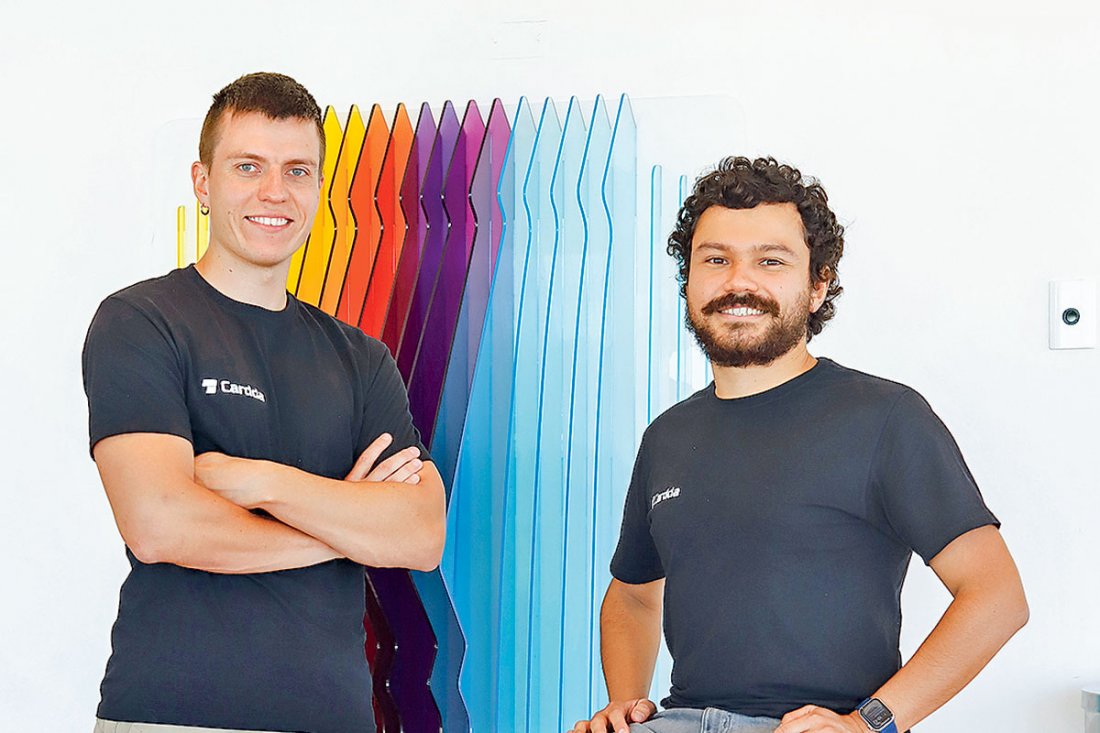
Their Y Combinator application tested the partnership in compressed form. Cardda applied in July 2021. The founders rehearsed with Chilean startups that had already passed through the accelerator, including Fintual, Toku, Justo and Fintoc. The first interview lasted roughly twelve minutes and felt, in Grinbergs’ word, “durísima” - extremely hard. A second conversation focused on competitors and differentiation. When it ended, both founders believed the probability of acceptance had reached zero.
Then came a late-night message asking for another call. This one delivered the acceptance. They told Cardda’s four-person team in Slack. There was little ceremony afterward. The founders returned to improving the platform and preparing for Demo Day, then spent time in California as part of the Winter 2022 batch. It is an almost comic founder rhythm: two interviews that feel fatal, one message that changes the horizon, and another morning of product work.
The card was the opening, not the plot
In Cardda’s first reported year, 2021, the company processed US$2 million in more than 8,000 transactions. By August 2026, Grinbergs wrote that the same volume moved through the platform in a week and that more than 300 Chilean companies used Cardda each month. The customer list he cited crossed categories and ages: NotCo, Fintual and Kavak alongside Sky Airline, Sura, Kaufmann and Masisa.
The progression matters more than the names. Customers who solved card failures revealed adjacent costs. Finance teams chased receipts. They reviewed invoices in email. They loaded payment files into banks and reconciled transactions after the fact. Cardda kept following the work. Each new layer made the original card more useful because the card no longer ended at the transaction notification.
This is the practical product lesson in Grinbergs’ story: a narrow entry point need not produce a narrow company. The trick is to expand along the customer’s workflow instead of collecting fashionable features. Cardda’s WhatsApp flow works because people already know how to send a photo. Its SII connection works because the invoice already exists there. Its accounting integrations work because a payment that cannot be reconciled is only half finished. Good automation respects where the work begins and where it must land.
In 2021, a year’s payment volume was US$2 million. By 2026, Cardda said it handled that in one week.
From Chile, with fewer tabs open
Cardda’s next geographic move grew from the same customer-led logic. A client, identified only as an airline, wanted the accounts-payable product available in Peru. Grinbergs saw familiar terrain: like Chile, Peru centralizes tax documents, and the target companies looked similar. The company planned to begin there in September 2025 and pursue 50 customers in its first year, focusing on financial businesses.
Expansion adds local complexity, especially in payments, but the underlying irritation travels well. A finance team in Lima can lose an afternoon to approvals just as efficiently as one in Santiago. The institutions differ; the appetite for retyping bank details does not. Cardda’s opportunity rests on making the local plumbing feel like one coherent room.
More recently, the automation edge has moved beyond human users. Grinbergs shared Cardda’s launch of webhooks that deliver Webpay verification codes to a company’s system instead of a staff member’s phone. Combined with card data exposed through an API, the feature is designed for automated payment flows, including software agents. The origin problem remains recognizable: a person should not need to stare at a phone and relay codes all day simply because the payment stack was built around occasional consumer purchases.
There is a sly detail in how discovery itself has changed. Grinbergs wrote that when “claude” first appeared as a referral source in HubSpot, he thought it was a bug. Then more prospects arrived after asking ChatGPT or Claude how to solve card, expense and supplier-payment problems. The software agents were recommending Cardda before Cardda gave them a way to pay.
The founder as careful subtractor
Grinbergs’ public voice is unusually willing to begin with mundane embarrassment. He once advertised an event appearance by saying he was not very good at selfies but was good at explaining how companies could pay with fewer errors and less time. It is a modest joke with a sales point tucked inside. The subject always returns to the work somebody would rather stop doing.
That instinct links the entire career so far. Rentz taught him that a company can be competently built around a market that suddenly vanishes. Cardda taught him to keep listening after the first product works. Y Combinator supplied pressure and a larger network, but the company’s durable material came from the finance desk: the blocked card, the duplicate payment, the receipt in a pocket, the invoice buried in email.
Founders are often advised to create delight. In corporate finance, relief is an excellent form of delight. It arrives quietly: the card works, the rule was already set, the receipt is attached, and the ledger agrees. Nobody throws confetti when an approval chain disappears. They simply get Friday afternoon back.
That is the scale Grinbergs seems to favor - not small in ambition, but precise in observation. Cardda’s aspiration is broad B2B payment infrastructure for Latin America. Its proof is measured in the stubborn chores it can remove, one by one, until an expense report begins to look like a quaint artifact from the age of the fax machine.