A round of golf with David Gang and his son Matthew has an important supporting act: ice cream. There are grander ways to describe a life in technology, and certainly more solemn ways to discuss the future of a golf club. Yet the ice cream earns its place. A score tells you how somebody played. A small family ritual tells you why they might want to play again.
Gang co-founded Brightspot, the publishing software company that began life as Perfect Sense. Before that came senior product roles at AOL. His working life has involved decisions about what people see, what they can do and how easily they can do it. Now he is applying his attention to a course in Cornwall, New York, where the usual instructions for a round have become negotiable.
At Storm King Golf Club, different tees can lead to different greens. A familiar patch of ground offers another experience when approached from another direction. Golf has many traditions; Gang appears quite happy to make some of them explain themselves.

Before the fairway, the Buddy List
The early career has a pleasingly literal software-company name: After Hours Software. Gang was its president from 1990 to 1992, then became vice president of marketing at Aldus Consumer Division. There, his work included Home Publisher and Art Explorer. Before enterprise publishing came products intended for people making things on their own computers.
By July 1995 he was vice president of product marketing at AOL. He moved into strategic development in 1999, became executive vice president of product marketing in 2002 and took the AOL Products executive role in April 2003. The sequence matters because it puts him across both the making and the presentation of software. What should exist, and how should an ordinary person encounter it?
AOL’s product introductions during his leadership included AIM, Buddy List, parental controls and successive versions of the service. These were features of everyday online life. A list could tell you who was available. A message could start a conversation without a telephone call. There is a considerable difference between having a network and finding someone on it.
Gang later served as chief technology officer and an executive vice president at WebMD. By the time he started his own company, he had worked through several layers of the digital experience: consumer software, product strategy, technical development and operations. The next business would bring those responsibilities closer together.
Software
marketing
co-founded
name
A publishing company finds its name
Perfect Sense was formed in 2008, with Gang and Lisa Beaudoin as co-founders. An early relationship with Scripps Networks Interactive brought work across product planning, technology and digital teams. This was the less glamorous end of the web’s promise: somebody had to make the publishing operation function once the presentation was over.
The Scripps relationship became a sustained partnership. In recalling its beginnings, Gang emphasized dependability. That is an unshowy word for a technology business, which gives it a certain distinction. A customer with an actual publishing schedule has limited use for a beautiful explanation of why the platform will be ready next season.
Brightspot grew out of that practical setting. Kate Condon, an early employee, remembers the move from product strategy work to building a content management system as a defining change. Her explanation is straightforward: the company wanted to meet needs it believed the existing market was failing to address. Consulting had exposed the problem; a product offered a repeatable way to work on it.
Gang’s 2019 formulation was “Start Finished, then Customize.” The phrase captures a recurring tension in business software. Customers want something ready to use. They also have their own habits, processes and requirements. An empty workshop offers freedom at the price of time; a sealed box offers convenience until someone needs to move a wall.
“Start Finished, then Customize.”
David Gang, on delivering digital experiences, 2019
In August 2020, Perfect Sense adopted the Brightspot name. The company and its principal product now answered to the same word. Customers at the time included news organizations and broadcasters with different publishing demands. The common work was helping teams organize and deliver their material while retaining room for their own ways of operating.
By then, an outside investment had added another chapter: Carrick Capital Partners invested $22 million in 2017. The company subsequently added senior leaders as it pursued a wider CMS market. A founder’s personal working relationships had become part of a business with a larger organization to support.
A different title, the same customers
In September 2022, Raleigh McClayton became Brightspot’s chief executive. Gang, who had held the role since the company’s founding, moved to president and chief customer officer. The announcement placed him alongside the incoming CEO rather than treating the handover as a disappearing act.
Gang’s own public explanation was brief: “I will be focused on the product, services and our customers.” For a founder, that is a fairly precise description of where to spend the newly available attention. The title had changed. The objects of interest were familiar.
The company’s current biography identifies him as co-founder. A glimpse of his influence appears in Glenn Facey’s recollection of joining Brightspot in 2022: meetings with Gang helped convey the company’s direction and the business he and Beaudoin had built. A founder’s role can include explaining a place well enough that somebody else decides to help build it.
An invitation that grew
Golf first appealed to Gang in the quiet hours. He played a neighborhood course near his home, taking opportunities around dawn and the end of the day. He later stepped away during his AOL years, returning when Brightspot began. This time, Matthew was part of the experience.
At Sherwood Country Club in California, Matthew walked a pro-am round with Tiger Woods. Gang remembers the welcome as the essential part. It helped prompt a larger effort to bring other players into events where they could share a course with professionals.
The effort acquired names, dates and tee times. In 2012, Gang arranged places at Congressional for four Special Olympics golfers, with professionals Gary Woodland and Brendan Steele among those participating. The following year, Brightspot sponsored an event with 60 golfers in 12 groups, mixing athletes, veterans, junior golfers, professionals and company participants.
Those arrangements gave the idea a practical shape. People met through playing together. Skill and experience varied, but everyone had shots to make and a round to share. Putting an invitation on a calendar takes more work than approving the sentiment. Gang kept finding occasions to do it.
Sixty-three acres, several ways through
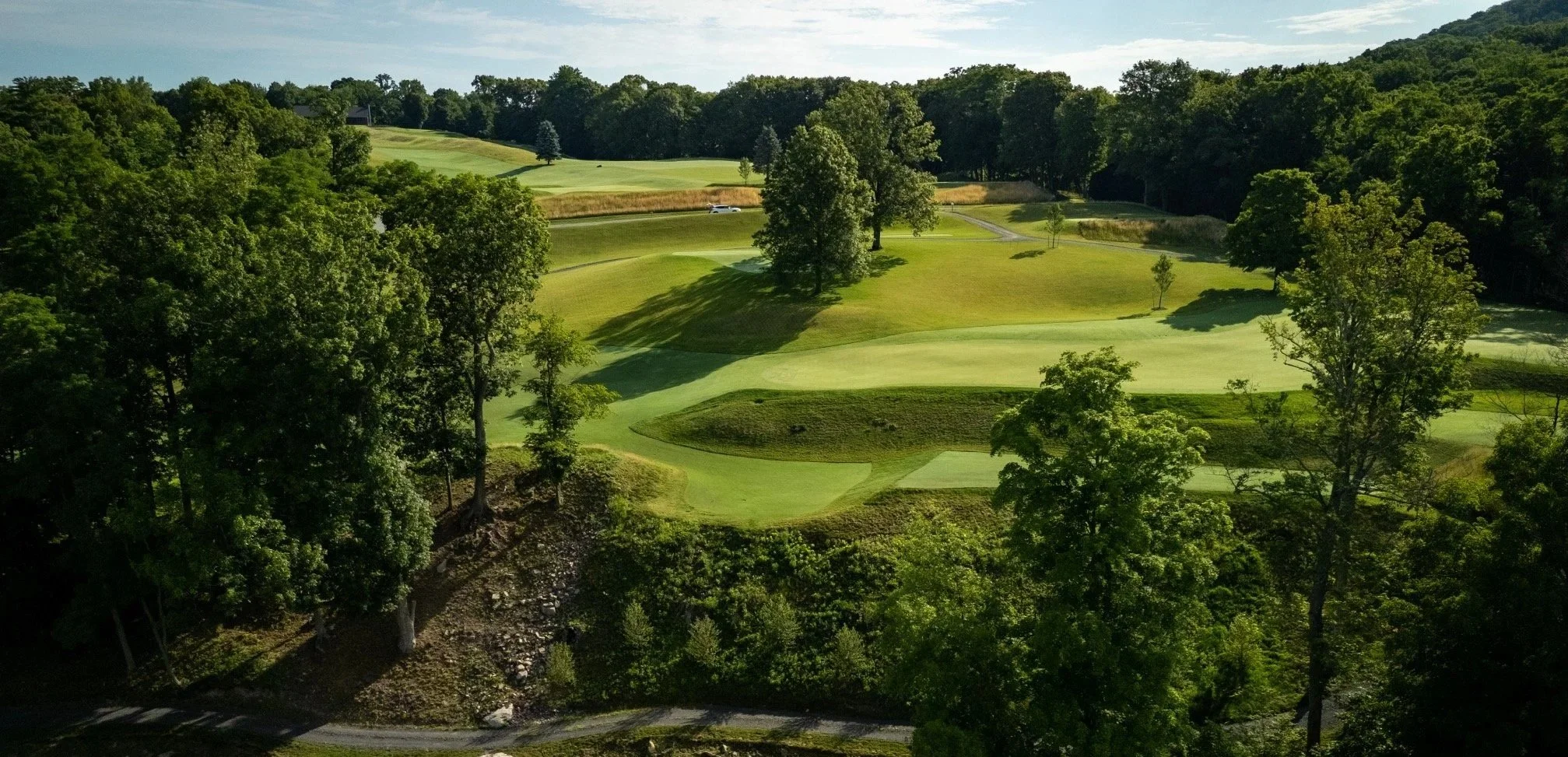
Storm King gave that interest a permanent piece of ground. Golf has been played on the property since 1894. More recently, architect Chris Gray worked on its reconstruction under an earlier owner. Gang took the project forward, adapting the existing design around flexibility and a wider range of players.
During the course’s 2025 development, five nine-hole routes and more than 30 teeing options were described. Shared greens allowed approaches from several directions. A player could experience the same land differently on another circuit. The acreage stayed compact while the choice of journeys expanded.
*Reported during the 2025 development phase. Routings continue to evolve.
The maintenance plan has its own product decisions. In a July 2025 essay, Gang described 18 robotic mowers working across the course, alongside electric equipment for the greens. GPS-guided spraying and drone work formed part of the operation. The machinery was chosen to fit the course’s needs, with quieter working methods among the intended benefits.
His three guiding principles are playability, maintainability and sustainability. Their order could occupy an agreeable clubhouse argument. A course needs to be enjoyable, but somebody must also keep the grass in condition and make sensible use of the property. Even an afternoon’s escape has operating requirements.
The next version is still being played
Flexibility brings complications. During an early public outing, players encountered waits where routes shared space and lengthy walks between some tees. Gang acknowledged the lessons and said changes had already been made. “It’s still a work in progress.” There is something reassuring about a builder who leaves that sentence available.
By September 2026, further changes were still being discussed, including additional tee work and a clubhouse in development. The course’s ambition also remained clear: become a home for adaptive golf, with programming that gives more people reasons and opportunities to play.
The connection to his software career is an interpretation, but a useful one. Both kinds of work ask a builder to consider what happens when people arrive with different expectations. The answer emerges in use, sometimes inconveniently. A route that looks elegant on a plan still has to accommodate the group coming the other way.
Gang has worked on ways to find a person online, publish a story and spend a day on a course. At Storm King, the questions have become pleasantly tangible. Where should we start? Who is joining us? How much time have we got? And, eventually, where is the ice cream?
Follow the next round
Explore Gang’s Brightspot biography, his LinkedIn profile and Storm King Golf Club.
Read his essay Why Storm King?, the 2022 leadership announcement and a closer look at the course’s routes.
Watch: DisrupTV conversation, 2021 Watch: Connectiv interview, 2016