Televisa had nine content management systems. Each brought maintenance and publishing overhead. The Mexican media company wanted its websites to look different. Running a separate publishing machine behind each one had become an expensive way to achieve that difference.
- Brightspot gives large content teams a shared place to create, approve and publish.
- Editors get publishing tools; developers can build their own front ends.
- The purchase includes an implementation decision, not just a software decision.
Brightspot’s case study describes what happened next. Televisa consolidated nine platforms into one and relaunched nine sites in five months. Eight used a headless architecture: the content lived in Brightspot, while developers controlled the presentation separately. The reported reduction in launch times was 50%. These are vendor-reported results, but they identify the company’s particular preoccupation: the work surrounding the words.
01 / The trouble was backstage
What had broken first at Televisa was coordination. Separate platforms created overhead and slowed publishing. Editors needed to work in Spanish and English. Developers wanted to spend time on the audience experience. Brightspot’s team worked alongside both groups, migrating content and establishing a first model with Las Estrellas before extending it across the other properties.

Televisa’s custom Style Selector supported 35 front-end styles through four fields. Standardizing the backstage operation did not require identical scenery. That distinction helps explain why enterprises buy a content platform rather than simply commissioning another website.
02 / A platform meets a designer
The company began in March 2008 as Perfect Sense, founded by David Gang and Lisa Beaudoin. Their starting ambitions were different. Gang wanted a publishing platform. Beaudoin wanted an agency focused on design and content. She had worked on authoring tools at WebMD, led creative teams at AOL and helped bring The Wall Street Journal onto the web.
That background matters. Publishing software is experienced through countless small decisions: finding a photograph, checking a preview, requesting approval, reusing a paragraph. Brightspot developed around the people making those decisions. Longtime employee Kate Condon later described the move from product strategy into launching the company’s own CMS as a defining transition.
“Every day, we wake up and try to delight editors”
Lisa Beaudoin, co-founder, 2020
In 2020, Perfect Sense adopted its product’s name. Beaudoin’s explanation was refreshingly practical: one name would end the recurring explanation of how Perfect Sense and Brightspot related. The company’s identity had caught up with the thing customers bought.
03 / Freedom, with a working publishing desk
Today’s Brightspot offers hybrid and headless foundations. Hybrid combines editorial tools, a Design System and prebuilt content types with delivery across channels. Headless gives developers API access, including GraphQL, so they can choose how and where content appears. Both approaches depend on structured content: information organized into reusable types and fields.
The surrounding tools handle digital assets, localization, permissions, approvals and collaboration. A marketing team can assemble pages; a newsroom can manage articles; a corporate communications team can coordinate material across brands. Brightspot says it serves hundreds of customers. Published examples include AP, NPR, NBC Sports, Whole Foods and Sotheby’s.
Its market position sits between enterprise experience platforms such as Adobe Experience Manager and API-oriented systems such as Contentful. Brightspot’s pitch combines delivery flexibility with a ready editorial environment and implementation help. For a buyer, the useful comparison is how much publishing capability arrives ready to use and how much the organization must build and maintain.
04 / The bill includes the changeover
Brightspot sells enterprise software, modular additions and services. Its pricing depends on project scope, customization, integrations and delivery support. Migration, creative work and managed operations belong in the buying conversation. The relevant cost is the running system plus the effort of getting the organization onto it.
The financing history reflects that longer relationship. Carrick Capital Partners invested $22 million in 2017. In 2021, Tailwind Capital acquired a majority stake, backing initiatives including product development and deeper market penetration. The company pairs software with people who help customers make it work.
Its community work is similarly concrete. Brightspot reported that 72% of employees participated in volunteering in 2024. Its Special Olympics relationship includes digital work as well as volunteering: the company’s 2025 review describes results-platform updates and a bilingual website for the Santiago 2027 Games.
05 / Give the robot a rulebook
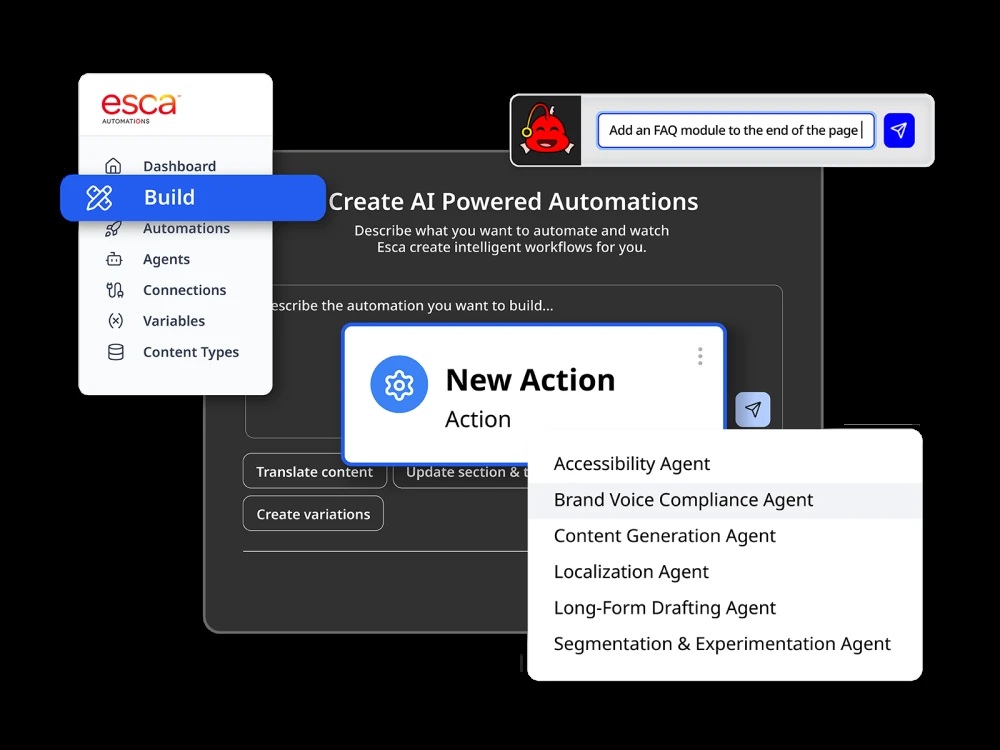
In May 2026, Brightspot introduced an MCP server, letting compatible AI agents interact with content through scoped permissions. In August came Esca Automations, a visual workflow engine for jobs such as translation, metadata generation, brand checks and routing work through connected systems. Its mascot is an anglerfish. Apparently, searching a vast content library called for something comfortable in the depths.
The practical lesson is to map the handoffs before buying more output. Define the content model, assign review ownership and prove one workflow before multiplying it. That is an inference from these examples, rather than a guaranteed recipe. A team with one simple site and little repeated work may gain less from this enterprise machinery. Without clear permissions or accountable reviewers, automation can move confusion faster.
Brightspot’s October advice on editorial workflows puts a sharper point on the problem: review needs a named owner. Bulk actions need approval gates. An audit trail needs to show who approved a change, and an agent needs the permissions of the person behind it. Those requirements give a prospective buyer something useful to test in a demonstration. Ask a vendor to show an ordinary draft crossing departments, being rejected, revised and approved. Watch the handoffs, especially the awkward ones.
Brightspot’s wager is that publishing improves when the surrounding work becomes manageable. Televisa needed fewer disconnected systems. The AI customer needs repeatable tasks under control. The technology changes; someone still has to decide how the story gets out.