At Lionsgate, the word “final” had become a logistical problem. Marketing files were scattered across servers, cloud shares, Box, and legacy platforms. A trailer could exist in several places. Finding a file did not settle whether anybody should use it. The storage worked. The agreement about what the storage meant had come apart.
That is the sort of mess Orange Logic sells software to untangle. The company makes digital asset management, or DAM, software: a place where photographs, videos, artwork, and documents travel with searchable descriptions, permissions, and approval histories. Its most interesting proposition concerns what the next person needs to know.
- The job: connect content to its rights, approvals, and destination.
- The buyers: enterprises with complicated media libraries and many teams.
- The catch: configuration, integration, and governance take real work.
The trouble with final
Lionsgate’s turning point was a renewal. With its old DAM contract coming around, the studio reconsidered the whole arrangement. It chose Orange Logic from an initial field of ten to twelve vendors, favoring its cloud strategy, APIs, and title-based metadata model.
The resulting system brought final marketing assets from seven legacy storage locations into one destination and gave more than 800 global partners secure self-service access. Working files could remain in familiar tools. The approved destination acquired a clear meaning.
“Everyone knows, if it is in Orange Logic, it is ready to use.”
Jacob Robinson · Lionsgate
There is a management lesson tucked inside that sentence. A content system becomes useful when people share a definition of what belongs there. Otherwise, a bigger library simply creates more places to be uncertain.
A library that remembers
Orange Logic traces its beginnings to founder Karl Facredyn solving a photo agency’s archive problem. Founded in 1998, the company still works on the same underlying difficulty: preserving enough information around a file to make it useful later. The archive now has deadlines, departments, outside partners, and AI agents attached.
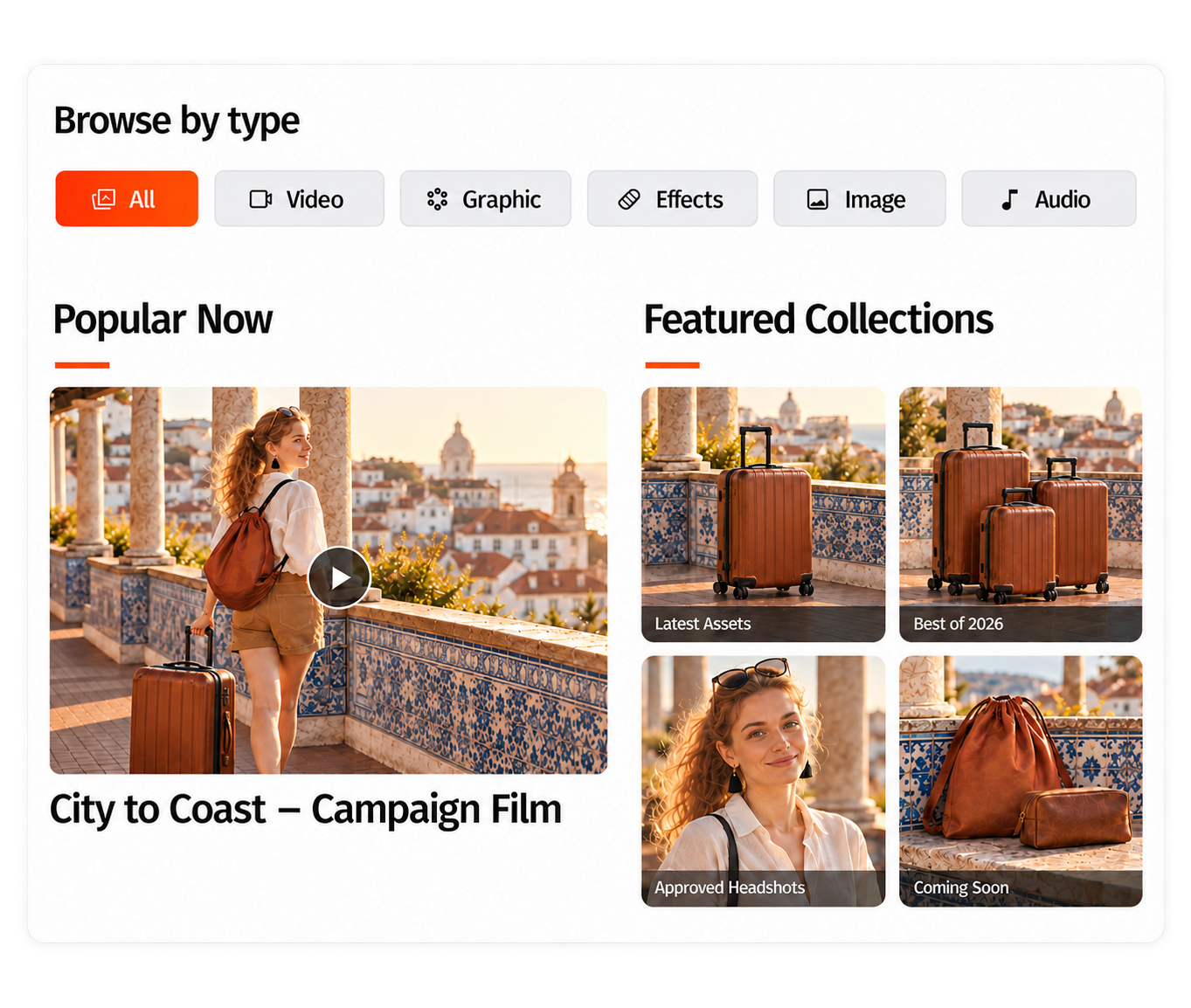
Its core DAM handles organization, search, versioning, and access. Media asset management adds production tools for video and audio. Rights management connects restrictions to assets. Creative collaboration brings reviews and annotations into the workflow; brand experiences present approved material through portals and sites.
Instacart offers a useful everyday example. Its Creative Studio was repeatedly asked to locate content for other departments. Orange Logic supplied self-service access and a branded portal displaying current material. Adobe integrations let creatives retrieve assets within their working tools. Fewer transfers meant fewer opportunities to lose track of a version.
What the invoice is paying for
These are enterprise purchases. Orange Logic’s AWS Marketplace listing shows one configuration priced at $600,000 for 36 months. Private offers are available; usage and infrastructure can add charges. Treat that figure as a specific public listing, rather than a universal quote.
The commercial argument depends on what disappears from the customer’s existing operation. Headspace had content spread across Box, Dropbox, Google Drive, local drives, and other systems. Its published customer story reports a roughly 60% reduction in third-party storage spending after consolidation. That measures one expense category, rather than the complete cost of running the DAM.
Indexed to 100 before consolidation. Customer-reported third-party storage spending; not total DAM cost.
Bregal Sagemount invested in Orange Logic in May 2023, following what the investor described as self-funded growth. The platform was then called Cortex. The deal supported further product development and market expansion, an indication of the business behind the library: recurring software contracts built around persistent organizational complexity.
The cloud can wait
One revealing product choice is Media Bridge. High-resolution production files can stay on local storage while proxies and metadata connect to Orange Logic in the cloud. People can search and preview footage without relocating every original. An editor’s need for fast local access and a marketer’s need to discover footage can coexist.
That flexibility helps explain Orange Logic’s market position. Alternatives include Adobe Experience Manager Assets, Aprimo, Bynder, and OpenText. Orange Logic emphasizes departmental configuration, connected workflows, and a shared platform for assets and their context. Buyers still need to compare actual integrations, storage arrangements, and rights requirements against their own work.

For a buyer, the comparison becomes more revealing with an awkward request. Ask each vendor to show the same film in two departments, with different permissions, an expiring license, and a partner who needs a different format. Then change the approval. Watch what happens downstream. That exercise tests the relationship between features that look perfectly respectable in separate demo screens. It also gives legal, production, and marketing a common example to argue over before their requirements become a signed contract and an implementation schedule.
AI joins the approval queue
Agent Studio extends that proposition into automation. Teams can use ready-made agents or configure their own, connect supported models and tools, and trigger work from content events. Human review remains available for approvals and exceptions. The attraction is less typing between systems; the prerequisite is knowing what an agent may touch.
September 2026 brought NVIDIA Nemotron models into Agent Studio. A separate Lionsgate announcement connected Comcast Technology Solutions’ video analysis with studio-specific title, character, and talent information across more than 2,000 hours of footage. Orange Builder, announced that month, added AI-assisted creation of brand sites and portals.
Copy the handoffs, then the software
The useful experiment is small: follow one asset from upload to publication. Record who describes it, who approves it, which rights expire, and where the approved version goes. Test those handoffs with the people doing them.
SAS’s case study supplies a reality check on timing. Its modernization initiative began in 2023, soft-launched in autumn 2024, and went fully live in April 2025. Eight legacy systems became one DAM connected to 13 platforms. Integration and ownership were part of the project.
The distinction is useful even for companies that never buy Orange Logic. An approval should have an owner and a visible result. A rights restriction should survive a download request. A portal should offer current material without requiring a designer to answer the same question all afternoon. Those are reasonable acceptance tests to bring to a demo, along with a few awkward files from your own archive.
A small team sharing a modest library may struggle to justify this machinery. A larger team without metadata owners or administrator training can struggle too; customer reviews on AWS describe the learning curve. Orange Logic’s own careers material stresses ownership and candid collaboration. Its customers need those habits as well. The practical test is whether the next person can use the file without starting another conversation.
Open the library
Explore Orange Logic, its blog, company news, and the customer stories from Lionsgate, Instacart, Headspace, and SAS.