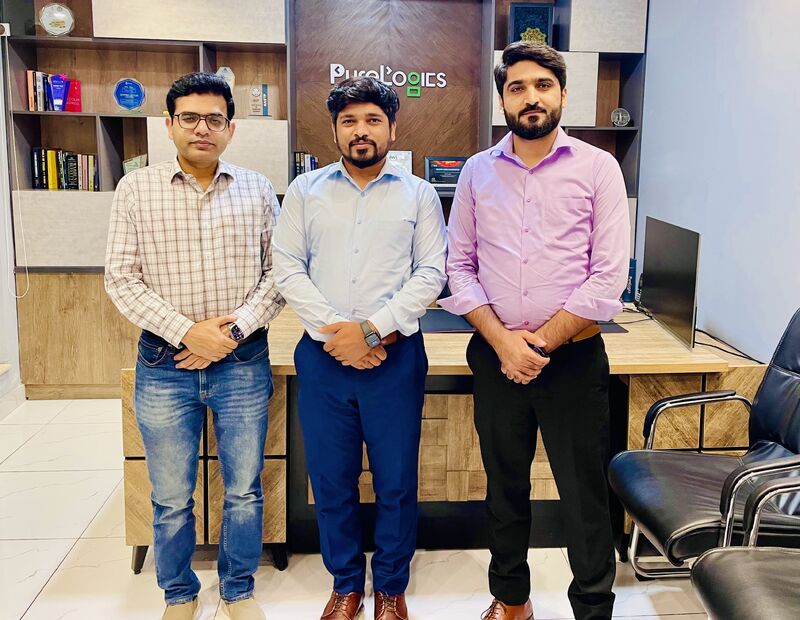
Three hours is a generous amount of time to spend discussing organizational design. Add hiring, marketing, automation and culture, and most people would begin examining the nearest exit. Nasir Ali Joiya stayed for dinner and coffee. He had gone to see Usman Akbar, co-founder and CEO of PureLogics, and came away enthusing about the conversation as much as the company.
The July 2025 visit offers an appealing introduction to ZAPTA’s co-founder and CEO. Here was a founder with a business of his own, making time to learn how another founder ran his. He admired Akbar’s generosity and values, alongside his experience. The questions concerned the machinery of a company: how its people work, how it hires, how it grows without losing the qualities that made it worth joining.
Joiya works from Lahore, in a professional world that includes software development, product design and conversations with founders abroad. His interests repeatedly return to things that can be examined rather than merely announced. A working prototype. An understandable screen. A team prepared for the tools it is expected to use. Ambition is present; it tends to arrive carrying a list of practical questions.
Three friends, then a company
ZAPTA was founded in 2020. Ateeq Asif, its co-founder and chief operating officer, describes the beginning as three college friends building a software business. The scale of the undertaking has changed since then, but the early picture is useful: people who knew one another trying to turn technical work into an organization.
At the end of 2021, Joiya was already taking stock. He reported more than 156 completed projects and clients in more than 20 countries. He also described dedicated departments and new opportunities for employees. These were the concerns of a business acquiring an internal structure while selling work across borders.
The thank-you list mattered to him. Khalil Ahmad, Ateeq and Abdul Rehman appeared among the people he acknowledged, along with others who had encouraged or helped the venture. His account of the first year made room for colleagues as well as results. A company anniversary can become a long speech by the person holding the microphone. Joiya used some of his time to name the people beside him.
Joiya’s reported milestones at the close of 2021. A snapshot of that year, with room to grow.
The designer’s suspicion of decoration
Design is a substantial part of his working life. ZeeFrames, another organization he has helped build, focuses on user experience and digital product design. Its vocabulary includes research, wireframes, prototypes and testing: the work surrounding a screen before somebody gets to admire it.
At ZeeFrames, the process includes mapping user flows and task flows before moving through wireframes, mockups and prototypes to usability testing. The distinctions are useful. A flow asks how someone moves through a product. A wireframe gives that movement a rough arrangement. A prototype lets the arrangement become an experience someone can try. Each stage makes a different question visible, giving the team a chance to revise an idea before it hardens into a development requirement.
In 2024, ZAPTA’s design department marked more than 1,650 UI/UX projects over four years, covering work from landing pages to complex dashboards. Joiya responded by thanking the team and naming former designers, too. It was a considerate accounting of accumulated work. Yesterday’s employee could still belong in today’s acknowledgment.
His design advice has a similarly practical character. He wants visitors to understand what a business offers, why it matters and what happens next. He favors early testing with representative users and treats feedback as something to interpret alongside business needs and technical constraints. A striking interface can attract a glance; somebody still has to use it.
“Function should always come before decoration.”
Nasir Ali Joiya
That preference gives his product thinking a certain restraint. There is room for creativity, provided it helps the person at the screen. The animation must eventually yield to the task. Even a very handsome button ought to know where it is taking you.
Let the prototype take the argument
For Joiya, a prototype provides a way to explore an idea before asking engineers to make the larger commitment. Teams and clients can inspect flows, try an interaction and give feedback while changes remain relatively inexpensive. His preferred sequence puts the prototype ahead of the minimum viable product, or MVP.
The attraction is more substantial than a tidy process diagram. Different people can use the same word and imagine quite different products. A clickable version gives the discussion an object. Someone can point to the troublesome step. Someone else can discover that a supposedly obvious instruction requires a small lecture.
- 01PrototypeMake the idea tangible.
- 02Test & alignExamine flows and assumptions.
- 03Build the MVPPut a focused product before users.
A conceptual sequence of his product advice, rather than a measured project schedule.
In February 2026, he returned to the question of getting a first product into the market. He singled out weak planning, uncertain scope and slow decisions as recurring problems. His prescription emphasized an aligned team, disciplined scope and feedback from actual users. Speed mattered because a product needs the chance to learn from its reception.
“Delay kills momentum. Learning saves products,” he wrote. It is an economical statement for a profession capable of holding a meeting about the next meeting. The practical challenge is deciding which uncertainty a team should resolve before building, and which it can only resolve by letting people try the result.
A shorter road from classroom to company
His interest in preparation extends beyond product teams. In August 2022, he shared ZAPTA’s agreement with the University of Management and Technology. The proposed collaboration covered training, internships, jobs, research and student development. It addressed a familiar transition: studying a subject and becoming useful in the work that follows.
A March 2023 agreement with GIFT University in Gujranwala made the exchange more concrete. ZAPTA would provide training and work opportunities while supporting research and development. The university would contribute academic resources and research expertise. Both sides had something the other could use.
Joiya described a mismatch between what students learn and what employers need. These agreements offered a route to practical experience before graduates were expected to arrive fully prepared. For a company, the relationship also creates a way to encounter potential colleagues earlier and understand the education they bring with them.
It is an extension of the prototype argument into professional development: exposure makes a conversation more useful. A student who has encountered a real project can ask different questions of a course. An employer who has worked with students can see the distance between a job description and an opportunity to learn.
Lahore, with room at the table
The PureLogics visit belongs to a broader pattern of professional exchange. Joiya is among the founders of Pakistan Tech Alliance, which brings together people from startups, established technology businesses and the wider industry. In September 2025, he promoted its Lahore meetup as a place for dialogue and collaboration.
The alliance’s 2026 Grand Iftar brought another gathering of founders and industry figures. Joiya appeared alongside speakers including Umer Ghumman, Usman Akbar, Furqan Aziz and Muhammad Fahad Tanveer. Discussions and questions shared the evening with a meal. Software is built on computers; people still find reasons to sit together.
His description of Eid at ZAPTA placed similar weight on time spent as a team. Gifts were part of the occasion, alongside appreciation, shared blessings and gathering for Iftar. The details give a more human scale to the language of company culture. There is a difference between putting togetherness in a presentation and arranging an occasion when colleagues can experience it.
Faith is also part of the language in which he describes his journey. In discussing his television appearance about entrepreneurship, he stressed consistency, focus and trust in Allah. The emphasis gives personal context to the professional story: achievement sits beside gratitude, and direction is something to keep seeking.
AI has to do a day’s work
New technology has supplied Joiya with another set of practical questions. In May 2026, he described trying paid AI tools that proved disappointing in use. His tests were ordinary business tests: whether a tool solved a meaningful problem, saved time, fitted a workflow and remained dependable. A fashionable label could not do that work on its own.
His company operates in AI and custom software development, so this interest is close to the work. In his account, the usefulness of a tool has to survive everyday demands. A demonstration ends; a team has to come back the following morning and accomplish something with the product.
Umer Ghumman later brought Joiya’s experience into a Seattle talk about Pakistan and AI. He recounted the student freelancing beginnings and described ZAPTA retraining and moving people toward emerging technical capabilities as design work changed. The account puts learning back at the center of the company’s response.
Joiya’s professional horizon also reaches Saudi Arabia. He has discussed work with founders there across financial technology, education and enterprise platforms, and invited conversations about product strategy and digital adoption. His questions travel comfortably: what needs to work, who will use it, and how a team should prepare.
His December 2025 plans included Riyadh, Jeddah and Makkah. The topics he wanted to discuss included improving user experience, strengthening digital platforms and building products able to grow. They were recognizably the concerns of his Lahore work, carried into conversations in another market.
Back at the PureLogics visit, his stated ambition was to build a company people could feel proud to belong to. That is a demanding aspiration because the people involved get to judge it every working day. It also explains why three hours of questions might seem a sensible investment. Dinner and coffee were a pleasant addition.