Andriy Sambir’s first office was a library in a student dormitory. The business had clients, programmers, and a director of about twenty. It also needed permission for team members who lived elsewhere to enter the building. For a technology company, access control began rather close to home.
That was Lviv in 2013. Sambir had more freelance work than he could comfortably handle alongside university. He recruited from programming classes he had organized for fellow students. His future wife, Nataliya, attended the first class and became a co-founder. Before software, he had wanted to be a rock musician. He decided he programmed better than he played guitar. The band’s loss became the clients’ opportunity.
Today, as co-founder and CEO of Linkup ST, formerly Linkup Studio, he is reconsidering what those clients should buy. A business that began by making software is trying to become better at deciding which software is worth making. It is a subtle change with an awkward implication: sometimes a capable development team should recommend doing less.
The spreadsheet years
There is an administrative middle age that arrives surprisingly early in a young company. Work keeps coming, people keep doing it, and the founder discovers that knowing what happened yesterday has become a substantial job of its own.
Sambir described that problem when discussing Linkup’s use of Hubstaff. He was piecing together project reports by hand from spreadsheets and documents. At the end of the day, people had to reconstruct which projects they had worked on. After switching between tasks, memory proved a rather casual accountant.
The company adopted time tracking and reporting tools to make the work more visible to the team and its clients. The episode has the advantage of being unglamorous. Before a founder can advise anyone else about business automation, there is something instructive about spending too long assembling his own reports.
It also gives a practical meaning to transparency. A client should be able to understand where the effort went. A team should be able to explain it without making the explanation another project. A growing company needs ways to preserve that understanding when the founder can no longer remember every conversation.
A startup has no spare afternoon
The work with Wisio offers another view of Sambir’s education as an operator. Wisio connected social-media creators with followers seeking paid advice and feedback through video. Linkup handled architecture, scaling, and development across the system, then continued supporting the product.
For a startup, a change in personnel can interrupt far more than a timetable. Knowledge can disappear with the person who has it. Sambir’s account of the work emphasized the arrangements that make a handover possible: readable code, accompanying documentation, and a period when departing and incoming colleagues work together.
These details rarely get their photograph taken. They matter when a new developer has to understand a difficult decision without its author sitting nearby. The next person needs more than a login and a cheerful welcome.
Working with a startup also required an appetite for quick responses. A useful feature could lose its relevance while a team was still debating how to deliver it. Sambir spoke about the attraction of working on new ideas, but the operating lesson was concrete. Enthusiasm needs a system that lets the work continue.
The user gets a vote
By January 2024, Sambir was putting his thinking about teams into an essay on the product mindset. He associated its adoption at his company with growth and improved client retention and satisfaction. His advice concentrated on what colleagues understood about the people using their work.
He recommended assigning work with individual strengths in mind, encouraging learning, and bringing user stories into the development process. He also argued for feedback across project boundaries. Someone outside the immediate team might notice an assumption that everyone inside it had stopped seeing.
There is a particular kind of inconvenience in that suggestion. The colleague who asks a basic question can interrupt an efficient meeting. The question may also reveal that the meeting has been efficiently avoiding something essential.
Sambir’s proposed checks included clear measures of progress and a mixture of numerical results and human feedback. The implication is demanding for a founder: the company’s internal account of a successful delivery has to survive contact with the user’s experience. Finishing the work is one event. Discovering whether it helped is another.
“My credo is to do as good as I can and trust in the results.”
Andriy Sambir
His public teaching returns to the business around the product. In February 2023, he joined Business of Apps for a discussion about monetizing free applications. The episode considered business models, differences between mobile platforms, and the choices facing games and other apps.
A free download is a wonderfully clear proposition for the person downloading. For the person paying to build the application, it opens a series of questions. The audience, the way people use the product, and the method of earning revenue have to fit together. A working application cannot settle those questions by merely working.
That is why the subject belongs in a profile of a software executive. Sambir spends part of his time explaining decisions that sit outside the code. The business model enters the room before the development team can declare its task complete.
His SaaS teaching follows a similar route. An August 2024 episode moves from explaining software delivered online to subscriptions, recurring revenue, and the steps involved in launching a product. He takes in minimum viable products and marketing along the way. The useful unit of discussion becomes the product’s life in a market.
The sequence is revealing. He puts research into the market, clients, and competitors before assembling the development team and choosing the technology. The minimum viable product then has a job: testing the concept. Later come choices about deployment and the work of reaching an audience through content, trials, referrals, or other channels. Even in a short explanation, the programmer has to share the stage with the customer and the marketer. There is a business to establish around the application, and the development plan has to leave room for it.
More tools, harder questions
Sambir has also taken on the job of explaining AI. In a June 2024 Building Digital Products episode, he walked through machine learning, neural networks, deep learning, and natural language processing. The format was brief, about nine minutes, with an audience that might be curious about the technology or considering a business application.
That explanatory role is part of a longer teaching habit. Sambir taught technical students at Lviv Polytechnic and describes his podcast as a place to discuss things he and his guests would have liked to hear at the beginning of their careers. The experienced founder is still addressing the beginner in the room.
His writing about AI has included the practical limits of implementation: oversight, privacy, and the need to consider a company’s situation. Those concerns give the technical explanations some ballast. A demonstration of what a tool can produce leaves the business with decisions about where to use it and who should check the result.
These questions help explain Sambir’s consulting ambition. More technical options create more decisions for a customer. Someone still has to connect a possibility to a problem worth solving. The ability to build provides part of the answer; judgment about the brief supplies another.
Someone to argue with
The relationship with investor Vitalii Gorovyi brought another kind of scrutiny. InSoft.Partners entered the business in 2022. Sambir has described how a partner’s experience helped examine the finances and confront late payments from long-standing clients.
Friendship could make those conversations awkward. A partner could help insist on the terms. The familiar good-cop, bad-cop arrangement had found a respectable office job.
More consequentially, Sambir described a practice of taking opposing positions on a new idea before bringing it to the team. The point was to test the thought while it was still changeable. For a founder accustomed to being responsible for the answer, choosing someone who can question it is a meaningful decision.
Gorovyi’s stake was reported to have reached 45% in 2025, with Sambir retaining 55%. Their public partnership plans extend beyond the existing company. They have invited people with specific expertise and their own ideas to discuss building service businesses together.

The next brief
By January 2026, Sambir was describing the destination as a “Digital McKinsey.” He wanted consulting that could diagnose a business problem and carry out the response. His example was a customer-management system: choose an existing platform and customize the part that needs it, rather than automatically commission a new system.
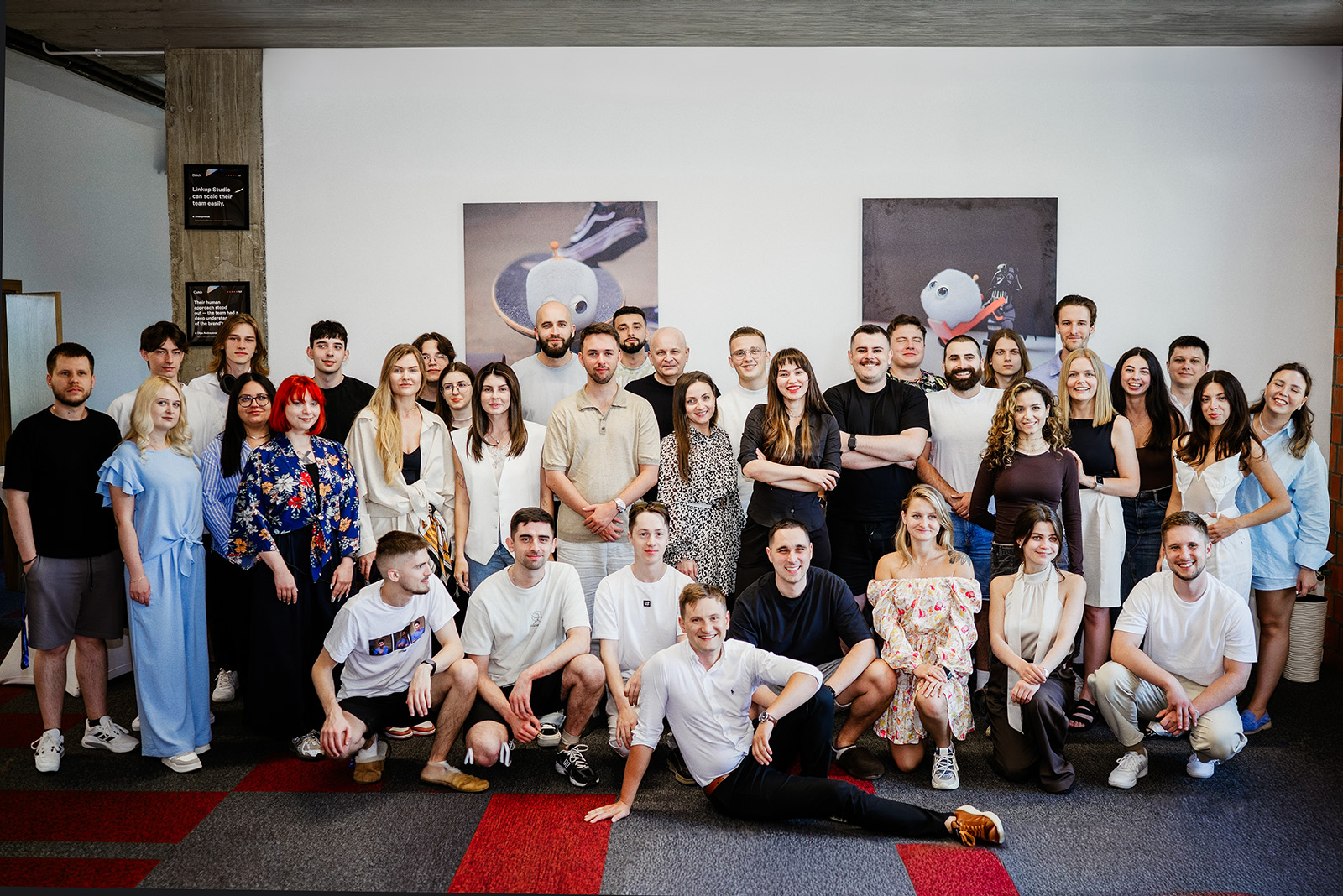
“I want to solve real problems,” he said. He also reported that Linkup had 73 people, compared with 110 a few years earlier, while revenue had increased. He was making a case for judging growth by more than the size of the team photograph.
- A few years earlier
- 110
- January 2026
- 73
Team members, in Sambir’s January 2026 comparison. He said revenue had grown over the same period.
The next partners, in his telling, should bring depth in a niche, a view of what to build, flexibility, and integrity. The arrangement asks them to work alongside the business. An idea gets access to experience and infrastructure; the people behind it accept the responsibility of operating it.
Outside work, Sambir describes himself as a husband, father, and Lego lover. It is a pleasing hobby for someone whose working life now involves deciding how much to construct. The pieces are available. The harder part is choosing what deserves to stand.