Before Rodion Yeroshek had a computer, he made one from a cardboard box. He drew a keyboard, cut out a mouse and prepared pictures he could swap into the screen. The machine had an ingenious display system and rather limited processing power. It did, however, make his wishes clear. His parents bought him a real computer in the fifth grade.
His parents were trained architects. When construction work was scarce in the 1990s, they made ceramics at home and sold the pieces to shops around the country. He watched things being made and watched those things become a living. His father taught him English; his grandfather taught him chess. A household workshop was an early introduction to the relationship between an idea and somebody willing to pay for it.
Today Yeroshek is the co-founder and CEO of Poster, the restaurant software company that began in Dnipro. His route there runs through graphic design, a student project, a city guide and a plastic discount card. Read backward, the sequence looks orderly. Lived forward, it involved discovering that the next useful thing was considerably larger than expected.
The computer came in a cardboard box
Once the real machine arrived, he explored design software, including 3ds Max. Making animated characters appealed to him: build a model, give it a skeleton, make it move. He began entering freelance competitions. Clients repeatedly picked somebody else.
Then he loosened up. For a business called Soft Café, he submitted a strange hedgehog illustration involving a bloody sickle. It failed as a logo. The client nevertheless bought it for $50 to hang in the office. His first sale was a consolation prize with unusually good wall space.
Design led to web development. At architecture school he found collaborators, including Alexander Ryzhkov, and helped build the studio called November. The name belonged to a service business: websites, applications, design, whatever the team could make for a client. Coffee Life, a local café chain, became an important customer.
There is a practical advantage to this beginning. Working for a café puts a designer within asking distance of people who run one. The counter stops being scenery. It becomes a place where software has to survive a working day.
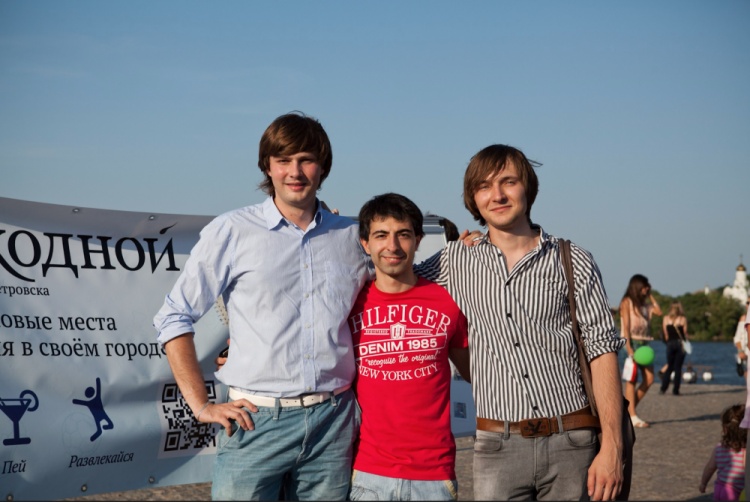
A guide, a card, an awkward question
The studio also tried making its own products. A student social network took so long to prepare that an existing network’s group feature overtook the idea. For the next project, the team moved faster. The Weekend began as a guide to things to do in Dnipro and grew into a business with contacts among restaurants and cafés.
A loyalty card followed. Customers could buy one card and use it for offers at different participating venues. Roughly 15,000 were sold. It was a tidy answer to the untidy collection of separate cards people carried around.
But the cards opened another question: how should the scheme connect with each venue’s accounting software? The founders went looking at the systems their partners used. Integration was difficult. Here was a business opportunity lodged inside a problem with another business.
- 01Design workMeet café operators
- 02A city guideBuild venue relationships
- 03Loyalty cardsEncounter integration trouble
- 04PosterBuild the system itself
At first, Yeroshek and his partners imagined their own restaurant system might complement the loyalty product. On December 1, 2013, they launched Poster’s first version. Within a year or two, the earlier project had been closed and their attention had moved to the new one.
The supposed supporting act had taken the booking. What makes the sequence interesting is how much it depended on proximity: each piece of work brought the team close enough to notice the next difficulty.
Tea for forty-five thousand
Early Poster was rudimentary. It could process a sale, print a receipt and provide basic analytics. Yeroshek later recalled a bug that added 45,000 of a venue’s most expensive teas instead of one. The software had found a way to make an ordinary drink order financially adventurous.
Restaurant operations were unfamiliar territory. The team learned by spending time in customers’ venues, where owners and managers explained recipes, deliveries, stocktaking and write-offs. Inventory became a substantial addition. Understanding how a meal affects the stockroom demanded more than arranging a pleasant screen.
That education also shaped the product’s audience. Small operators needed something they could understand without first becoming accounting specialists. Yeroshek’s own lack of restaurant experience gave him a reason to ask elementary questions. For an interface designer, the questions that sound embarrassingly simple can be the ones worth keeping.
Success supplied a different sort of clutter. Customer wishes accumulated on a Trello board until opening it made his laptop’s fan complain. He once spent six hours reading through the requests. Listening was becoming a problem of organization as well as attention.
He also described development as a mixture of new features and less visible work: refactoring, fixing bugs and handling load. A customer sees the button that appeared this morning. Keeping yesterday’s buttons dependable takes its own share of the day.
The company grew; the maker stayed
Yeroshek’s advice to other service businesses included trying products of their own, launching quickly and being prepared to close an idea that failed to work. He had examples for each instruction. November supplied client work; the early social project supplied a warning about delay; Poster supplied a reason to concentrate.
There was ambition behind the practical decisions. In 2021 he said he wanted to build a large global company, while also making more room for art and creative work. He described progress through repeated routines: work with the team, look at the metrics, keep learning. The cardboard computer had acquired a rather more demanding operating schedule.
Company-reported figures on Poster’s public About page, checked October 2026.
Forbes Ukraine included him in its inaugural 30 Under 30 list in 2020. Asked later about colleagues, he emphasized honest communication, taking responsibility and sharing credit for the team’s successes. He wanted people who treated other people as people, rather than as a resource.
The current company is larger than the early café experiments. Poster reports 27,000 active venues across 110 countries. Its leadership page still presents Yeroshek as someone who makes product features and credits him with Postie, the AI assistant launched in 2025. The executive role has continued alongside the work of building.
That combination gives his story a useful tension. Running a company requires other people to make decisions. Making software rewards a close interest in exactly how a particular thing works. He has kept a public connection to both.
A bookshelf with a smiling frog
His personal website provides a welcome change of scale. He introduces himself as a Ukrainian technology entrepreneur, says he has been programming for about twenty years, mentions learning to drive faster on a circuit and notes daily walks with his dog, Twixie. The list fits comfortably beside poems.
He also keeps a reading list. A book needs at least seven out of ten by his own reckoning to make it onto the page. Favorites receive a smiling frog. Literary judgment could use more frogs; they are less cumbersome than a panel discussion.
The selection wanders well beyond business. Somerset Maugham and Stefan Zweig appear in the 2026 entries. Earlier years include Oscar Wilde, Kurt Vonnegut, history and product books. The shelf accommodates fiction alongside customer research, without asking either to justify its effect on quarterly revenue.
His art page describes a weekend hobby of searching Artsy for paintings and sculptures he likes. His Dnipro guide is equally particular: Georgian and Uzbek food, an Irish pub, breakfast places and a venue in Shevchenko Park with a view. Opinions do some of the navigating.
There is a pleasing continuity here. Before the point-of-sale business, he helped people decide where to go. The personal guide preserves that pleasure in recommending a place. A city can be a market, a working environment and somewhere you have a strong opinion about lunch.
Fast tools, slower judgment
In August 2026, Yeroshek published an essay about using AI to develop products. It began with an old wish: computers that could talk. He remembered a simple terminal chat program, an early attempt to make the machine answer back.
“Do not delegate thinking to AI.”Rodion Yeroshek · translated from Ukrainian
His excitement about the new tools sits beside specific demands. Read the code they produce. Keep responsibility for the decisions. Test ideas with people. He sometimes asks an AI system to question him, finding value in having to formulate his own answers.
Cheap prototypes have also changed his attachment to code. He can build something, inspect how it feels and discard it if the idea creates more trouble than value. His argument favors the experiment while leaving room for refusal. Making a feature possible does not settle whether customers should receive it.
It is an apt place to find him after the long route from the cardboard machine. Better tools have repeatedly expanded what he can make. The consequential decisions have concerned what to make next, whom to ask and when to let an earlier project go. Behind the discount card was a café counter. Behind the counter was another question.
Keep following the questions
Explore Yeroshek’s personal website, AI development essay, Dnipro guide and reading list.
Find him on LinkedIn, Instagram and Facebook. Visit Poster or read his 2024 restaurant-software interview.
Watch: how Poster was created IT RULIT · 2017 · Russian