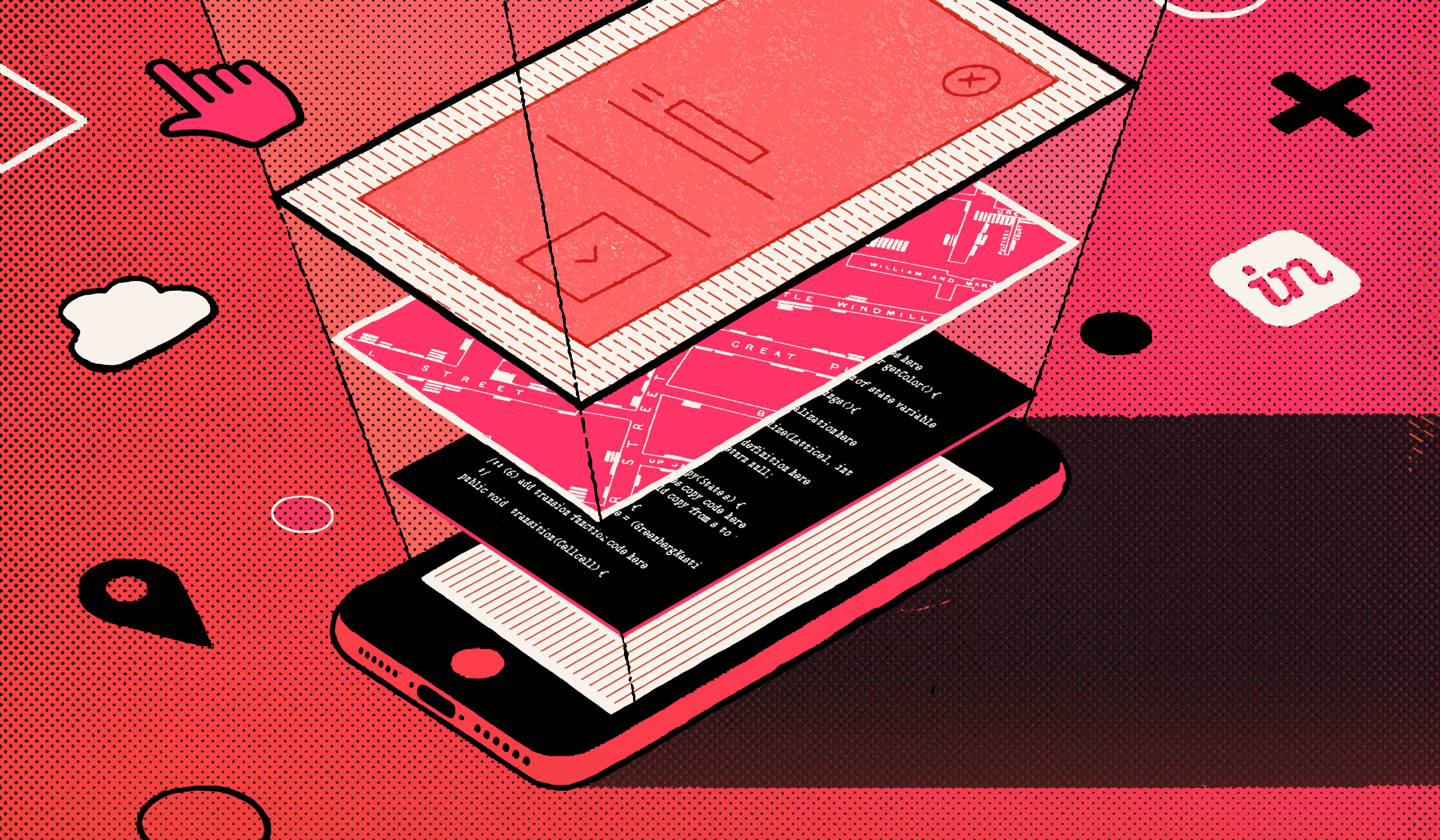
The interesting thing about an InVision prototype was that the button could work before the software did. A designer linked pictures of screens together. A client clicked. Suddenly, an argument about a document became a conversation about an experience. There was something to point at, something to misunderstand, and, crucially, something cheap enough to change.
The story in three clicks
- InVision made static designs clickable and feedback easier to collect.
- It expanded into design software, design systems and Freehand whiteboarding.
- Miro acquired Freehand in 2023; InVision’s design services ended in 2024.
That small intervention grew into a company with more than five million users by December 2018. Its financing announcement reported customers at 97 of the Fortune 100. Those numbers describe its reach at the time, rather than five million paying accounts. But they establish the puzzle: how does something so widely used lose its place?
A button before a business
Co-founders Clark Valberg and Ben Nadel came from agency work. The recurring difficulty was familiar to anyone who has commissioned software: explaining an idea does not guarantee that everyone pictures the same thing. InVision, founded in 2011, let teams turn images into a simulation and invite others to react before an expensive build.
Valberg recalled that the agency had been making coded prototypes when a colleague proposed connecting designs exported from Photoshop. The experiment promised much of the communication value with less work. At first, he resisted selling the resulting tool. It was the agency’s advantage. Colleagues persuaded him that other agencies could use it too.
“I wanted to be on the same side of the table.”
Clark Valberg · Distributed, 2019
The appeal extended beyond designers. Product managers needed agreement; engineers needed to understand intended behavior; clients needed a way to give useful feedback. Prototype supplied a shared object for that discussion. Later offerings addressed adjacent work: Inspect communicated specifications, while Design System Manager organized reusable design assets and documentation.
December 2018 announcement · historical figures
The office they could not hire for
InVision’s own organization supplied another experiment. Valberg described competing for New York recruits who were also talking to Google, Yahoo and Facebook. Two founders in a small rented office had limited attractions beside those employers. Hiring people elsewhere became a practical answer to a recruiting problem.
By a November 2019 interview, he described roughly 900 people working remotely. The arrangement required deliberate social contact. Valberg wanted much of the time spent together in person to build relationships. The reasoning was concrete: knowing a colleague as a person could make their messages easier to interpret later.

The step the market could skip
InVision also wanted more of the design process. In October 2017, it introduced Studio, combining screen design, animation and prototyping with its collaboration platform. The ambition made sense: fewer disconnected tools, fewer handoffs, more work happening within InVision’s products. It also meant competing with the software that created the original designs.
Meanwhile, Figma was changing the arrangement. It offered browser-based multiplayer editing in 2016 and added prototyping in 2017. Its argument was that colleagues could work around a shared design that stayed current. A separate upload-and-review stage had to justify its existence all over again.
Where the work happens
A conceptual workflow comparison, not a feature audit.
My reading is that InVision’s position became less secure before the shutdown became inevitable. Visor founder Michael Yaroshefsky, who had used InVision, offers another diagnosis: expansion distracted the company from its original collaboration job. That is an interpretation, rather than a complete accounting of the failure. Both explanations ask whether the next product strengthens the reason customers arrived.
The difference matters when choosing software. A specialist review tool can still earn its fee if it handles a difficult approval process or serves people who work across several creation tools. But a team already reviewing designs inside its editor has less reason to maintain another destination. That is a condition of the business, not proof that every standalone collaboration product must disappear.
The financial scale makes the question sharper. InVision raised $100 million in its 2017 Series E and another $115 million in December 2018. The latter round carried a reported $1.9 billion valuation. Investment bought room to develop a broader platform. It could not guarantee that teams would keep a separate place for it.
The whiteboard gets a second address
Freehand offered a broader invitation. People could sketch a flow, run a retrospective or arrange ideas together without being interface designers. Microsoft documented real-time drawing and image sharing inside Teams. Templates helped people start with a structure. The customer could now be an entire working group, rather than a design department gathering comments.
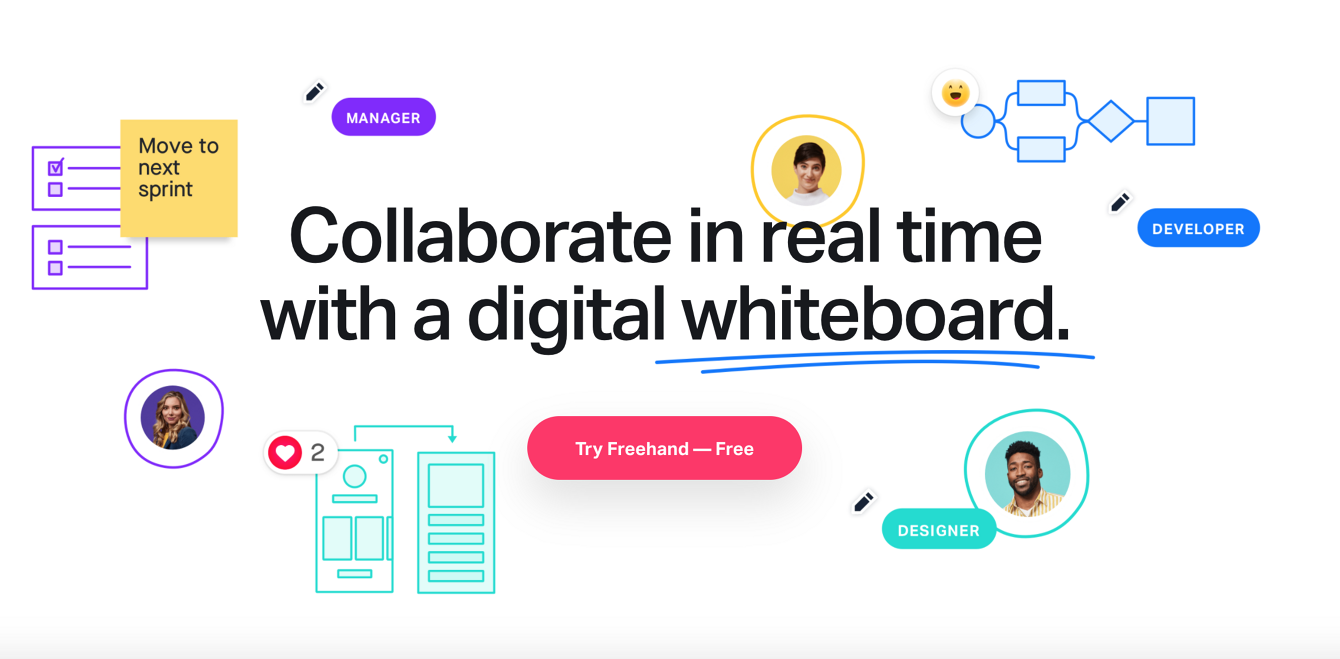
Freehand’s proposition also exposed a stubborn problem in team software: the people whose input matters may be the people least comfortable using the specialist tool. A loose sketch or a sticky note gives them a smaller first task. In practice, the method still needs someone to frame a question, invite contributions and decide what happens next. A canvas supplies room for discussion; a team has to supply the decision.
The business used free access, paid subscriptions and enterprise agreements. Archived pricing lists Freehand Pro at $4 per user per month; terms varied. In 2023, InVision emphasized organization-wide pricing and launched its Intelligent Canvas beta, including tasks and bidirectional Jira synchronization. It was trying to move a whiteboard’s output into everyday execution.
The company had already announced workforce cuts and simpler product lines in 2022, citing shifting market conditions. In November 2023, Miro acquired Freehand’s technology, brand assets, customers and associated talent. In January 2024, Miro confirmed that InVision’s design products and standalone Freehand would end on December 31. Miro offered migration services and subscription recognition for Freehand customers.
Freehand assets acquired by Miro
InVision design services discontinued
Keep the experiment. Check the dependency.
There is a useful method to copy here. Make a small model of the decision people keep misunderstanding. Put it in their hands early. Watch where expectations diverge. A prototype can expose that gap before it becomes production work. It cannot establish that the eventual software will be fast, accessible or reliable.
For a software business, the harder exercise is to repeat the test on itself. If the tool beside yours absorbs your useful step, what still brings people back? InVision helped teams ask better questions about products before building them. Its ending gives builders another question to keep asking after launch.
Follow the thread
Explore the company’s archive, the Freehand transition and the original product experience.