01 / THE OPERATOR
A company built on the least glamorous idea in software
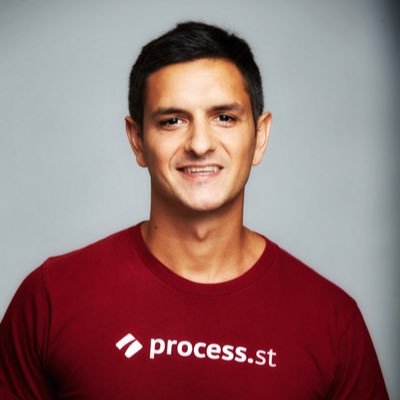
Vinay Patankar runs Process Street, which sells companies a way to write down exactly how they do things and then make sure those things keep getting done. Employee onboarding. Client setup. The general office inspection nobody remembers to run. It is checklists, escalated to a platform, escalated again to an AI-powered compliance operations tool. The pitch is not romantic. The pitch is that the most valuable knowledge in most companies lives in one person's head, and one person is a single point of failure.
This turns out to be a fundable idea. Process Street has raised roughly $15 million, and the names on the cap table are the ones founders want: Accel led the Series A, with Salesforce Ventures and Atlassian alongside. The company went through Y Combinator in the Winter 2015 batch. It serves thousands of customers, from small teams to enterprises, and it has been remote since the day it started, because Patankar had never run a company any other way.
The part where he never rents an office
Process Street was Patankar's third company, and by the time he started it he had already spent about a decade running businesses without a headquarters. When investors ask a founder how he will handle a distributed team, most founders talk about the tools they plan to adopt. Patankar had a ten-year track record. Being remote, he has said, let the company skip the overhead of office space and, more usefully, widen the talent pool - hiring the right skills quickly instead of the nearby ones.
The team spans multiple continents. When they closed the Series A around 2020, they were roughly 50 people scattered across the map, at a moment when the rest of the corporate world was frantically discovering video calls for the first time. Patankar had been doing the remote thing since before it had a name and a backlash.
02 / THE LONG TRIP
One year of travel that lasted ten
The origin is almost a cliche of a certain era, except that he actually did it. Patankar read Tim Ferriss's The 4-Hour Workweek, saved enough money to travel for a year, left Australia at 24, and launched his first company - an e-commerce store - from the road. The one-year plan did not survive contact with reality. He kept building, kept earning, and the trip stretched to roughly ten years of moving around the world while running businesses on a laptop.
Somewhere in there he built an affiliate marketing company with teams in the United States, the Philippines, and India that generated a million dollars in revenue in under three years. Later he ran an SEO and content marketing agency with a portfolio of websites. That agency is where Process Street was born - not as a grand vision, but as an annoyance. He kept writing the same instructions for the same repeatable tasks across all those sites, and he wanted a tool that would run the instructions instead of just storing them.
Before the road
Patankar did not come from nowhere. He grew up technical - the youngest Cisco-certified engineer in Australia at 16 - and stacked two bachelor's degrees before leaving: a Bachelor of Commerce in finance from the University of Sydney and a Bachelor of Business in marketing from the University of Technology Sydney. His early resume reads like someone sampling the whole stack of a business: server administration, junior accounting, technical recruiting for engineers and DevOps. Then in 2009 he founded Blue Glass Technology, in 2012 he co-founded a consumer mobile startup called Vitoto, and in 2015 he settled into the thing that stuck.
The through-line is not any single industry. It is a temperament. A person who is certified on networking hardware at 16, who reads one self-help book and reorganizes his entire life around it, and who builds a company whose product is literally "write down your process and follow it," is a person with a specific relationship to systems. Patankar's whole career is an argument that the way work gets done matters more than where it gets done.
What he is building toward
The current chapter is AI. In 2023 Process Street launched Process AI, a version of the platform wired into large language models, betting that the next phase of workflow software is not just documenting the steps but having a model help run them. It is a natural extension of the original insight. If the goal was always to get operational knowledge out of one person's head and into a system anyone can execute, then a model that can read, draft, and route that knowledge is the obvious next tool. Patankar has spent fifteen-plus years on the same problem from different angles. The tools change. The obsession does not.