In November 2025, Mukhtar Ahmad Baig went to an art college and found a way to talk about software. He was touring Lahore’s National College of Arts during its 150th-anniversary celebrations. In a concrete room in the Product Design Department stood a Ratcliff printing press from the 1930s. A young volunteer explained its history. Baig began thinking about engineers.
It is a pleasingly unfashionable object for a technology chief to notice. The press has neither a subscription plan nor an invitation to upgrade. Its interest, for Baig, lay in how separate parts made creative work repeatable. He connected its reusable type, stable structures and production routines to the tools a software team needs. A machine mattered because of what people could do with it.
That visit offers a useful entrance to Baig’s working life. The co-founder and CEO of CodeNinja keeps returning to a problem that is partly technical and partly human: who gets to act? The developer waiting for permission, the founder handling every small task and the enterprise dependent on a vendor all occupy different versions of the same uncomfortable chair.
A founder writes his own exit instructions
CodeNinja began in 2014 as a bootstrapped engineering firm. Its work has since expanded across software development, enterprise systems and AI. The geography widened too, with operations in Lahore, Riyadh, Dallas and Santiago. Under the changing descriptions of the business sits a practical occupation: helping organizations make technology function inside the complicated lives they already lead.
Baig’s public career record includes an earlier digital marketing role at NETSOL Technologies. That background adds a useful dimension to the picture of an engineering-company founder. The job requires explaining value as well as producing it. A working application and a persuasive account of why someone needs it are separate achievements. A company needs both.
In February 2023, Baig published an essay with an unusually self-effacing instruction for entrepreneurs: work toward replacing yourself. His reasoning was practical. Delegate repeatable tasks, automate where possible and build processes that continue as the business grows. That creates room for expansion and more demanding responsibilities. The founder remains busy, presumably, but fewer people need to queue outside his calendar.
There is a difference between endorsing delegation and arranging a business around it. Baig’s later writing becomes interesting precisely where it describes that difference. The recommendation starts as personal time management. Eventually it becomes a question about the design of the whole company.
The friendship behind the founding titles
Founding teams look tidy when reduced to names and job titles. CodeNinja’s own story has a more human seam. Muhammad Umar Bilal, its co-founder and COO, has described joining his friend Mukhtar after another venture, Klipda, had closed. He called himself a “retrospective co-founder.” The phrase leaves room for a company’s relationships to develop after its beginning.
Bilal’s account describes an early ambition to reach global customers with demanding problems, while smaller assignments kept the company operating. His explanation of selling centered on creating value for the customer and receiving a portion of that value as revenue. It is a sober account of commercial learning, with little room for the idea that technical competence automatically produces a business.
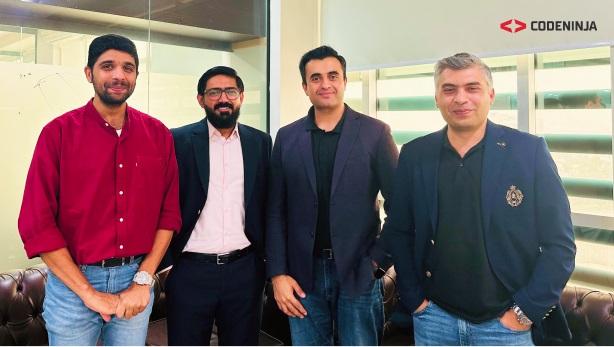
Alongside Baig and Bilal, CodeNinja identifies Adil Khalil as its CTO and co-founder. The division of responsibilities gives the story more texture than a solitary-founder legend. Strategy, operations and engineering all need someone’s attention. A business built around shared authority begins with the rather ordinary recognition that one person cannot supply every kind of judgment.
What $1.6 million was meant to buy
In December 2023, CodeNinja announced $1.6 million in investment from sAi Venture Capital, with participation from strategic partners Plutus21 Capital and affiliates. The announcement also said sAi managing partner Ahsan Jamil would join the board. By then, reporting on the business described more than 100 clients worldwide.
Baig tied the funding to expansion into new markets and further work in enterprise cloud, data and AI. His stated aim was to put computing and intelligence into clients’ everyday operations. That is a more demanding destination than a demonstration. The technology has to survive contact with existing work, existing rules and people who have other things to do.
Capital gave the next stage a date and a number. It also brought another person into the company’s governance. For a founder who had already written about making himself less central to routine work, the episode marks a useful transition: the growing enterprise would depend on systems, colleagues and partners as well as his own effort.
The year the company grew more moving parts
Looking back on 2024, Baig emphasized international expansion, supported by sAi Ventures, and the development of Global Capability Centers. These centers put dedicated technical capability around an enterprise’s work. His interest in them was connected to a larger aspiration: giving Pakistan a stronger place in global technology development.
He also highlighted the launches of LENS and HYPER, and the formation of the Quantum AI Alliance. The accumulation of names could easily overwhelm the story. The connection between them is more useful: CodeNinja was trying to turn its engineering experience into repeatable capabilities and products, while working with partners beyond its own organization.
His reflection ended with the people doing the work. That emphasis is common in a CEO’s annual message, but it also fits a persistent concern in his writing. Opportunity requires somewhere to practice, tools to use and responsibility for an outcome. For an engineer, being included in the photograph is pleasant. Being trusted with a consequential decision is more substantial.
Four to six people, and fewer permission slips
By December 2025, Baig was describing a problem inside CodeNinja itself. As the company grew, it had added project managers, architects and layers of authority. Decisions traveled upward, losing useful context along the way. The arrangements intended to organize work were making learning harder.
His response was a smaller, cross-functional unit he called a diamond team: four to six people assembled around a particular problem, with authority distributed according to expertise. An internal product provided an early test. In his telling, the team could act without repeatedly waiting for approval. The model subsequently moved into client work.
The appeal is understandable. An organization can buy capable people and still arrange their days so that very little capability escapes. A meeting to approve a meeting has excellent attendance and poor output. Baig’s proposed remedy puts the person who understands a problem closer to the decision about it.
This remains his account of the change and its advantages. What makes it revealing as a portrait is the admission underneath: CodeNinja had participated in the very management habits he now criticized. His argument about autonomy came with an account of having helped build the obstruction.
“It’s to create rooms that think on their own.”Mukhtar Ahmad Baig, on the CEO’s job, December 2025
Hyper begins with a problem at home
Baig’s August 2025 explanation of Hyper described an internal development accelerator that became an enterprise platform. CodeNinja’s teams first used it to improve delivery, reuse engineering patterns and reduce repeated work. That origin matters. The product’s initial audience included people who could object to it from the next desk.
As Hyper developed, he connected it to a broader ambition: enabling enterprise teams to build and own their software. His account of version 0.6 emphasized turning requirements into code, documentation and deployable foundations. He also advocated reversible decisions: test an idea, assess it and discard it when it fails to earn a future.
There is an economical human argument within that technical description. An idea becomes less precious when trying it costs less. People can argue over an actual result rather than defend their preferred forecast indefinitely. The same founder who wanted entrepreneurs to delegate routine work was now promoting infrastructure that might let teams attempt more work themselves.
The logic also explains why ownership keeps appearing in Baig’s vocabulary. Speed alone leaves a second question unanswered: once something useful has been built, who can change it, understand it and continue using what was learned?
Who keeps the knowledge when the work ends?
In July 2026, Baig made that question the center of an essay about enterprise AI. He distinguished stored records from the context that helps an organization reason about them. An event can be logged without preserving why it happened, which exception applied or what resolved the problem.
His suggested questions for enterprise buyers were concrete: can they take trained models with them, expose operational context to systems they control and govern the infrastructure where that knowledge accumulates? These are Baig’s arguments about how organizations should buy and build AI. They also reveal where he wants CodeNinja’s work to go.
The company’s AWS Select Tier announcement in July 2026 placed client ownership inside its delivery proposition, including the transfer of fine-tuned model weights, training datasets and pipeline configurations. The business was giving an architectural form to a theme that had already appeared in Baig’s management advice.
His professional profile lists training in financial management, mergers and acquisitions, and private equity and venture capital. The subjects suit this stage of his career: technology decisions have organizational and commercial consequences. A useful tool needs a business that can maintain it, people who understand it and an arrangement that lets those people keep learning.
Back to the room with the printing press
Baig’s argument for Lahore is tied to this same question of participation. He has written about building research-oriented engineering teams with the processes and technical environments to turn knowledge into practical work. His ambition is for Pakistani talent to carry greater responsibility in global technology, supported by institutions capable of sustaining that responsibility.
The printing press makes a fitting object to return to. Baig noticed a system that allowed human judgment to travel further because essential work could be repeated reliably. His own company has moved from individual assignments toward teams, platforms and arrangements intended to preserve what people learn.
There are still customers to satisfy and software to ship. Yet the recurring test in his public thinking is simple enough to carry out of that art-college room: after the founder steps away, or the engagement finishes, what can the people left behind do for themselves? For Mukhtar Ahmad Baig, building the company increasingly means working on that answer.