The revealing detail in one Trellissoft customer story is the fax. A growing American coffee chain had hundreds of locations, hourly workers, timesheets, and invoices arriving in assorted formats. At the center sat an office doing the unglamorous work of entering the information. The business could open more stores. The paperwork had a harder time keeping up.
- Trellissoft combines software engineering with its own enterprise AI products.
- Its targets include call quality, document handling, billing, and disconnected data.
- The useful lesson: connect the whole workflow, including its human exceptions.
The fax is the clue
Trellissoft’s response was specific. Use AI and optical character recognition to read timesheets and invoices, then move the extracted data into Sage accounting through an extract, transform, and load process. Supervisors could review the resulting work instead of retyping it. The destination system mattered as much as the reading technology.
That is a useful introduction to this company. Enterprise AI can sound like a machine waiting for a sufficiently ambitious question. Here, the question was closer to: how does this invoice get into accounting without somebody keying it in again? Trellissoft’s opportunity lies in those ordinary, expensive handoffs.
A services company builds its own tools
Severo Dsouza founded Trellissoft in 2016. Its engineering roots remain visible in its offer to help startups and product businesses define requirements, build software, and modernize existing systems. Development centers in Bengaluru, Gandhinagar, and Goa support a business headquartered in San Jose. A Dubai office opened in 2023; a partnership with Doha-based Nine Star followed in 2024.
Today, the catalog puts names on recurring problems. PulseAI360 evaluates customer conversations. DocuVera360 handles enterprise information and workflows. RelyBill manages invoices, reminders, recurring billing, and payment acceptance for smaller businesses. Custom engineering and data services sit alongside those products. The company’s proposition combines a reusable tool with people who can connect it to the customer’s operation.
Its published client-logo roster includes VirtuOx, Crowdz, Empereon, and GetixHealth. Those names span different businesses; they should not be read as endorsements of every product. The practical buyer is often an operations, technology, or compliance leader whose teams already have software and still spend too much time moving information between it.
The less visible part of that offer is training. Trellissoft describes continuous learning, collaboration, and leadership development as priorities for its staff. For a services business spanning several technical domains, keeping engineers current is part of the delivery problem. The culture it describes is organized around that need.
The calls outside the sample
Consider another company-published case: a healthcare revenue-cycle services operator whose manual auditors reviewed only 3-5% of calls. The first limitation was coverage. A recorded conversation could contain an important mistake and never reach a reviewer.
Trellissoft says it deployed PulseAI360 on an on-premises NVIDIA H100 cluster, keeping patient data under the operator’s control. It reports more than 12,000 call evaluations daily. The rollout began with selected business units and high-risk queues. Calls rejected by the AI went to supervisors for review. That last detail deserves attention: exceptions had somewhere to go.
The lesson extends beyond contact centers. Automating review changes the supervisor’s job. Someone still needs to examine the difficult cases, challenge a score, and decide what the team should do differently. A larger stream of evaluations becomes useful when the organization has a way to act on it.
An answer while the customer waits
Post-call evaluation addresses yesterday’s conversation. Live AI Agent Assist, announced in January 2026 within the PulseAI360 ecosystem, moves into the conversation itself. It transcribes speech, retrieves knowledge, suggests responses, and guides agents through call flows. Trellissoft advertises a free Windows download; its October 22 announcement says the platform supports 11 languages.
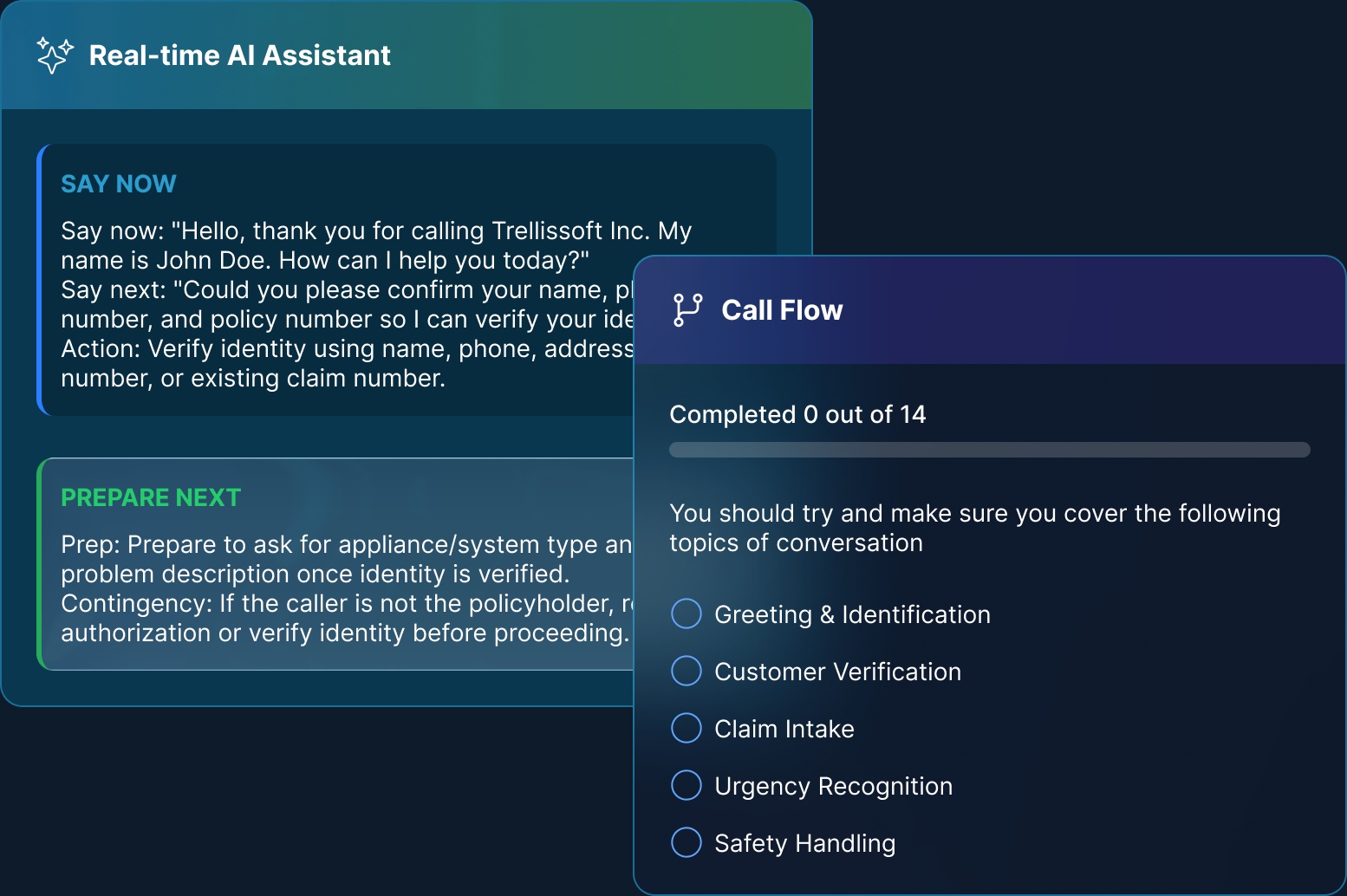
The attraction is easy to understand. An agent looking through several knowledge bases while a customer waits has two jobs competing for attention. Putting an approved answer beside the conversation could reduce that conflict. The quality of the answer still depends on the material being retrieved. A quick response built on an outdated policy remains an outdated response.
The document gets a bigger job
DocuVera360’s recent history shows the company widening its ambition. The February 2026 launch focused on intelligent document processing. By September, Trellissoft was describing an enterprise intelligence platform connecting structured systems such as ERP and CRM with emails, contracts, and reports. The intended output includes searchable knowledge, analytics, and workflows that cross departmental boundaries.
“Enterprises are adopting AI faster than they can unify the data behind it.”
Severo Dsouza · CEO · September 2026
That diagnosis also explains the DataReady program. Its sequence runs from assessment to pipelines and shared metrics, then to AI activation. Trellissoft describes each stage as fixed-price, with defined outputs and documentation for handoff. Against a platform the customer must configure, it sells implementation. Against open-ended consulting, it promises a bounded job. Those are commercial distinctions buyers can examine in a proposal.
RelyBill applies a more familiar version of the same idea to getting paid. Its advertised tools include scheduled invoices, automatic reminders, payment links, and card or bank-transfer acceptance. The workflow stretches beyond creating a document: the invoice has to reach a customer, prompt a response, and produce a payment.
Buy the handoff, measure the result
There are several ways to buy this kind of work: a specialist call-analytics product, a document-processing platform, a consultancy, or an internal engineering project. Trellissoft occupies the space where software and implementation meet. Its readiness assessment offers a two-to-four-week route to a scorecard, pilot plan, business case, and longer roadmap.
A buyer can borrow the method before signing anything. Pick one handoff. Record its delay, labor, and error rate. Give a pilot a destination system and an exception owner. Then measure the whole job, including review and corrections. Count infrastructure, integration, and upkeep in the budget alongside software access.
That test becomes less persuasive when the underlying records are unreliable, the team cannot agree on the right answer, or nobody owns the exceptions. The coffee-chain example offers the clearest standard: an invoice starts on paper and reaches accounting. Follow that journey. It tells you more than the word “intelligent” ever will.