The sun was doing its job. The computer was having trouble keeping up. In Caresoft’s account of its work at ACCIONA’s Nevada Solar One plant, the field controller crashed in cold weather. Aging Windows 95 machines and poorly documented code complicated the repair. Caresoft upgraded hardware, rewrote controller software and introduced its FlexKonnect system. It reports that recovery fell from more than fifteen minutes to less than one.
- Caresoft builds, connects and supports enterprise software, with particular depth in Oracle EPM and Microsoft AI.
- Its work spans finance departments, technology businesses and technical staffing.
- The useful lesson: follow one real workflow before buying another tool.
Consider what makes that assignment interesting. A solar plant has an obvious purpose. Its software has a less obvious obligation: keep many physical components working together, including during recovery from a fault. The glamorous asset depends on an unglamorous chain of instructions. Break the chain and the business feels it.
That is a useful way into Caresoft. Enterprise technology is full of these chains. They connect a ledger to a forecast, a customer’s question to an internal document, a new application to an older database. The work can look miscellaneous from outside. From inside a company, it can be the difference between owning software and being able to use it.
The ledger has to get there first
Take a finance team preparing its next forecast. Before anyone can debate assumptions, the actual numbers must arrive in a usable form. Caresoft’s DataKonnector targets this specific handoff: moving general-ledger data from ERP systems into Oracle Enterprise Performance Management, or EPM. Its listed features include configurable account mapping, scheduled synchronization and an audit trail.
The mapping deserves attention. Moving a number is straightforward; preserving what it means is the assignment. Different accounting structures can turn a tidy transfer into a reporting problem. An automated connection is useful when it respects those structures and leaves a record that someone can inspect. Speed alone is a rather poor accountant.
Illustration of the product’s stated role, not a measured customer result.
That connector sits within a broader Oracle practice. Caresoft offers implementation, cloud migration, budgeting, forecasting, consolidation and reporting work. Its support menu includes month-end tasks, data loads, changes to organizational structures and management of Oracle releases. These are recurring obligations. A finance system has to survive the next close, not simply the presentation announcing its arrival.
The company also describes reusable code, templates and a deployment toolbox. Those assets give its specialist positioning a practical shape: experience from one assignment can inform the next, while the client’s accounting and operating details still require attention. Buyers should judge that promise by the proposed team and the actual scope, rather than by the size of the toolbox.
A business with two kinds of delivery
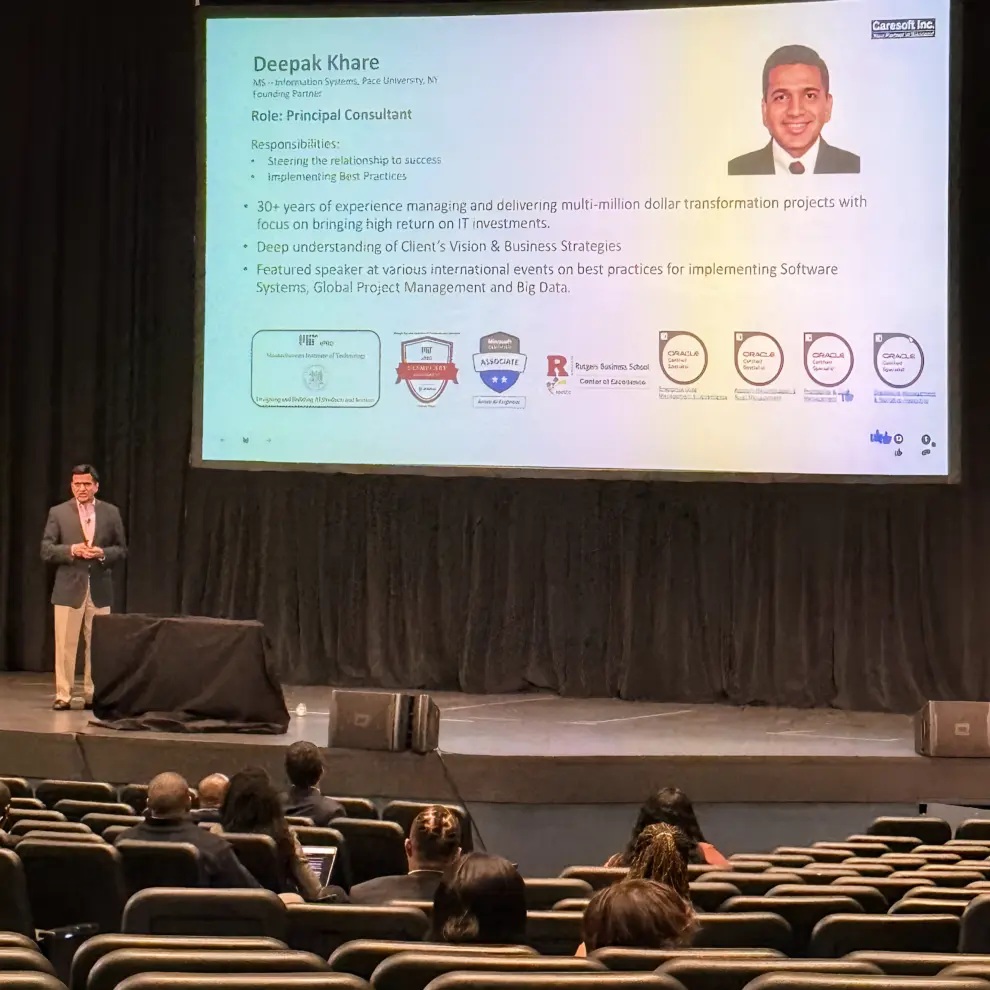
Caresoft was founded in 1994 and operates from the United States and India. It presents itself as a boutique provider, serving organizations from emerging technology companies to large enterprises. Deepak Khare, its founding partner and President, remains the public face of the business. This is a services company with proprietary products alongside it.

One customer example makes that distinction clear. Caresoft’s Birdzi case study describes an exclusive development relationship covering customer intelligence, engagement and personalized wellness platforms for grocery retail. It says the work included development, implementation and maintenance. Here, the deliverable was part of another company’s business, rather than a packaged tool carrying Caresoft’s name.
Custom development is offered on time-and-materials and fixed-cost terms. Those choices distribute uncertainty differently. A fixed scope gives a buyer a defined commercial boundary; evolving requirements need a way to be priced and approved. An hourly engagement can accommodate discovery, but the client still needs a clear definition of progress. Neither arrangement excuses a vague brief.
The product portfolio reveals a similarly practical appetite. Columbus is aimed at importers, wholesalers and distributors. I-Commercer is positioned as a brand-management and business-intelligence tool for consumer-goods owners. FlexKonnect handles monitoring and control in thermal solar plants. These offerings address different users, but each begins with an operating task.
The most revealing question is what the software has to do on an ordinary Tuesday.
In the market, Caresoft sits among specialist implementation firms, custom developers and technical staffing providers. A large systems integrator offers a different kind of procurement proposition; an internal team offers another. Caresoft’s stated pitch emphasizes direct attention, technical depth and flexible delivery. The sensible comparison is the team assigned to your problem, its relevant experience and its responsibility after launch.
AI meets the application boundary
Caresoft’s Microsoft AI practice covers custom copilots, retrieval augmented generation, document intelligence, Power BI, data engineering and integrations with existing systems. It also offers readiness assessments, workshops and assistance with governance. That combination matters because an AI interface can be deceptively simple. The information it retrieves, the permissions it observes and the workflow it enters are often much less so.
CompaChat applies the communication idea to internal documents, procedures and customer questions. For a buyer, the appeal is easy to understand: an answer is more convenient than a hunt through folders. The evaluation should be equally concrete. Choose representative questions, check the answers against the underlying material and see how the system handles ambiguity. A fluent answer still owes you an explanation.
“Can you show this working with our data, our permissions and our exception cases?”
An editorial checklist, not a customer testimonial.The newer Diligeo offering sharpens Caresoft’s finance focus. Its published approach distinguishes capabilities inside Oracle applications from work across bank portals, other ERP systems and on-premises software. Caresoft positions its own platform for that latter territory. It describes deployment in a client’s Azure environment, recorded evidence and human control over payments and journal postings.
The commercial logic is telling: begin with capabilities the customer already owns, then commission additional engineering where the work requires it. That gives buyers a useful question to copy: which part of this proposal improves something we already have, and which part adds something we need? Software procurement becomes more intelligible when those answers are separate.
The people are part of the system
Caresoft’s strategic sourcing practice adds another dimension. The company argues that its experience building technology helps it understand a hiring requirement within the project that produced it. Its staffing offer includes recruiting strategy, technical screening, candidate relationships and workforce support. The connection is plausible: knowing why a system needs a specialist can improve the search for that specialist.
Its culture materials emphasize sponsored training and certifications. Employee spotlights describe long careers and internal progression. These are company-published accounts, but they identify what the organization wants to reward: accumulated knowledge, learning and continuity. In a business selling expertise, those habits belong close to the product.
Continuity also requires ordinary administrative discipline. In a 2025 BBB complaint response, Caresoft acknowledged that candidate communication could have been better. It described controls against duplicate outreach, recruiter training and improved CRM tracking. The candidate accepted the response while remaining critical of the experience. That exchange supplies a useful corrective to any polished account of staffing: follow-up is part of service quality.
Start with one inconvenient workflow
For a potential client, the most useful starting point is narrow. Pick a process with a visible owner and a recurring problem: a financial-data transfer, a document search, a reporting task or a difficult technical vacancy. Describe the current route, including the manual steps. Then decide what evidence would show that the new arrangement works.
This approach depends on access to reliable data, people who understand the process and someone prepared to maintain it. An integration cannot rescue an undefined policy. A model cannot settle every disputed accounting judgment. A staffing partner cannot infer priorities that the hiring team has never agreed upon. Those are conditions to establish before commissioning the work.
Caresoft is interesting because its portfolio makes the connective work visible. The controller, the ledger and the portal each bring their own inconveniences. The reader does not need to copy the company’s entire service catalogue. Copy the habit of looking closely at the handoff. That is where a surprisingly expensive amount of work can hide.