An analyst may plan the work. A developer may build it. A reviewer may inspect the result. At Info Origin, these job descriptions apply to AI agents, and the restrictions are rather revealing: the analyst does not implement code, the developer does not validate its own work, and the reviewer does not modify production code. The company has taken a familiar office arrangement and made it part of a software system.
- Info Origin combines enterprise AI engineering with products for contracts, documents, testing and analytics.
- IO-AgentFarm gives specialised agents separate responsibilities, permissions and persistent records.
- Its IIT Delhi collaborations connect the business to generative AI research and healthcare engagement.
- A local talent strategy runs through its Indian office network and graduate recruitment.
The arrangement offers a good place to begin understanding this company. AI demonstrations often invite us to admire what a model can produce. Info Origin’s more interesting proposition concerns what happens around that output: who requested it, who checked it, which tools were used, and how the work survives an interrupted session. A business buying automation is buying a relationship between those steps. Eloquence alone has a surprisingly small role in the job description.
A consulting firm acquires an organisation chart for AI
Info Origin’s public history reaches back to 2011. Its founder and president is Ashishkumar Chauhan; Preeti Chauhan is identified as CEO in its July 2026 healthcare collaboration announcement. The business has roots in technology consulting, application development and software engineering. Its present identity is explicitly AI-first, with a portfolio that stretches from business applications to the infrastructure needed to run them.
The older consulting proposition still helps explain the newer one. Public company descriptions emphasise involving the customer’s team in the solution, through collaboration and mentoring. That places knowledge transfer inside the engagement. A client might outsource an entire assignment, but the stated philosophy also makes room for a client that wants to become more capable while the work is being done.
Today the emphasis is on production systems: multi-agent workflows, analytics, governance and integration. Commercially, this places Info Origin between a software vendor and an engineering partner. A buyer can approach it with a particular business application or with the larger problem of building an AI platform. Custom development, implementation and operational support belong to that services proposition; IT recruitment and staffing remain part of its wider public footprint.
The reviewer cannot mark its own homework
IO-AgentFarm is the clearest expression of the current strategy. A conversational interface called Jarvis mediates between a user and a team of specialised agents. An orchestrator delegates the work. Analysts investigate and plan, developers implement, and reviewers validate. The platform describes workflows defined in YAML, a readable configuration format, together with persistent conversation history, artifacts and run status.
Orchestrator delegates • Permissions bound each role • State and artifacts persist
The less theatrical features matter just as much. The product describes retry tracking, crash recovery, stale-run detection and artifact synchronisation between computing instances. Permissions are limited by role, credentials are isolated, and decisions and outputs are recorded. These are design features described by the company, rather than a promise that an agent will always make a correct decision.
The distinction is practical. Consider a software task that produces a plausible change and then loses its session before review. A useful system must know which step finished, retain the artifact and resume at a sensible point. The buyer’s question becomes whether the workflow can be inspected and recovered. Info Origin is making those questions part of the product pitch.
The everyday work hiding inside the AI pitch
Its application portfolio deals with recognisable office frustrations. Contract Insights offers clause extraction, contract comparison, natural-language search and obligation tracking. CDMS addresses document editing, collaboration and compliance. Info QA provides codeless test automation; current application materials also describe AI-generated test suites and validation. Analytics applications cover dashboards, natural-language data queries and scenario modelling.
Each starts with a fairly ordinary bottleneck. A contract is stored but difficult to interrogate. A document circulates through review. A release waits for testing. A manager has a question but needs someone else to write the query. The value lies in shortening those journeys while preserving the checks that make an answer usable. A generated answer still needs a definition, a context and an accountable owner.
The intended buyers are business and technology teams with enterprise constraints. Info Origin markets sector-specific work in finance, healthcare, insurance, manufacturing and energy. Some customers may need an application; others need help connecting data, tools, permissions and monitoring. An in-house engineering team, a systems integrator or a specialist software package is an alternative, depending on how much of that surrounding work the buyer already has.
When a contract needs to keep a secret
A research project in Info Origin’s portfolio supplies a more concrete technical wrinkle. CON-QA, submitted to arXiv in September 2025, explores question answering over contracts while protecting sensitive information. Its authors include Anurag Tripathi and Sudhir Bisane, alongside research collaborators. The problem is easy to appreciate: a contract may contain the answer you want and several details you would prefer to keep local.
The proposed framework divides the process. A local model analyses the question and retrieves relevant document sections. Sensitive entities are anonymised before a cloud model generates a response. The answer is then reconstructed locally. The authors introduce an evaluation corpus of roughly 85,000 question-answer pairs across 510 contract documents. Those are research dataset figures, rather than a customer or sales count.
“This showcase gives industry a direct line to emerging technologies at IIT Delhi enabling us to spot innovation, form partnerships and accelerate commercialization.”Dr Anurag Tripathi, quoted by IIT Delhi at its Open House
The research connection has an institutional history. A November 2024 announcement described an agreement with FITT, IIT Delhi’s industry interface, covering generative AI research, engineer upskilling and prospective joint intellectual property. In July 2026, a further company announcement described an IIT Delhi healthcare initiative focused on engagement with healthcare providers. Its stated aim is to analyse engagement patterns and improve strategies across channels. That is a research agenda, with outcomes still to be demonstrated.
A global business with local desks
There is another organisation chart to consider: the human one. Info Origin’s current website lists US offices in Durham and Topeka and Indian locations in Gondia, Noida, Pune and Dehradun. The Indian network includes places outside the usual shorthand for technology employment. Its recruiting slogan, “Stay Local. Be Global.”, is unusually economical. It explains the intended relationship between where people live and the markets their work serves.
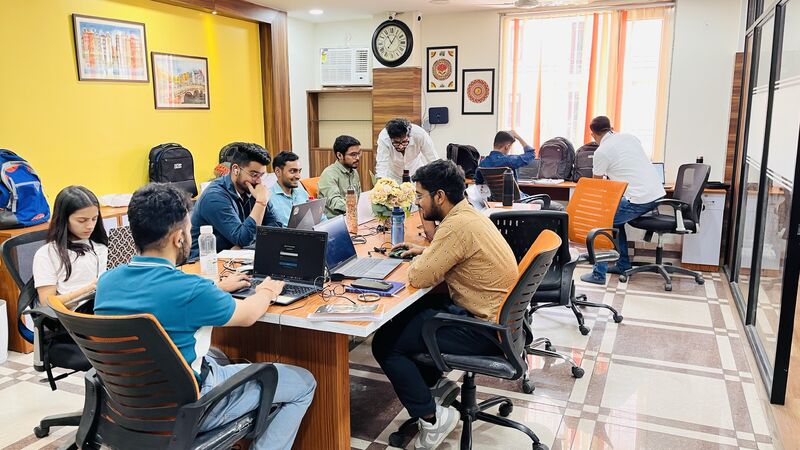
Company posts document a Dehradun office opening, campus outreach and graduate hiring focused on AI engineering and Python skills. Such posts are an employer’s account of its culture, but the pattern is visible: recruit, teach and connect people to work through local offices. A services business needs a dependable supply of expertise. The training effort and the delivery effort therefore sit close together.
Buy the workflow, then measure the work
For a prospective customer, the useful lesson is to begin with a bounded process. Map its inputs, decisions, permissions and handoffs. Decide who reviews the result. Then establish a baseline: time spent, error rate, reporting delay or operational cost. That is an editorial reading of Info Origin’s architecture-led approach, and a practice another team can copy without buying anything.
The company’s published bank case study follows this logic. It describes a classifier, regulatory-document retrieval and audit-log generation integrated into an existing JIRA exception workflow. Info Origin reports a 68% reduction in manual review hours and a 14-week payback period. These are company-reported results for an unnamed client, so they are best treated as a prompt for a buyer’s own measurement.
The fit depends on the work. An organisation with defined processes, governed data and substantial integration needs has reasons to consider an engineering partner. A straightforward task already served by a packaged application may call for a smaller purchase. Info Origin’s most persuasive idea is the disciplined division of labour: let the planner plan, let the builder build, and give the reviewer enough independence to be inconvenient. In enterprise software, inconvenience can be a useful qualification.