A customer sends a delivery company a message. Then another. Then a shipment number. Taken separately, the messages are almost useless. Taken together, they contain a perfectly ordinary request: where is my parcel? The small pause between receiving those messages and answering them is the kind of problem DreamzTech Solutions gets paid to solve.
- Custom software engineering sits beside a family of proprietary enterprise products.
- Maintenance, field service and asset tracking give its AI work an operational home.
- The useful buying question: which work can be configured, and which needs a custom build?
DreamzTech builds web and mobile applications, connects business systems, modernizes older software and develops AI tools. Its pitch covers a formidable vocabulary. But the more revealing question is pleasantly modest: can the software move a real task from unfinished to finished?
That question leads away from the glamorous demonstration and toward the shipment record, the spare-parts inventory and the supplier’s inconvenient PDF. DreamzTech’s proprietary products live in precisely these places. A maintenance platform knows which machine needs attention. A field-service application knows who should go. An AI agent can help interpret the request. The business value depends on their ability to exchange the right information.
01 The parcel is the point
In a published logistics case study, DreamzTech describes a bilingual customer-service agent spanning X Direct, Facebook Messenger and Instagram Direct. AI identifies intent and extracts information; controlled flows handle operational responses. The company reports that 84% of 2,888 conversations closed without a human agent during a measured 30-day period. That is a company-reported result for one implementation, rather than a forecast for every buyer.
The clever answer still needs a working shipment record.An observation on DreamzTech’s integration work
For a business evaluating this sort of system, the architecture suggests a useful test. Ask for a demonstration with an incomplete number, an unavailable record and a customer who wants a person. The cheerful, successful lookup tells you less than the awkward conversation. An assistant that cannot leave a task with an accountable owner merely changes the shape of the queue.
There is a broader lesson here. An interface can appear intelligent while the work behind it remains fragmented. DreamzTech’s opportunity is to make the interface and the underlying operation agree. That calls for application engineering, integration and support, skills that existed long before the current enthusiasm for agents.
02 A consultancy with a cupboard of products
The product portfolio makes the company easier to understand. DreamzCMMS manages maintenance and enterprise assets. DreamzFSM covers field-service work. RFID Tracks provides asset and inventory tracking. RestoNXT handles restaurant operations, including ordering and billing. BestBrain supplies a no-code environment for AI applications and agents. DreamzFacility addresses facilities and their operational workflows.
These are different markets, but many of the tasks rhyme. Something must be identified, assigned, checked, approved or billed. The customer needs a record that survives the handoff. A product can package that recurring work; a development team can adapt it to the local complications.
Conceptual workflow, not a performance chart.
DreamzCMMS is a good example. Its integration offering connects maintenance with ERP, finance, inventory, sensors and other systems. The platform’s stated approach preserves existing systems while exchanging the information maintenance teams need. A machine’s service history and the financial system’s purchasing record can have different jobs without becoming strangers.
For a manufacturer, that suggests a way to add maintenance workflows around an established ERP. For a service business, mobile job execution may be the more pressing requirement. For a startup, the engagement may instead be a commissioned application. DreamzTech sells engineering across those circumstances, rather than one universal interface.
03 Give the AI a job description
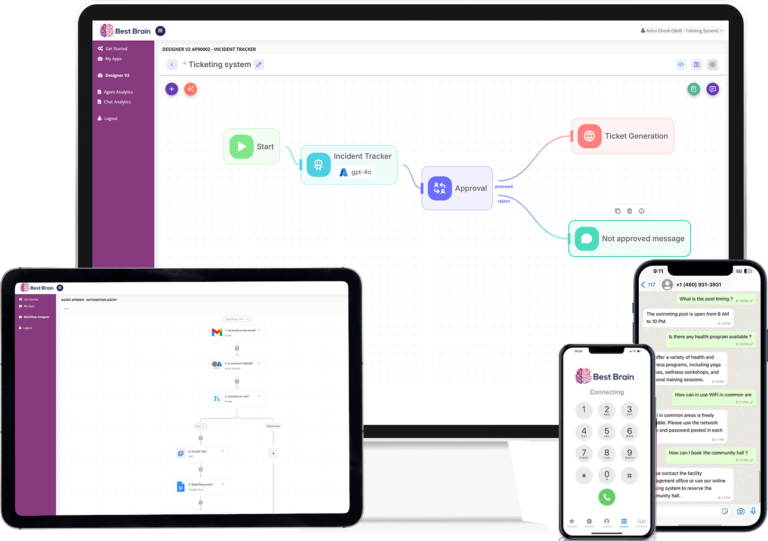
BestBrain brings the agent-building proposition into focus. Its published interface shows an incident workflow with a start node, an AI step and an approval branch. The product offers conversational and voice capabilities, document handling, workflow automation and connections to business tools. No-code describes the building interface; the buyer still has to define the process.
A procurement blueprint published by DreamzTech offers a more consequential example. Designed for an Indian structural-steel and infrastructure business, it reads supplier quotations in several document formats, organizes comparisons and connects them to purchasing controls. The page explicitly presents a proposed design, not verified production outcomes.
Its division of labor is instructive: AI extracts information, deterministic rules normalize commercial details, and people authorize decisions. Reading a price is different from comparing landed costs; comparing costs is different from committing money. Treating those as separate responsibilities makes the automation easier to inspect.
The copyable idea is to draw the boundary before choosing the model. Decide what the system may interpret, what it must calculate and what a person must approve. Give each exception an owner. A workflow becomes easier to test when its responsibilities are specific enough to argue about.
04 Two cities, then a longer relationship
DreamzTech’s founding account begins in Tempe and Kolkata in 2010. Its leadership page identifies Krish Ghosh as founder and CEO, and Kuntal Mazumder as co-founder and COO. The cross-border beginning remains visible in a business that combines client-facing offices with distributed development.

Founder and CEO

Co-founder and COO
In its December 2017 announcement, the company reported placing 34th in Deloitte’s Technology Fast 50 India, with 105% revenue growth over the relevant three-year period. That historical marker is more useful than an undated trophy: it places the consultancy’s growth well before BestBrain’s introduction.
Today the company names DHL, Nestlé, AB InBev and Close Brothers Brewery Rentals among its customers. Its work spans enterprise operations and smaller businesses. The breadth explains the services-and-products arrangement: a customer can need a familiar maintenance task and a peculiar integration in the same contract.
Public descriptions of its culture emphasize learning, agility and client-focused delivery. Those are stated values. The practical question for a buyer is how they appear in a working relationship: who reviews changes, how requirements are recorded and what the team leaves behind when an engagement ends.
05 The price of making it fit
DreamzTech’s business model combines custom-development contracts, engineering teams and support with proprietary software. Clutch lists an indicative minimum project size of $25,000 and hourly rates of $25-$49. One interviewed ERP customer reported about $1.5 million spent across ten years of projects. The same review asked for more integration documentation early in the engagement.
Listed minimum custom project size. Scope, integrations and support determine the actual quote.
The figures describe different purchases. A rate helps estimate labor. A project budget needs a defined scope. A long engagement accumulates work over time. Comparing any of these with a software subscription without considering implementation would make the arithmetic impressively tidy and the decision rather poor.
DreamzTech occupies the space between buying a packaged application and assembling an engineering capability yourself. Its distinguishing proposition is the combination of proprietary operational software and people who can connect or extend it. Buyers should compare that combination against both an internal team and specialist vendors.
The sensible first move is a narrow task with a measurable finish: a maintenance request routed correctly, a quotation prepared for review, a shipment inquiry resolved using live data. Integration access, reliable records and clear authority are prerequisites. Where those are missing, a polished AI interface will inherit the disorder.
DreamzTech is most interesting when the conversation moves from the model to the work. The parcel must have a status. The machine must have a history. The purchase must have an approver. There is a great deal of enterprise software hiding inside those ordinary sentences.
Open the product cupboard
Explore DreamzTech, DreamzCMMS and BestBrain. Follow the company on LinkedIn, X and Facebook, or its maintenance product on Instagram.
Watch the DreamzCMMS mobile walkthrough and field-service demonstration. More videos appear on the DreamzTech channel; explore further projects in its case-study library and updates on its blog.