An invoice arrives at a manufacturer. Someone reads it, types its contents into SAP, checks the entries, and passes it along. Repeat that often enough and a routine office task becomes a queue. Payments slow. Errors creep in. A supplier waits for money while an employee waits for the system to catch up.
This is where AIT Global becomes interesting. The software development and consulting company offers plenty of fashionable technology, including generative AI. But one of its most revealing case studies concerns the decidedly unfashionable business of paying a bill.
- Builds and maintains custom software, cloud systems, and data pipelines.
- Automates repetitive work while routing exceptions to people.
- Also supplies engineering talent and EDGAR/XBRL filing support.
An invoice is a surprisingly good place to start
In AIT’s account, the manufacturer’s original process depended on manual entry. The replacement used optical character recognition to extract invoice data, checked it against SAP, and flagged discrepancies for the finance team. AIT reports a reduction in processing time of up to 80% for this engagement.
The qualifying words matter: “up to,” in one company-reported case. The more useful detail is the design. The system did not treat every invoice as equally straightforward. It established a route for the awkward ones, keeping human review inside the process.
That gives another business something concrete to copy: map the ordinary path, identify the exceptions, and decide who resolves them before automating the handoff. An extractor that reads a document beautifully still needs somewhere sensible to send a disputed number.
Up to 80% lower processing time reported by AIT in one manufacturing case study.
The browser moved on
Another client had a different problem. A fintech administration tool had been built with Flash. As browsers and operating systems stopped supporting it, access to the tool became an obstacle. The business still needed the work done; the surrounding technology had moved on.
AIT describes analyzing the existing functionality and workflow, then migrating the administrative tools to Angular 8 and PrimeNG. Scrum and Kanban supported collaboration during the project. The objective was continued access, a better interface, and room for additional functionality.
Here, the trigger for change was unusually clear. The old tool’s environment could no longer be taken for granted. AIT’s case illustrates a recurring buying decision in enterprise software: preserve the business process while replacing the machinery underneath it. A rewrite begins with understanding what people already depend on.
The old tool’s environment could no longer be taken for granted.
The modernization problem
The business lives between the systems
AIT’s customers range from startups to large enterprises. Its published examples reach across financial services, manufacturing, hospitality, technology, and real estate. The common thread is work that crosses applications, documents, and teams.
Consider its Canadian real estate case. Data needed to move from a portal into a shared cloud repository for reporting. AIT used Node.js to capture CSV files at scheduled intervals, compare each extract with earlier versions, and retain new entries. Each run produced an HTML processing report with statistics and success indicators.
The report is a small but telling choice. Automation needs to make its own behavior legible. Someone should be able to see whether yesterday’s run succeeded without reconstructing the entire pipeline.
- 01CaptureScheduled portal CSVs
- 02CompareKeep new entries
- 03LoadCloud repository
- 04ReportRun statistics
A hospitality example follows similar logic: cleanse and filter mixed MongoDB data, move it into Snowflake, and structure it for reporting. These projects explain AIT’s place in the market more clearly than a broad promise of digital transformation. It sells the engineering needed to make existing business information usable.
People, platforms, and the price of the handoff
The commercial offer stretches from individual specialists to managed delivery. Staff augmentation includes temporary support, contract-to-hire arrangements, and permanent recruitment. Application work covers development and ongoing management. Quality assurance, cloud services, and data modernization address the surrounding operating requirements.
Its EDGAR and XBRL service is a distinctive addition. AIT provides document conversion, tagging, and filing assistance for organizations submitting disclosures to the SEC. The catalog puts software engineering beside document operations, reflecting the varied work financial organizations need handled.
Its current Palantir Foundry offering adds implementation, data modeling, ontology development, automated pipelines, Workshop applications, and support. AIT Global India also markets NIRAXO HRMS and Invoicify, bringing named HR and invoice products into the wider AIT offering.
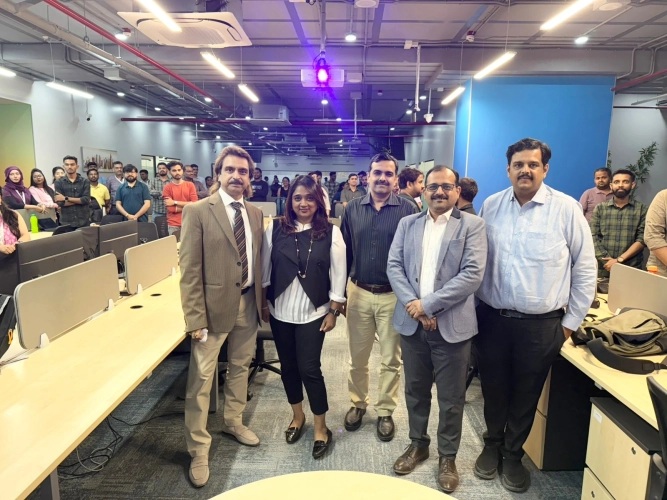
The delivery model blends onsite and offshore teams. Pinky Mishra is identified as co-founder and CEO; company-associated posts also name Raj Mishra as a founder. AIT emphasizes inclusion and professional development, and describes its women-owned and minority-owned business certifications.
For buyers, the relevant comparison is with other development consultancies, specialist automation firms, staffing providers, or an internal team. AIT’s breadth may help when a project needs several disciplines. A narrow, standardized requirement may suit a packaged tool. Distributed delivery also calls for clear ownership, timely feedback, and agreed acceptance criteria.
Start with the exception
A useful budget starts with the entire workflow: discovery, integration, migration, testing, infrastructure, and maintenance. Buyers can request those as separate proposal items and compare the cost with the time and errors in the existing process.
Automation also needs stable inputs and explicit rules. If the underlying process keeps changing, or nobody owns exception handling, speeding it up can simply move confusion downstream. The manufacturer’s review queue and the real estate company’s run reports offer practical checks against that problem.
AIT’s most instructive work begins with a specific inconvenience: an invoice entered twice, a tool people cannot open, a report assembled by hand. That is a useful place for any technology buyer to begin. Pick the broken step. Understand its dependencies. Make the next handoff easier to trust.
Website ↗ Services ↗ Company blog ↗ LinkedIn ↗ X ↗ Facebook ↗ India Instagram ↗ India videos ↗