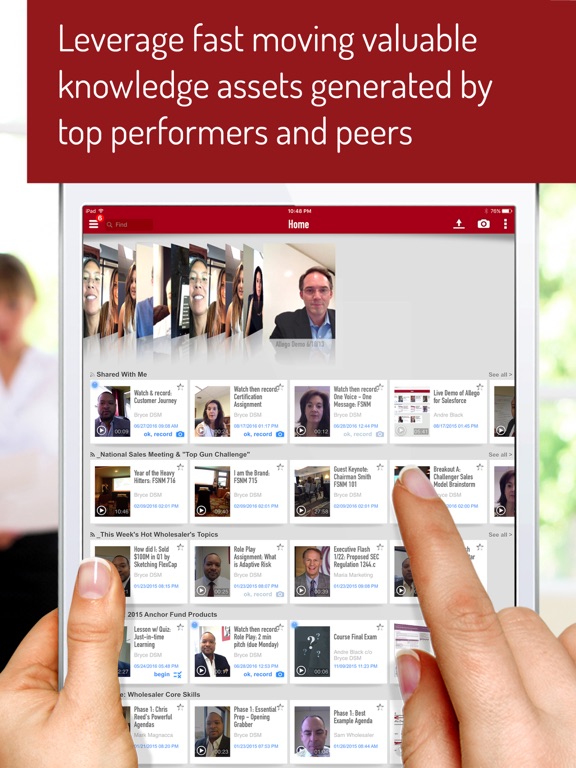
In 2012, Mark Magnacca gave a sales force an assignment that sounded sensible: record a presentation on the iPads their employer had just distributed. Managers could review the performances without flying everyone into a room. There was one small complication. A 30-minute presentation was an awkward houseguest on a 16GB tablet. Storage filled; uploading and sharing became difficult. The future of sales training had arrived carrying a file nobody particularly wanted to move.
- Allego connects learning, coaching, sales content, and buyer engagement.
- Its useful trick is turning individual know-how into material colleagues can find and rehearse.
- Customers buy annual subscriptions; effective adoption still takes human work.
Magnacca had spent years coaching people in financial services. His friend Yuchun Lee understood software, having built Unica and led it through an IPO and a sale to IBM. Their conversations turned an inconvenient training assignment into a business. Allego launched in 2013. The pairing helps explain the product: a coach’s concern with performance, expressed through an engineer’s concern with making useful information travel.
A good answer needs somewhere to go
The small problem inside that iPad contained a larger one. A salesperson learns to handle a difficult objection. Elsewhere, a colleague struggles with exactly that objection. Unless the useful answer moves between them, the organization pays twice for the lesson. Allego’s proposition is to make those lessons easier to capture, distribute, practice, and retrieve.
That is what revenue enablement means here. Modern Learning handles onboarding, courses, reinforcement, and readiness. Sales Content Management organizes approved materials and keeps versions under control. Conversation Intelligence records and transcribes calls, helping managers find moments worth coaching. AI role-play gives reps somewhere to rehearse before a customer is listening. These are connected jobs: knowing the product, explaining it, hearing the response, and improving the next attempt.

Digital Sales Rooms extend the idea to the buyer. Marketing can prepare a branded template; a salesperson personalizes the materials, messages, and next steps. Buyers get a shared space rather than another attachment chain. Engagement data shows sellers which materials attracted attention. It cannot tell them everything a buying committee thinks, but it gives the follow-up conversation somewhere more useful to begin.
- 01 Capture
- 02 Coach
- 03 Practice
- 04 Share
The missing file has a price
Consider Hillman, the hardware and fastener business. Its published Allego customer story describes slow onboarding and conflicting materials scattered through SharePoint. Hillman built a structured program with five job-specific courses and 65 role-based videos, then organized product and promotional content into channels. It also introduced Digital Sales Rooms. The intervention involved organizing work, not simply buying a new login.
Published before-and-after figures. They describe this implementation, not a forecast for every customer.
Hillman reports that new hires reached full productivity in 90 days or less, compared with six months or more previously. Internal content requests fell by 74%. Those numbers suggest a practical benefit that can disappear beneath the AI vocabulary: fewer people waiting for somebody else to send the right thing. They are customer-reported outcomes, rather than controlled proof that software alone caused the changes.
Another example comes from Ash Brokerage’s retirement division. Its executive attributed $1.6 million in additional revenue to knowledge sharing and advisor thank-you videos enabled by Allego. Fifty licenses generated 25,000 views within 18 months. The interesting detail is the repeated use. A training library becomes valuable when people return because it helps with a live problem.
Buying fewer handoffs
Allego sells subscriptions per user per month, billed annually upfront. Seats and contract length affect the quote. Its pricing page describes three-year contracts as typical, with one- and two-year options. AI and standard success services are included; optional managed services cost extra. A buyer’s calculation therefore includes the subscription, the systems it can replace, and the internal time required to maintain the program.
The connection to existing systems matters, too. Allego documents integrations with CRM, conferencing, content repositories, and enterprise learning tools. Approved materials can stay connected to their source, while buyer engagement can feed back into CRM. For an enablement leader, that suggests a useful evaluation exercise: follow one actual product update from marketing’s revision through a rep’s practice session to the buyer’s room. Count the handoffs that remain.
The company’s funding history offers some context. In July 2018, Allego announced a $7.5 million investment led by General Catalyst, its first institutional investment. It later disclosed another $25 million from General Catalyst and Summit Partners, completed in the fourth quarter of 2020. That December, it acquired UK conversation analytics company Refract after a year-long partnership, adding call-analysis expertise and a European base.
Its market is crowded. Seismic, which completed its Highspot merger in August 2026, offers a broad alternative. Allego’s distinctive emphasis is the connection between readiness, coaching, content, and buyer interaction. That combination matters most to distributed teams selling complex products: financial services, life sciences, technology, and manufacturing. A team seeking only a video repository has a narrower purchasing problem.
The manager is still in the picture
In October 2025, Allego published research conducted with neuroscientist Carmen Simon. It reported stronger recall after AI coaching, while human feedback supported motivation and emotional connection. This was company-sponsored research using simulated sales calls. It supports a measured conclusion about the product’s intended role: plentiful automated practice can sit alongside a manager’s judgment and encouragement.
“AI coaching is not a replacement for human coaches; it’s a powerful complement.”
Yuchun Lee / October 2025
The same emphasis appears in Allego’s published operating principles, which encourage employees to question assumptions and learn from mistakes. Its May 2026 Allego 9 announcement added deal alerts, expert chat, document creation, and expanded governance. In October, the company announced Leader recognition in Forrester’s revenue enablement evaluation. The scope has grown considerably since the iPad assignment.
The transferable lesson is smaller than the platform. Capture a useful response. Make it easy to find. Let another person practice it. Then examine what happens in the next real conversation. The inference for managers is straightforward: stale materials, neglected coaching, or weak participation would undermine that loop. Buying the software creates an opportunity to repeat useful behavior. People still have to decide which behavior deserves repeating.