At Givaudan, the flavors and fragrances company, a sales problem began with something less glamorous than persuasion: finding the right file. Materials lived in several places. Sellers sometimes reached for outdated versions. The business wanted more personal conversations with customers, but its information habits kept getting in the way. Before anyone could tell a better story, someone had to make the current story findable.
- Mediafly connects approved sales content, ROI tools and seller learning.
- Its customers include manufacturers, technology companies and other complex B2B businesses.
- The practical lesson: organize the evidence, test adoption, then expand.
That is an unexpectedly good introduction to Mediafly. The Chicago company sells revenue enablement software, an ungainly name for a recognizable job: helping sellers prepare, explain a purchase and understand what happens afterward. Its territory lies between marketing’s content factory, the sales conversation and the buyer’s budget meeting. An impressive presentation can still leave that last meeting painfully underprepared.
The first thing to fail was the filing system
Givaudan introduced a Mediafly-powered application that brought approved materials together, available online and offline. Sellers could adapt presentations while marketing could see what was being used. The rollout started with 125 North American users and expanded to more than 1,000 worldwide. The interesting change was organizational: visibility into content use gave marketing a reason to improve what it produced. Distribution had become feedback.
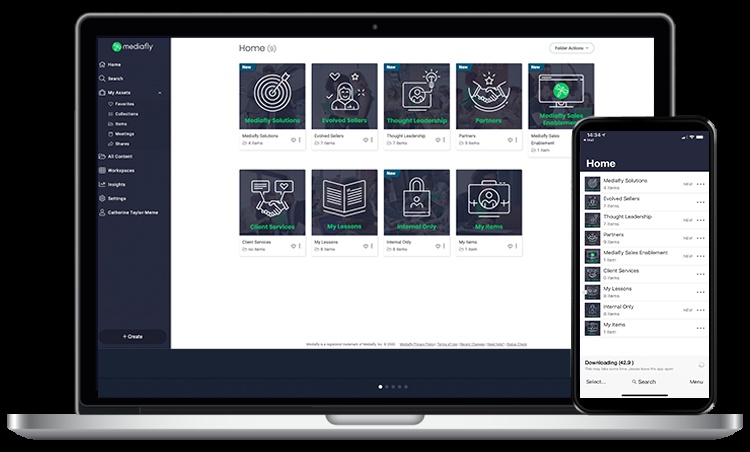
A similar pattern appears at Voyager Sopris Learning, which had relied on IGLOO, ClearSlide, Salesforce and Google Drive. Its Mediafly environment grew into a content hub, training resource and customer workspace. The company’s published case study says every seller had sent share links and nearly 98% of sales content was used and shared. Useful evidence of adoption, certainly. Evidence that software alone caused revenue growth? That requires a different test.
A calculator with a passport
Mediafly organizes its offer around Engagement, Value, and Learning & Coaching. Engagement manages content permissions, personalized presentations and digital sales rooms, where buyers can revisit selected materials. Value supplies return-on-investment calculators, total-cost-of-ownership estimates and business cases. Learning, through Appinium, puts onboarding and certification inside Salesforce. Professional services help customers configure the system and create the material that goes into it.
The Value piece gives the company a particular position in a crowded market. Highspot, Seismic and Showpad compete for sales enablement budgets. Mediafly emphasizes the connection between the sales story and its financial argument. A buyer can like a product and still need to explain its economics to finance, procurement and a manager who missed the demonstration. A useful business case has to travel without its original presenter.

Consider the distinction between projected and realized value. Before purchase, a calculator models what could happen. After deployment, customer success teams need to establish what actually happened. Mediafly offers tools for both. That continuity is appealing because a promise made to win a contract can otherwise disappear until renewal, when everyone suddenly wishes they had kept better notes.
The rule behind the story
StoryGuide reveals how Mediafly thinks about consistency. According to its product announcement, customers liked the guided experience of its financial tools and wanted something similar for ordinary sellers. Those tools were built for value engineers; navigating a full model was asking too much of every representative. The feedback suggested a more focused task: guide the presentation itself.
StoryGuide asks about the buyer and selling situation, then uses configured logic to assemble slides from approved content. Its documentation is refreshingly precise: the current product does not independently read slides and decide what belongs in a deck. Rules and mappings do that work. Conversational AI access is described as a future capability. The distinction matters when the wrong sentence can create a compliance problem.
“We focus on the sales part, not the automation.”
Carson Conant, founder · 2021 interview
There is a useful idea here for managers: some expertise can be expressed as decisions. Which customer problem comes first? Which proof belongs beside it? Which slides must remain? Encoding those choices makes experienced judgment available to more people. It also makes the quality of the underlying choices everyone’s problem. A confident workflow can faithfully reproduce a weak argument.
Buying the missing pieces
Mediafly did not arrive at this breadth through one product launch. Founded by Carson Conant in 2006, it began in media aggregation and podcasting. Acquisitions later added specialties: Alinean in value selling, Presentify in visual communication, InsightSquared in revenue intelligence and ExecVision in coaching. Bill Walsh took over as CEO in early 2024. The business became an exercise in connecting capabilities as well as collecting them.
In August 2023, Mediafly announced an $80 million investment led by BIP Ventures, with Boathouse Capital and insiders participating. Appinium followed in April 2025, with the acquisition announced that June and financial terms undisclosed. Its Salesforce-native learning system fits a practical strategy: put training near the work. Buying a capability, however, leaves the integration and adoption work to do.
Start smaller than the software
Mediafly sells through custom quotes based on modules, users and integrations. Its FAQ describes a typical implementation of eight to ten weeks. Buyers should budget attention as well as money: someone must approve content, maintain financial assumptions and decide which behaviors deserve coaching. For a small team with simple products and a short sales cycle, those responsibilities may outweigh the benefits of a broad platform.
75% fewer sales assets. Index: before = 100. Customer-reported in SLB’s 2025 SAP awards submission.
The copyable approach is modest. Choose one team and one recurring buyer problem. Establish an approved library. Build a business case with assumptions customers can challenge. Track what sellers use and buyers revisit, then review outcomes alongside those signals. Givaudan’s small initial rollout is a useful example of earning the right to expand.
Mediafly’s proposition is strongest where products are complicated, sellers are dispersed and purchases need internal justification. Content alone cannot supply that justification. Neither can a calculator with optimistic inputs. The valuable connection is between a clear claim, credible evidence and a seller who can explain both. That is the work worth making repeatable.