David A. Steinberg wanted to sit next to John Sculley. The dinner seating plan had other ideas. So, at a networking event in the late 1990s, the young wireless entrepreneur arranged for the place cards to be switched. Sculley, the former Apple chief executive and Pepsi president, became his dinner companion. A relationship that would help shape several businesses began with a small act of administrative disobedience. Sometimes the first distribution problem is getting yourself into the right chair.
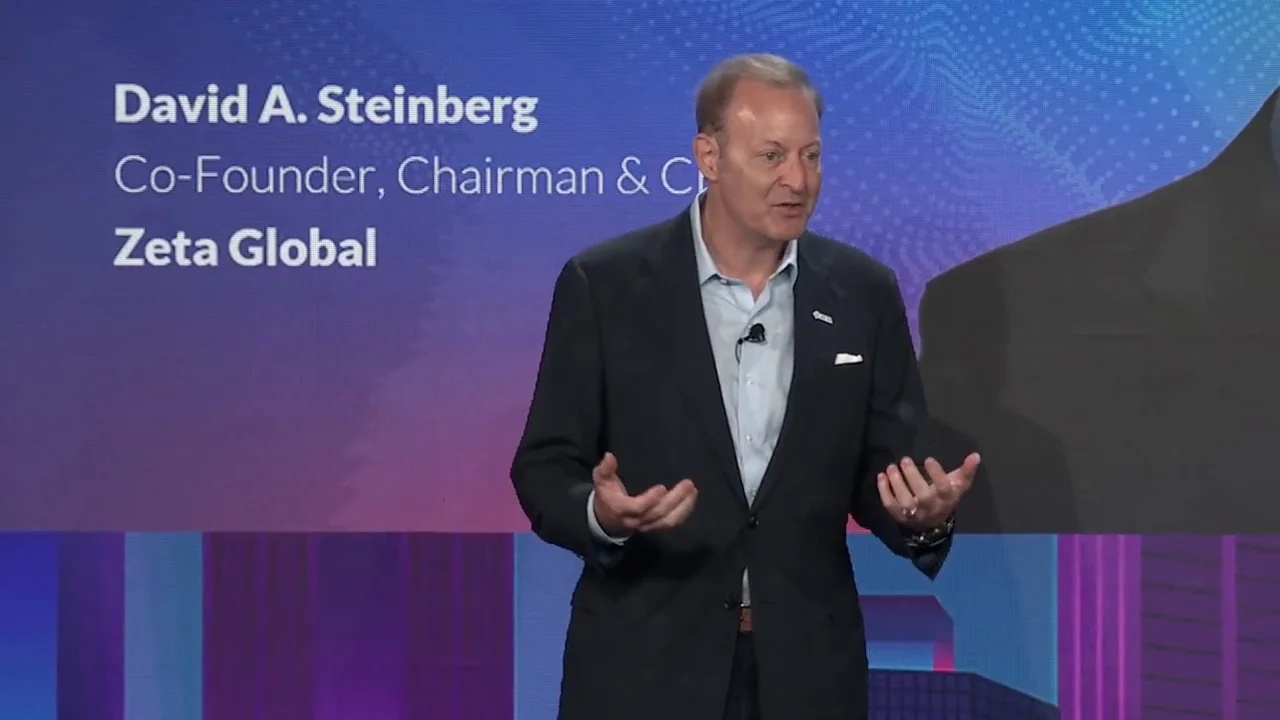
Today Steinberg is co-founder, chairman and CEO of Zeta Global, the public company he started with Sculley in 2007. Its business has traveled from customer acquisition to marketing software and, increasingly, enterprise AI. The products have changed considerably. The question behind them has stayed recognizable: how do you get a business in front of the person most likely to buy?
There is another question in his career, less suitable for a conference backdrop. What happens when a founder becomes very good at growth before his company becomes equally good at handling it? Steinberg has lived that experiment. It gives his enthusiasm for the next thing a history, and his attention to cash a reason.
Two fathers, two kinds of arithmetic
Steinberg grew up in New York City between two different examples of working life. His father was an accountant who rose through PricewaterhouseCoopers. His stepfather was an entrepreneur whose formal education ended with high school. One career offered institutional discipline; the other demonstrated what someone could build outside it. Steinberg has described himself as a mixture of the two.
He studied economics at Washington & Jefferson College. His first preference was investment banking, but the banks did not share the preference. Work on Capitol Hill exposed him to telecommunications and wireless licensing. An insurance sales job followed. His father worried about the use being made of his education. His stepfather regarded selling as an education in itself.
Early in the 1990s, Steinberg started Sterling Cellular from his Bethesda basement. He saw a business market for mobile phones and built an outside sales force to reach it. The pitch concerned productivity: a phone could help people work away from their desks. Carriers paid for customer activations and shared subsequent spending. The sale was the beginning of a relationship with recurring economic value.
That relationship had an awkward calendar. As Steinberg later recalled, carriers paid on 60-day terms while his people needed paying every two weeks. Growing sales could leave him short of payroll. His stepfather eventually supplied a loan. A young founder had discovered the distance between a sale and cash arriving. The distance was measured in days, and it was quite capable of swallowing a business.
The internet needed something to sell
Sterling Communications took the wireless proposition into telemarketing. InPhonic carried it onto the internet. Steinberg’s account of the opportunity was practical: online content and mobile adoption were expanding, and internet portals had advertising space that went unsold. Put those pieces together and an unused patch of screen could become a storefront.
InPhonic built wireless stores carrying partners’ brands, including AOL, Yahoo and MSN. The portal supplied an audience; InPhonic handled the machinery behind selling and activating phones. Partners earned a fee when an activation happened. A visitor could encounter the familiar name of a portal while another company did much of the work behind the counter.
This is an early clue to Steinberg’s enduring interest. He sells connections between businesses and customers, whether the delivery mechanism is a salesperson, a telephone call, a portal or software. He has described sales, marketing and understanding the direction of technology as his domain. The handset was one item passing through that system.
InPhonic topped the 2004 Inc. 500 and went public that November. By 2005, Steinberg was hosting poker evenings that brought executives together with a board featuring Sculley and prominent investors. The company had raised capital, bought a competitor and built a substantial online position. Profitability was still an unfinished assignment. The poker table made a memorable image of a business growing into its public-company clothes.
InPhonic goes public
Zeta is founded; InPhonic files for Chapter 11
Zeta lists on the NYSE
AthenaOS is announced
The balance sheet gets a vote
InPhonic filed for Chapter 11 on November 8, 2007. Its filing described a proposed sale of substantially all its assets to Versa Capital Management and a $25 million debtor-in-possession financing facility. The legal paperwork gives an unromantic ending to the growth story. A business that had persuaded customers, partners and public investors still needed a way to pay its obligations.
In later reflections, Steinberg acknowledged that internal systems had fallen behind the company’s expansion. The finance organization had not developed sufficiently as transaction volumes grew. There was too much debt. A transaction that would have provided cash fell apart, and refinancing became unavailable. His own diagnosis was concise: “We had the wrong balance sheet.”
The lesson reached into hiring as well as borrowing. Loyalty to people who helped build a smaller company could interfere with appointing the people needed to run a larger one. That is a difficult admission for a founder whose relationships are part of his commercial method. Familiarity can make an organization comfortable long after its job has become unfamiliar.
He began again quickly. Within a month of leaving the CEO role, Steinberg moved office furniture into a building next door in Georgetown. The proximity is almost too tidy for a business parable. There was no need to travel far to encounter the consequences of the previous venture. The next one would have to be operated differently.
“We had the wrong balance sheet.”
David A. Steinberg, reflecting on InPhonic
Build the next company out of the pieces
Zeta’s starting insight came partly from the cost of finding customers at InPhonic. Its Wirefly division had been a heavy internet advertiser, giving Steinberg a direct view of marketing economics. He saw an opening to help other businesses acquire customers and keep them longer by combining data, analytics and the means to deliver a message.
He, Sculley and investor Bill Landman supplied the founding capital. Acquisitions gave the young business useful components: databases, customer relationships, email capabilities. Steinberg described combining assets that separate companies had struggled to monetize. Then came a familiar sales technique. They opened their contact lists and called people they knew.
The business became known as XL Marketing, then Zeta Interactive and eventually Zeta Global. Its reach widened from finding customers to managing relationships across their lifetime. Buying complementary companies offered a way to assemble those capabilities. The operational challenge was making the assembled parts function together. A collection of tools still leaves someone holding the toolbox.
In July 2017, Zeta acquired Boomtrain, a platform using machine learning to personalize digital messages. That deal supplies a concrete marker for its AI work years before conversational AI became a routine corporate talking point. Zeta returned Steinberg to the public markets in June 2021, listing on the New York Stock Exchange under ZETA. Another listing began another period of public measurement.
A mentor with a longer appointment
The dinner-seat maneuver produced an unusually durable professional connection. Sculley became both a co-founder and a sounding board. In 2015, Steinberg wrote that Sculley had participated as a catalyst or adviser in every pivot he had made over the preceding 18 years. Finding a mentor, in this instance, meant finding someone who could question the next idea after the previous one succeeded.
The lessons Steinberg singled out were revealingly ordinary: understand the audience, listen, remain willing to change course, treat people kindly and invest in talent. They sit below the language of acquisitions and platforms, where leadership consists of thousands of small encounters. A founder can arrange an introduction. He still has to learn something once the conversation starts.
Sculley retired from Zeta’s board in June 2025 and became vice chairman emeritus, retaining an advisory connection. Steinberg also chairs the David Steinberg Family Foundation, which supports disadvantaged children. These commitments place a longer timescale beside the quarterly one. Partnerships and institutions can continue after a particular title has changed.
Now the customer asks the software
In January 2026, Zeta announced a collaboration with OpenAI to support Athena, its conversational system for enterprise marketing. In June, a partnership with Palantir set out plans to rebuild Zeta’s Data Cloud on Foundry and connect customer intelligence with operational decisions. The ambition was expanding beyond making individual campaigns easier to run.
On October 8, at Zeta Live, the company announced AthenaOS. Its proposed starting point is a business objective. A team states what it wants to achieve; the system brings together information, applications and actions around that goal. Zeta also announced specialized inference-model work with Fireworks using NVIDIA Nemotron. AthenaOS remained in limited internal beta at announcement, with general availability planned for the first quarter of 2027.
The promise is attractive to anyone who has spent an afternoon moving between software screens. Its commercial test will be whether customers can turn that convenience into useful decisions and repeatable results. Steinberg is asking companies to entrust more of their work to a system assembled around their data. That requires confidence in the machinery behind the conversation.
There is a useful measure of the business already operating underneath that ambition. For the second quarter of 2026, Zeta reported $443 million in revenue, up 44% year over year, and $8 million in GAAP net income. It also reported $58 million in free cash flow. Those figures cover one quarter. They offer something more concrete than a product’s proposed future.
For Steinberg, the next chapter therefore carries two familiar tasks. Persuade customers that a new way of working is worth trying. Build an organization capable of delivering it. The first has been visible since the basement and the switched dinner cards. The second acquired urgency in 2007. At Zeta, both now have to fit in the same chair.
Continue the conversation
Follow Steinberg’s work, revisit the early chapters, or hear the latest pitch in his own voice.
- Zeta Global
- X
- Steinberg’s leadership essays
- The early wireless years
- The InPhonic reckoning
- Lessons from John Sculley
- The AthenaOS announcement