A help desk ticket is a small monument to unfinished business. Someone wants to work. A computer, an account or an approval has other plans. The request receives a number, which is reassuring in the way a restaurant buzzer is reassuring: you have entered a system, although lunch remains theoretical.
Muddu Sudhakar has built much of his career around these intervals between wanting something done and getting it done. His companies have worked on storage, information discovery, analytics, security and AI service management. The labels change. The underlying enterprise predicament is familiar: useful information exists somewhere, and reaching it requires more effort than anyone intended.
Today he is Salesforce’s senior vice president and general manager of IT and HR Service. He is also the co-founder and former CEO of Aisera, which he began in 2017, years before generative AI became an everyday business conversation. The continuity is striking. After building a company around automated support, he has returned to employee service inside a much larger software business.
Following the sequence of his career reveals a particular kind of entrepreneurship. He keeps entering the rooms behind the shopfront, where businesses store their information, inspect their systems and process their requests. These are useful places to look for a business. Nobody has ever held a parade because their access permissions worked.
Before the chatbot, there was the storage network
Sudhakar was born in Kakinada, in Andhra Pradesh, India. His education took him through electronics and communications engineering at IIT Madras and graduate study in the United States. He holds an MS and a PhD in computer science from UCLA. The combination matters: his professional starting point was the machinery beneath applications, rather than the conversation on a screen.
At Silicon Graphics, he worked on CPU and server technology. He has described working around Jim Clark and John Hennessy as an inspiration for becoming an entrepreneur. Watching experienced technologists build companies gave the possibility a practical shape. Sanera Systems, his first startup venture around 1999–2000, pursued faster connections between servers and storage. McData acquired it in 2003.
Kazeon followed. It addressed the disorder of corporate information, including electronic discovery. By 2009, its software could help businesses collect, process and review documents scattered across enterprise systems. EMC announced its agreement to acquire the company that September. A file share is an unglamorous thing until somebody urgently needs to know what is in it.
The progression from moving data to finding it is a useful way to read these early businesses. A company first needs its information to travel. Then it needs to locate and understand what has accumulated. Sudhakar’s later work would keep adding verbs to that sequence.
The information learns to raise its hand
With Cetas, he turned to real-time analysis of unstructured data. True Ventures invested at the company’s formation in December 2010. Its co-founder Jon Callaghan remembered being introduced to Sudhakar by lawyer Ted Wang, and being drawn to his plans for a platform that could analyze and manage this expanding material. VMware acquired Cetas in 2012.
That investor’s account offers a grounded picture of how one of these companies began: an introduction, an idea and an emerging customer problem. Across True’s portfolio, businesses were producing application and engagement data they wanted to understand quickly. Cetas operated in the space between having data and being able to use it while a decision still mattered.
Caspida brought machine learning to security. In July 2015, Splunk acquired it for approximately $190 million, comprising about $127 million in cash and $63 million in restricted securities. The practical challenge was detecting suspicious behavior, including activity carried out with valid credentials. An account can have permission to enter a system and still be doing something unwelcome once inside.
Seen together, Cetas and Caspida mark a shift toward software that notices patterns. One sought useful signals in business data; the other looked for behavior that deserved investigation. This history gives Sudhakar’s later enthusiasm for AI a longer runway than the recent popularity of conversational interfaces might suggest.
Different businesses. An expanding job description.
- MoveSanera · storage networks
- FindKazeon · information discovery
- UnderstandCetas / Caspida · analytics & security
- ActAisera / Salesforce · service workflows
A conversation with Ram Shriram, then a company
In 2017, while at ServiceNow, Sudhakar discussed customer service with his mentor Ram Shriram, a founding Google board member. Their concern was the repetitive work performed by support and contact-center staff. Sudhakar wanted a cloud-based AI service that could remain available around the clock and resolve requests. Aisera grew from that problem.
The early customer story contains a useful correction to the usual Silicon Valley tale about knowing everybody. Asked how Zoom came aboard, Sudhakar said he had not previously spoken to Eric Yuan; the connection came through Yuan’s team. He named Zoom and McAfee among the initial customers. Even an experienced founder still had to put a product in front of people willing to use it.
His explanation of the product was blunt: “We took this to full workflow automation.” A support conversation could be the beginning of an action, rather than the end of an exchange. He described connecting the answer to the work required to fix an issue. The ambition was to shorten the route between a user’s question and a completed task.
There is an appealing severity to that test. An employee who needs access to software has little reason to admire a beautifully worded delay. For Sudhakar, service automation offered a commercial setting where the value of intelligence could be measured against something ordinary: whether the person could get on with the day.
“We took this to full workflow automation.”Muddu Sudhakar · 2022 interview
The red jacket years
Aisera attracted institutional backing as the business developed. In August 2022, it announced a $90 million Series D led by Goldman Sachs Asset Management’s growth equity business and Thoma Bravo. The investor group also included firms such as True Ventures, Menlo Ventures and Khosla Ventures, alongside Zoom Ventures and Shriram’s Sherpalo Ventures.
That list combined returning relationships with large financial backers. The financing supported market expansion and the company’s commercial strategy. It also situated Aisera in an established enterprise software economy, where products have to meet buyers, integrate with existing applications and survive the journey from demonstration to use. An engaging chatbot is only one participant in that meeting.
In June 2023, Sudhakar was named an EY Entrepreneur Of The Year Bay Area Award winner. Aisera was then developing generative AI products including AiseraGPT. The recognition belonged to a specific regional award; his response credited the team and investors. By this stage, a company begun around service automation was working with the language-model tools drawing a wider audience to AI.
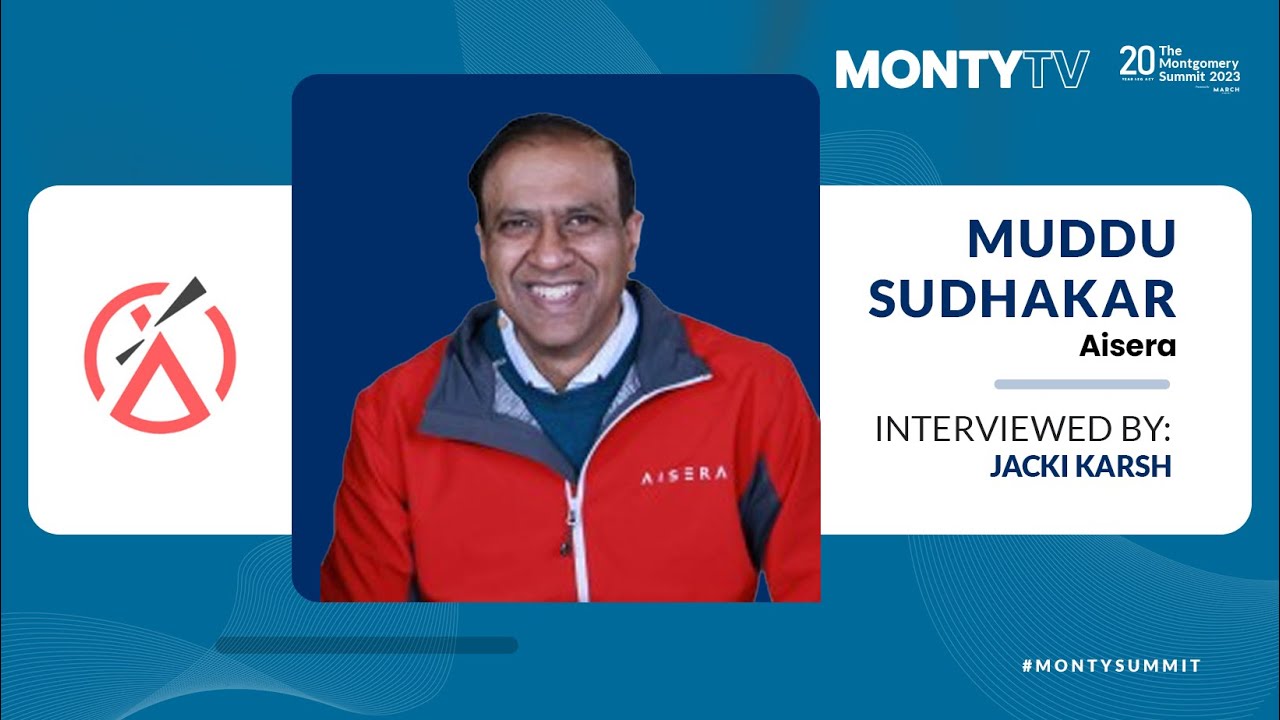
The public image had a cheerful practical detail: the red Aisera jacket. In his 2023 Montgomery Summit interview, he wears the company name across his chest. Enterprise software can be difficult to photograph. A founder in company colors at least gives the camera a fighting chance.
The founder leaves; the problem stays
Aisera later announced that Sudhakar had transitioned out of the CEO role after seven years. CFO Abhi Maheshwari became interim CEO. The handover separates two chapters that are easy to blur: founding and leading a business, then watching it continue under different leadership. Sudhakar’s place in Aisera’s history does not require presenting him as its current chief executive.
Aisera subsequently became part of Automation Anywhere. Its buyer describes the combination as bringing Aisera’s self-service agents for IT, HR and customer service together with broader enterprise process automation. Sudhakar, meanwhile, took his service-management work to Salesforce. The company changed; the ambition to connect a request with action remained recognizably close.
Salesforce introduced Agentforce IT Service at Dreamforce in 2025. In his November account of the product, Sudhakar described employee agents, agents for IT teams, a service desk, and tools for discovering and mapping technology dependencies. The agenda extended beyond answering questions to routing incidents, coordinating work and understanding which systems affect one another.
By March 2026, he was explaining how IT and HR service were built on the same Service Cloud foundation as customer service. Shared case structures and workflows were central to his argument. Employees move between departmental problems during a working day; software architecture can make that movement easier or add another door to knock on.
The next queue needs a brake pedal
His more recent writing adds an instructive complication. In July 2026, Sudhakar argued for “circuit breakers” for AI agents. Giving software authority creates questions about governance, escalation and accountability. He warned that over-automation can leave gaps when complicated situations require human judgment. That is a consequential concern for someone whose companies have sold automation.
The argument fits his security background. Systems that can act need boundaries, monitoring and a way to stop. Enterprise intelligence has to operate among permissions, exceptions and people who remain responsible for outcomes. The work of designing those controls can be less photogenic than a fluent demonstration, but it belongs in the same product.
Sudhakar also spends time mentoring founders and executives. His public profile lists coaching with Alchemist Accelerator, and IIT Startups includes him among its mentors. These connections echo the importance he has placed on advice in his own career. A founder with several acquisitions behind him still describes learning from mistakes and from the people around the table.
The career is easier to understand through that combination of technical depth, commercial repetition and correction than through a tally of exits. He has repeatedly chosen enterprise problems with practical consequences. Somewhere, a document must be found, a suspicious account investigated or a request resolved. His latest work returns to the employee waiting for help. The ticket already has a number. The interesting question is how soon it can be closed.