Sierra Hit $15.8B, Aisera Got Bought. The Agents Grew Up.
Two AI customer service companies took very different exits from the same stretch of the agentic-AI boom. One raised nearly a billion dollars at a $15.8B valuation; the other got folded into a bigger machine. The split says a lot about where enterprise AI is heading.
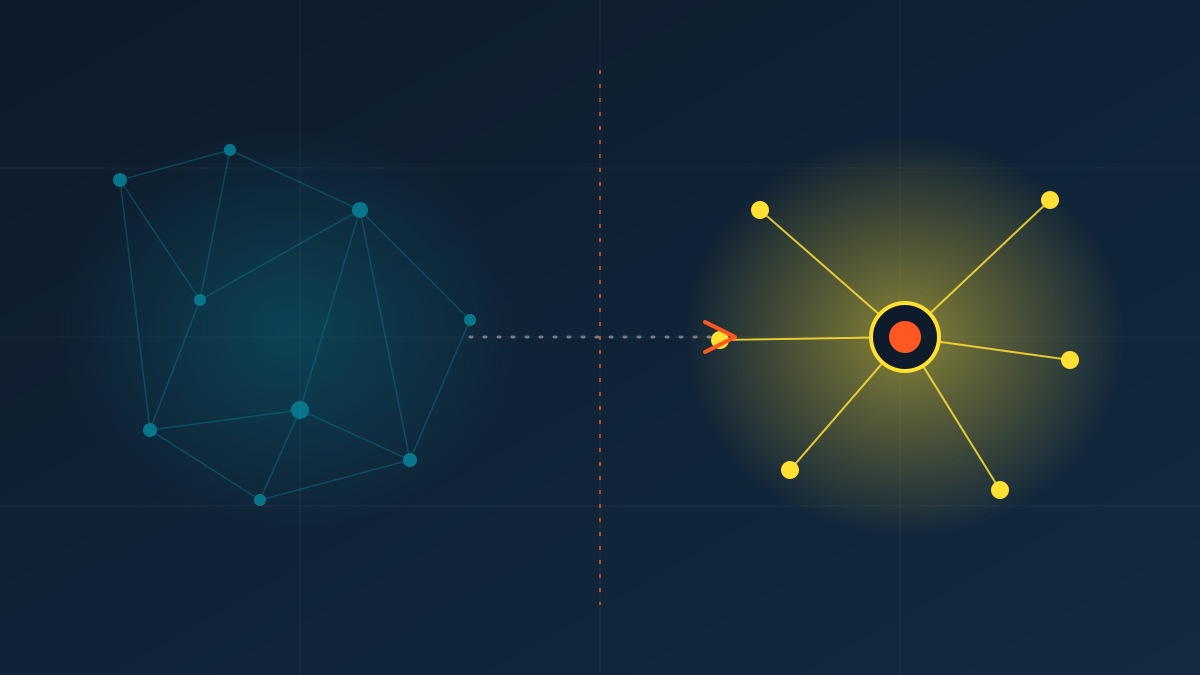
Look at two headlines from the same twelve months of enterprise AI and you get the whole story. In November 2025, Automation Anywhere bought Aisera, one of the first companies to put AI agents inside corporate help desks. In May 2026, Sierra raised $950 million at a $15.8 billion valuation. Same market, same promise, two very different endings. The gap between those outcomes is the most useful thing you can study if you want to understand where AI agents are actually going.
Both companies sell more or less the same pitch to a buyer: let software handle the customer, the employee, the ticket, the request. What separates them is not ambition. It is what "handle" means - and how much that definition changed in a single year.
The old job was to guess what you meant
Classify · route · answer
Aisera was founded in 2017 by Muddu Sudhakar and Christos Tryfonas. Sudhakar had already built and sold four companies before it, and he built Aisera the way that generation of enterprise software got built: around intent. A user types a question, the system classifies what they probably want, and it routes them to the best available answer or workflow. Done well - and Aisera did it well - that automates a huge share of IT and HR tickets. Password resets, access requests, "where is my form," the long tail of repetitive help-desk work.
That model raised real money. Aisera pulled in roughly $150 million across its rounds, including a $90 million Series D led by Goldman Sachs, and reached a valuation near $772 million. It grew a team of more than 100 AI engineers. By any normal standard, that is a successful company. It just belonged to a category that was about to be redrawn underneath it.
The tell was in how these systems failed. When an intent-classifier got it wrong, you felt it immediately - the loop of "did you mean this?" menus, the canned reply that answered a question you did not ask, the eventual surrender of "let me connect you to an agent." Every one of those moments was a reminder that the software was a very fast receptionist, not a problem-solver. It could find the right door. It could not open it. For years that was simply the ceiling of what the technology could do, and the whole industry priced itself accordingly - deflection rates, containment rates, tickets avoided. Useful numbers. Also a tacit admission that the hard part still landed on a human.
The new job is to finish the task
Read · decide · act
Sierra was started in 2023 by Bret Taylor and Clay Bavor. Taylor's resume reads like a tour of the last twenty years of software - he co-created Google Maps, was CTO of Facebook, co-CEO of Salesforce, and now chairs OpenAI's board. Bavor ran Google's VR and Labs work. They built Sierra around a different verb. Instead of classifying intent and handing off, a Sierra agent reads the full knowledge base, follows the company's actual operating procedures, and takes the action itself. It issues the refund. It cancels the subscription. It processes the upgrade. And when it hits something it shouldn't touch, it escalates cleanly to a human.
That sounds like a small upgrade. It is not. An intent-classifier's ceiling is a good answer. An agent's ceiling is a resolved problem. Everything downstream - pricing, trust, how many humans you need on a support floor - changes when the software stops pointing at the door and starts walking through it.
The founders' backgrounds are worth pausing on, because they explain the confidence. Taylor has spent his career at the exact seam where consumer polish meets enterprise plumbing - Maps, Facebook's platform, then two years running Salesforce, the company that more or less invented modern customer software. He is not a first-time founder guessing at what large companies need. He has sold to them, run one of them, and now sits on the board that governs the lab setting the pace of the whole field. When someone with that vantage point decides the next thing to build is agents that take action, the bet is not that the models got better. It is that the models finally got good enough to trust with a button, and that whoever wraps them in the right guardrails wins the enterprise.
Two exits, one tide
Follow the money, not the marketing
Here is the part worth sitting with. Aisera's acquisition is not a failure story. Automation Anywhere bought it specifically to move toward what it calls the "autonomous enterprise" - a world where a large majority of enterprise work is automated or assisted by agents. Aisera's team and its self-service agents became the engine for that. The first generation proved the demand was real. The second generation is capturing the value it exposed.
You can see the whole shift just by watching where capital went. One company absorbed into a larger platform. One company handed a war chest to keep going alone. The market did not vote against automation. It voted for the version that acts.
It is also worth being fair about the terrain each company chose. Aisera planted itself inside IT and HR - the internal help desk, where the requests are repetitive, the audience is captive, and a wrong answer costs an employee ten annoyed minutes. Sierra went at customer-facing service, where a wrong action costs the company a refund it should not have issued or a customer it should not have lost. That is a harder, riskier place to let software act, which is exactly why the ability to act there is worth so much more. The reward tracks the stakes. An agent trusted to resolve a paying customer's problem, on a call, without a person watching, is operating at the top of the difficulty curve - and that is the part enterprises had never been able to buy off the shelf before.
The pricing idea worth stealing
Sell the outcome, not the seat
The most quietly radical thing about Sierra is not the technology. It is the invoice. Sierra ties its pricing to outcomes - it charges when an agent actually resolves an issue, not just for having a conversation. That flips the usual software contract. "Does it work?" stops being a question the sales team dodges and becomes the thing you are literally billed for. If you are building anything in this space, that is the move to copy: package the resolved task, let the customer measure it, and charge for the result.
It also explains the valuation in a way a demo never could. Reaching around $150 million in annual recurring revenue in under two years is not a story about a clever chatbot. It is enterprises paying real money to let software close the loop, and signing up fast enough that a company barely three years old is worth $15.8 billion.
Where the agents show up next
Out of the chat window
If 2025 was about proving agents could resolve a support ticket, 2026 is about pushing them into places where the stakes are higher. Sierra has been signing partners that put agents into real operational workflows: Kraken built autonomous agents for utility customer service on top of it, SoftBank took it into Japan, and a Plaid integration now lets Sierra agents securely connect to a customer's bank accounts. That last one matters. Connecting a bank account is not a chat feature. It is the difference between an agent that talks about your money and one that can act on it - with all the trust and guardrails that demands.
This is the direction the whole category is bending. The interesting question is no longer "can AI answer this?" Everyone can answer. The question is "how much are you willing to let it do without a human in the loop, and how cleanly does it hand back the cases it shouldn't touch?" Aisera and Sierra are two points on that line, about twelve months apart. The distance between them is the story of the year.
For anyone buying this software, the lesson is simple enough to act on today. When a vendor says "AI agent," ask what it actually does when the conversation ends. If the answer is a routed ticket or a suggested reply, you are looking at the old generation - useful, proven, and increasingly a feature inside someone else's platform. If the answer is a completed refund, a canceled plan, a connected account, you are looking at where the money went. The agents grew up. The buyers are starting to notice.
Read & follow
- Sierrasierra.ai
- Aiseraaisera.com
- DealAutomation Anywhere acquires Aisera
- FundingTechCrunch: Sierra raises $950M
- ProfileForbes: Inside Sierra
- PartnerAxios: Sierra moves into utilities
Frequently asked
What is the difference between Sierra and Aisera?
Aisera came from the earlier wave of enterprise AI focused on classifying user intent and routing to answers, strongest in IT and HR service management. Sierra represents the newer wave of autonomous agents that read a full knowledge base, follow procedures, take real actions like refunds or cancellations, and escalate to humans only when needed.
How much is Sierra worth?
Sierra raised $950M in May 2026 at a $15.8B post-money valuation, up from a $10B valuation in September 2025. It reported roughly $150M in annual recurring revenue in under two years.
What happened to Aisera?
Automation Anywhere acquired Aisera in November 2025 to expand its autonomous-enterprise portfolio, bringing Aisera's IT, HR, and customer service agents and its 100+ AI engineers in-house.
Who founded Sierra?
Sierra was founded in 2023 by Bret Taylor, the OpenAI board chair and former Salesforce co-CEO, and Clay Bavor, a former Google vice president.
Why does the Sierra vs Aisera comparison matter?
It's a clean before-and-after for enterprise AI. The money and momentum moved from AI that answers questions to AI that completes tasks - a shift visible in Sierra's funding surge and Aisera's acquisition within about twelve months of each other.