The accounting department is not the traditional launchpad for an AI chief executive. It lacks the romance of a garage and offers remarkably few opportunities to pose beside a whiteboard. Yet it teaches a useful habit: every claim must eventually meet a number. Abhi Maheshwari carried that habit from PwC to Logitech, from Logitech to CrowdStrike, and from CrowdStrike into Aisera. He arrived at the enterprise AI company in 2021 as chief financial officer. By June 2024, he was interim chief executive. In 2025, as CEO, he steered Aisera into an acquisition by Automation Anywhere.
The sequence looks brisk when compressed into a biography. It was built over two decades of work in the less photogenic machinery of technology companies: reporting, treasury, tax, global finance, capital, operating discipline. Maheshwari’s career suggests that the spreadsheet is not merely where ambition goes to be audited. Read properly, it is a map of the business. Revenue reveals customer appetite. Costs reveal conviction. Cash reveals time. A good finance operator sees the product, the people, and the promises hiding behind the cells.
At PwC, where his public work history dates from 2005 to 2014 and includes the title of director, he learned inside a profession organized around evidence. He later became head of worldwide finance at Logitech. In 2018 he joined CrowdStrike as chief accounting officer, overseeing accounting operations, reporting, treasury, and tax. Those were consequential years. CrowdStrike went public in 2019 and expanded around the world. The experience placed Maheshwari close to the rituals and risks of scaling an enterprise software company while the market was paying attention.
The numbers learn to speak
When Aisera appointed Maheshwari CFO in October 2021, it introduced him as an executive with more than 20 years of experience supporting global enterprise and software-as-a-service companies. Aisera was selling AI for service management: software meant to resolve requests from employees and customers across systems such as Salesforce, Zendesk, ServiceNow, Slack, Workday, and Microsoft Teams. The company said its customer base had grown 300 percent for several years and its products reached more than 65 million users.
Maheshwari did not sound like someone joining to count paper clips. In his announcement, he called autonomous service management the future. He wrote about empowering teams to innovate, scale, and serve, and invited people who wanted to make work more fun to join the company. The phrasing matters. His enthusiasm was attached to a measurable promise: routine work could be resolved without making a person shepherd every step.
Then came the capital work. Aisera’s official biography credits Maheshwari with leading its Series D financing as CFO. The $90 million round, announced in 2022, was led by Goldman Sachs Asset Management and Thoma Bravo. Financing is often described as fuel, as though companies were lawn mowers with pitch decks. In practice it is a choice about which future deserves to become expensive. Aisera was choosing to deepen its AI platform and expand while the vocabulary of the market was moving from chatbots to generative AI and, soon, to agents.
A promotion with the wiring exposed
Aisera changed leaders in June 2024. Founder Muddu Sudhakar moved out of the chief executive role, and Maheshwari became interim CEO. The company emphasized continuity: its CFO already knew the business and its customers. This was less a parachute into the top job than a move from the engine room to the bridge. By then, Maheshwari had spent nearly three years watching how money, product ambition, and customer expectations tugged at one another.
His public calendar widened. At AWS re:Invent in 2024, he discussed generative AI as Aisera’s CEO. He and field technology executive Utkarsh Contractor met with the AI Entrepreneurs at Berkeley group to talk through Aisera’s journey and the effect of AI agents on work. In 2025 he led a masterclass at HumanX in Las Vegas and joined a New York CIO Summit fireside chat on strategy, implementation, and business value. The accountant had become the explainer.
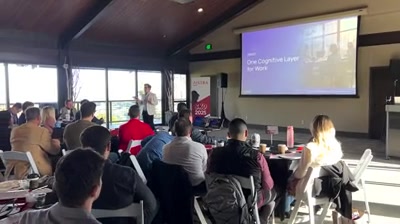
His explanation of agentic AI was practical. A conventional bot can retrieve an answer. An agent is meant to understand intent and context, reason over the request, coordinate with other systems, and take an approved action. For an employee, that might mean requesting access or resolving an IT issue without learning the private dialect of a ticketing portal. For a company, it means the seductive fluency of a language model must be joined to permissions, governance, integrations, and a record of what occurred.
From “help me” to “handled”
This is where Maheshwari’s finance background becomes more than biographical garnish. Finance dislikes an activity that cannot be traced to an outcome. Agentic software makes the same demand of AI. A polished answer is pleasant; a safely completed workflow can be counted. Aisera’s reported results under his leadership included auto-resolution rates above 84 percent, agent productivity gains above 55 percent, and annual cost efficiencies of $5 million in customer deployments. Those are company figures, but they reveal the scorecard: completion, productivity, money.
The outcome test
Selected customer results reported by Aisera
The acquisition as a product sentence
In November 2025, Automation Anywhere announced it had acquired Aisera. The financial terms were not disclosed. The product logic was easier to read. Aisera brought conversational AI and self-service agents for IT, HR, and customer service. Automation Anywhere brought a large process-automation platform, an orchestration layer, and experience connecting work across enterprise systems. One side specialized in understanding the request; the other had spent years automating what happened next.
Maheshwari called the combination an “agentic automation powerhouse.” In his own account of the deal, he described a unified idea: “AI + Automation.” The plus sign does unusually heavy labor. Generative AI can make software feel articulate, but enterprise work is an obstacle course of identity, data, permissions, policy, exceptions, and elderly software with formidable opinions. Automation reaches into that thicket. Conversation provides the front door.
The deal also placed more than 100 Aisera AI engineers inside Automation Anywhere. Existing Aisera customers were promised continuity, while the combined companies planned new bundles across IT, HR, finance, and operations. Maheshwari’s role in the transaction drew on both halves of his career. The CFO understood capital, risk, and the anatomy of a deal. The CEO had to explain why the products belonged together and what employees and customers would gain after the lawyers finished.
His answer returned to people. Aisera’s stated mission was to build AI “in service of humans and humanity.” Maheshwari argued that autonomy should create room for creativity, innovation, and strategy. This is a restrained aspiration for a loud industry. It also sets a hard test. If automation merely produces more alerts, dashboards, and administrative ceremony, it has failed its human brief. The useful agent is the one that gives attention back.
The operator’s advantage
Maheshwari’s story offers no mythology of solitary invention. It is a story of adjacency. He stood beside the systems that make companies legible, then gradually took responsibility for more of the company itself. At CrowdStrike he helped manage the obligations of rapid public growth. At Aisera he financed expansion, learned the customers, inherited leadership, and negotiated the company’s next home. The route was cumulative. Every role made the next one less surprising.
There is a lesson in that for operators. Functional expertise becomes strategic when it connects rather than encloses. A finance chief who sees only finance will remain the keeper of a well-organized room. One who sees how every number is produced can understand the building. Maheshwari’s move to CEO suggests that Aisera valued that wider view during a period when the company needed both continuity and change.
There is a second lesson for AI builders. The market’s language will keep changing. Chatbots became copilots; copilots became agents; agents became systems of agents. Labels enjoy a vigorous social life. The durable question is less fashionable: what useful work was completed, under whose authority, with what evidence? Maheshwari’s public record repeatedly returns to operations, customer value, governance, scale, and human time. It is the vocabulary of someone who expects the demo to reconcile.
The spreadsheet, then, never left the driver’s seat. It became the instrument panel. Aisera’s acquisition closed one corporate chapter while widening its product ambition inside Automation Anywhere. Maheshwari’s own next chapter remains connected to the same wager he made when joining as CFO: enterprise AI earns its place by doing work people can trust, and by leaving them with more interesting things to do.