Chakri Gottemukkala was one month into his first job at i2 Technologies when he was sent to work on a major technology client assignment. He learned quickly, helped close a deal and took a practical lesson from the experience: a customer’s problem deserves more attention than an organization chart. If a product needed attention, he went to the person responsible for it. The route mattered less than getting the work done.
That episode offers a useful entry into the career of o9 Solutions’ co-founder and CEO. His subject is business planning, a field whose vocabulary can make even an enthusiastic reader reach for the coffee. Underneath it sits a familiar human predicament. People can be competent, conscientious and busy, yet collectively arrive at a result nobody wanted. Each department has done its job. The company has somehow missed the point.
Imagine a retailer preparing a promotion. Sales wants an attractive offer, finance wants a respectable margin and operations wants enough stock. These are reasonable ambitions. Trouble begins when each team makes its calculations against a different picture of the business. A successful sales push can become a logistical scramble. A prudent inventory cut can become an empty shelf. This hypothetical is the sort of coordination problem Gottemukkala has made his working territory.
His career asks a deceptively plain question: can the whole organization understand the consequences of a decision before everybody commits to it? The question has survived changes in software, corporate fashion and the arrival of generative AI. For Gottemukkala, the interfaces keep changing. The need to connect decisions remains.
The years before the launch
Gottemukkala holds an engineering bachelor’s degree from IIT Madras and a master’s from UCLA. At i2 he worked in several roles, gaining experience in a company that helped establish advanced supply chain planning software. There he also worked with Sanjiv Sidhu, i2’s founder and his eventual co-founder at o9. Their partnership joined an established planning entrepreneur with someone who had encountered the practical demands of enterprise customers.
They founded o9 in 2009. The platform arrived in late 2014. Between those dates, the team consulted with global businesses to understand why planning improvements were so difficult to deliver. The obstacles included adoption, data, organizational change and processes that struggled to keep up with changing business models. The founders were studying the distance between a technical solution and a solution people could actually use.
That interval matters. A founding date can make a company look as though it sprang into the world carrying a finished product and a pricing sheet. Here the sequence included years of listening before the software launch. It suggests a business built around accumulated problems rather than an empty space on a technology diagram. A diagram, after all, has the considerable advantage of never refusing to attend a meeting.
o9’s account of its early development says the business reached profitability before taking outside investment. The detail gives some texture to Gottemukkala’s emphasis on fiscal discipline. Customers and useful work were part of the company’s foundation. Later funding would support expansion, but the early exercise was to make the economics and the product stand up together.
Putting the relationships on the page
The name Digital Brain is o9’s shorthand for its planning platform. A more concrete description is a connected model of a business: products, customers, suppliers, facilities and the relationships among them. Its Enterprise Knowledge Graph is designed to preserve those connections so a change in one place can be evaluated alongside its consequences elsewhere.
A graph stores relationships as well as individual pieces of information. For a planner, knowing the cost of an ingredient is useful; knowing which products depend on it, where they are made and which customers buy them makes the information actionable. The attraction of this approach is the ability to follow the consequences through the business. Gottemukkala’s technical argument turns on that connected view.
This is also why his work reaches beyond the traditional boundary of supply chain software. Revenue decisions and operational decisions are entangled. A new commercial opportunity may need additional capacity. A purchasing decision may alter margin. A product launch may compete for the same materials as an existing bestseller. A system that can represent those relationships gives people a common basis for discussing the trade-offs.
The word “brain” makes a bold metaphor. The practical test is less theatrical: can someone answer a useful question sooner, with the relevant constraints in view? In a business, intelligence often appears as a decision made early enough to matter. A beautifully presented explanation arriving after the shipment has left is a rather expensive souvenir.
Capital catches up with the idea
By July 2023, o9’s existing investors were adding $116 million at a $3.7 billion company valuation. General Atlantic’s BeyondNetZero led the investment, with KKR and Generation Investment Management participating. The valuation had been $2.7 billion in the January 2022 round. These are dated company financing milestones, a record of what investors agreed at those moments.
The scale changes the founder’s task. Selling an idea requires persuasion; serving a growing set of enterprise customers requires repeatable delivery. More customers mean more implementations, more colleagues and more opportunities for the software company itself to acquire the coordination problems it promises to solve. Growth can be a stern examiner of an operating philosophy.
Gottemukkala’s ambitions have also become geographically broader. In November 2025, he described Asia as o9’s next growth driver after North America and Europe. He spoke of 16 Indian customers, each with revenue above $2 billion, and an organization with roughly two-thirds of its 3,000 employees in Bengaluru. India was both a customer market and a substantial part of the company’s capacity to build.
The figures make his story more interesting than the familiar account of a founder securing a large valuation. A planning business must earn its place inside organizations with complicated habits, established systems and employees who already have plenty to do. Capital can finance that effort. It cannot, on its own, make a new process useful on a Tuesday morning.
o9 company valuation, following $116 million of additional investment.
Give the plan a replay button
By 2025, Gottemukkala was arguing for shorter cycles of innovation instead of lengthy, intimidating transformation programs. His October keynote described managers and planners spending less time on routine work and more on strategy and judgment. The proposal was to let capabilities evolve as the business changes, rather than treat modernization as a project that ends with a final presentation.
In March 2026, o9 formally announced APEX, its model for Agile, Adaptive, Autonomous Planning and Execution. The accompanying report said the company had completed more than 130 go-lives during 2025. The language around APEX is ambitious, but its central sequence is understandable: detect a situation, analyze possible responses, make a decision, then learn from the difference between the plan and the result.
At the center is a marriage of language models with structured enterprise knowledge. Language models make information easier to ask about; a business model supplies the relationships, policies and constraints needed to reason about a particular company. In July 2026, o9 promoted Ashwin Rao to chief technology officer. Gottemukkala praised his understanding of the relationship between technology and practical business value.
One of Gottemukkala’s recurring ideas is post-game analysis. In sport, the final score tells you who won; the replay helps explain what happened. He wants businesses to examine the equivalent of the replay: why an actual result diverged from a plan, and what should change in the next cycle. This is an aspiration for the operating model, with human judgment still part of it.
His May 2026 argument concerned capable employees struggling to keep up with change. VUCA is the business acronym for volatility, uncertainty, complexity and ambiguity. It can sound like a committee’s attempt to name bad weather. His concern is concrete: important knowledge lives in people’s heads, and assembling the right people to answer each question takes time.
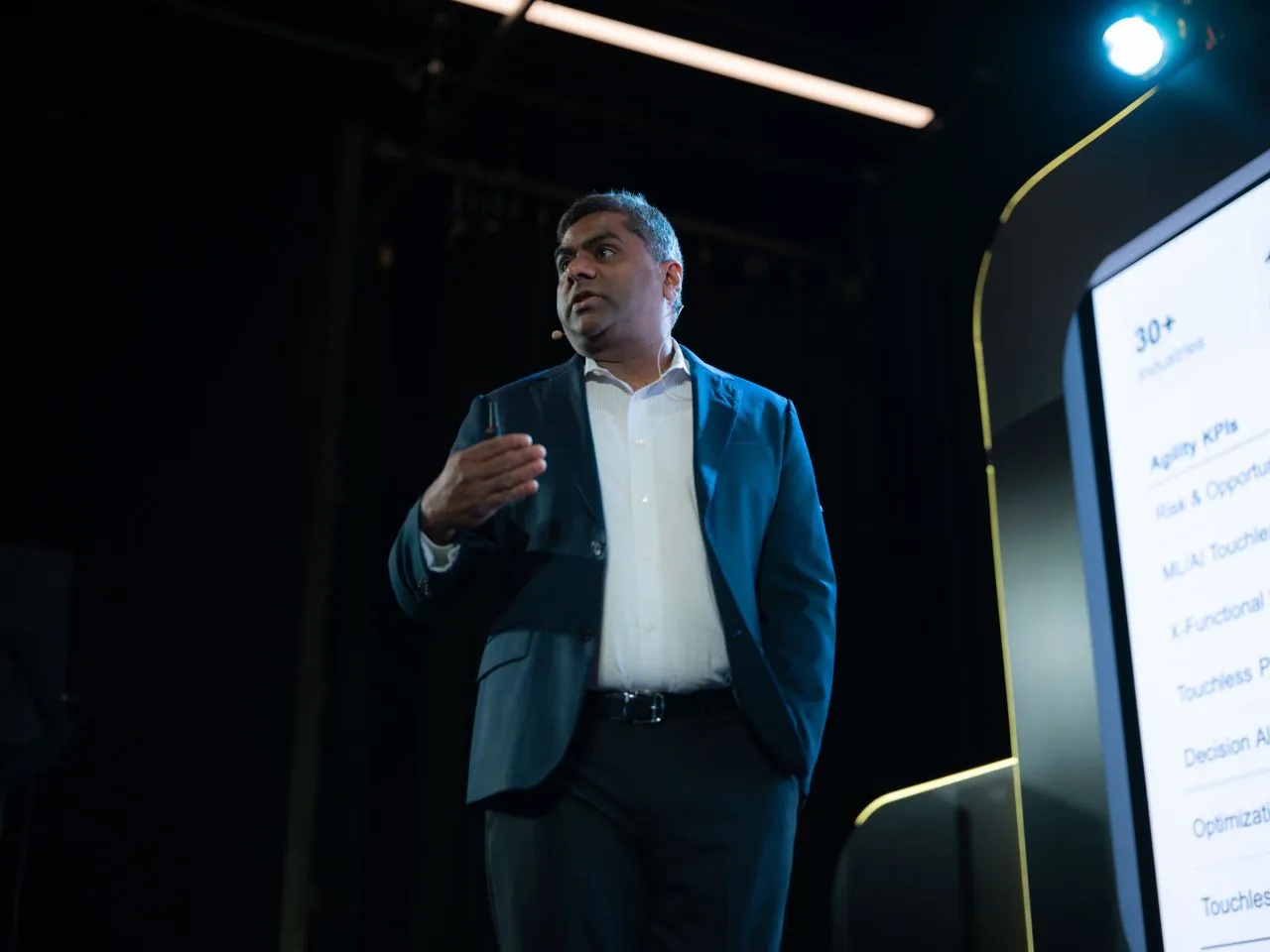
“Talented people are getting overwhelmed. VUCA is winning.”Chakri Gottemukkala
The golf course and the missing watch
Away from the platform vocabulary, Gottemukkala plays golf and has played the Old Course at St. Andrews. He also has an unusually candid relationship with possessions. “Whatever I collect, I lose,” he has said, explaining why he stopped wearing expensive watches. There is a pleasingly human exception here to a career devoted to keeping track of interconnected things.
Golf has another place in his story. He has described personally supporting students from disadvantaged communities in India with coaching and resources. Over five years, some became national junior champions. The point he draws from the experience concerns access: ability is distributed more widely than the chance to develop it. Providing the conditions to learn can change what becomes possible.
That example makes his view of company building easier to understand. He sees professional opportunity as part of o9’s contribution, with successful employees able to support others in turn. This is a stated ambition, rather than a calculation that every job automatically produces a social benefit. It places the careers being built inside the company alongside the value its software aims to create outside it.
The same theme runs through the enterprise story. A knowledgeable employee needs access to the rest of the business’s knowledge. A capable young athlete needs access to coaching. The settings and stakes differ, but both examples turn attention toward the conditions surrounding talent. Gottemukkala’s work keeps returning to what people can accomplish when useful information, resources and opportunity reach them.
His company has a grand name for its software. The recurring problem is modest enough to recognize at any desk: someone knows something useful, someone else needs it, and the organization makes the journey unnecessarily difficult. Gottemukkala has built a career trying to shorten that journey. The next chapter will depend on how well his own growing business can keep making the connections.