Samik Ghosh arrived at a Bangalore IT startup in 1999 with a law degree, an MBA and a job as HR manager. His CEO's instructions included cleaning the toilet and picking up reception calls within three rings. There are gentler ways to introduce somebody to the limits of a job title.
Ghosh remembers resenting the assignment. He later came to regard it as a lesson in humility and adaptability. The episode makes an awkward little opening to a technology career: two qualifications, one telephone, and work that refused to consult the business card.
Today, he is co-founder and CEO of Neutrinos, working on AI and insurance operations. The distance between those jobs is considerable. Yet that first-day story supplies a useful question for reading the rest of his career. When an organization needs something done, what determines who is allowed to do it?
An education that crossed departments
Ghosh grew up in a Kolkata joint family and describes himself as an outgoing sports enthusiast. His early work combined selling computers with lower-court practice. It is an unusual pairing, though both jobs offer fairly brisk instruction in how people make decisions.
His formal education crossed disciplines too. He studied economics at the University of Calcutta and human resources through an MBA at the University of Kalyani. His professional biography also lists an executive program in technology innovation and entrepreneurship at Stanford. Economics, employment and entrepreneurship make a revealing combination for somebody whose later business would promise to let more people build software.
Before Neutrinos, his responsibilities included leading an Africa region and managing strategic accounts across Singapore, Britain, South Africa and North America. He also held a board position at Village BPO. That background places him in the commercial and organizational side of technology: customers, relationships, regional businesses and the practical arrangements that make a technical idea useful.
The distinction matters to this story. An application can work beautifully and still be difficult to buy, introduce or teach. Ghosh's career ran through several of those difficulties before he was asking customers to trust a platform of his own.
The app was only half the problem
Neutrinos' early public history describes a bootstrapped rapid application development business founded in 2015. By February 2018, it had a reported team of 55 and a presence in South Africa, India and Singapore. The original proposition was broad: help people build applications without making development an expensive expedition through scarce technical skills.
Customers could buy the platform and create their own applications, or ask Neutrinos to help implement them. That second option is telling. Selling access to a tool does not automatically give somebody the confidence, time or knowledge to use it. An open door still needs a workable route through the room.
Ghosh had already published an essay titled Democratizing Innovation in May 2017. The phrase has a grand public-address sound, but its practical test is small and personal. Can a person with a problem make something useful? Can the person who understands the problem participate in building the answer?
Those questions have followed Neutrinos as its product has changed. The early platform addressed application development. The present business concentrates on insurance automation. Moving into a specific industry narrows the customer list, while making the work more demanding: a solution has to fit the decisions and obligations of that industry.
A driver gets a different set of keys
At the Johannesburg office launch in January 2018, Ghosh appeared alongside Tukiso Mateka and Dayanand Virasamy. Mateka had been a Taxify driver before joining Neutrinos as an intern the previous November. Two months into the program, he had learned to develop Edu-App, intended to help students find funding for further study.
The office opening also introduced Winds of Change, a skills initiative with an initial plan to take 15 young people aged 18 to 23. Training would include technical and personal development, a stipend, and arrangements for employment opportunities afterward. Ghosh connected the effort to South Africa's shortage of technology skills.
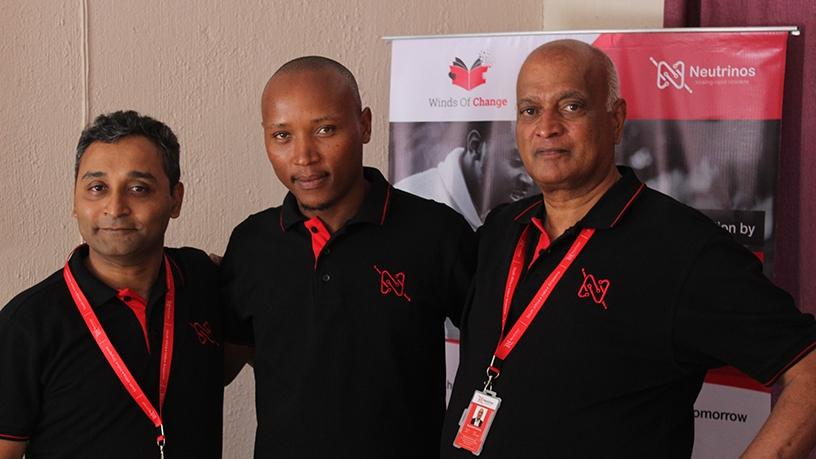
Mateka's story gives the company's early ambition a face. The application addressed an obstacle its maker understood. That is a more interesting demonstration than a stopwatch beside a software demo. Technical access mattered because it let experience outside the technology profession enter the design process.
It also gives the opening telephone story a second reading. Workplaces assign people categories, then organize opportunity around them. HR manager. Driver. Developer. The categories are useful until they become a ceiling. Here was an attempt to teach somebody enough to move between them.
The arithmetic of being turned down
Ghosh's account of Neutrinos' early selling is less cheerful. He recalls pitching 147 prospects in the first two years and receiving 132 refusals. He also remembers the 2017 team working from a borrowed meeting room with a whiteboard that would barely erase. Even the stationery, apparently, wanted to retain the previous version.
These are his recollections, and the distinction matters. They describe the experience of building the business from inside, rather than a tidy retrospective in which every rejection becomes a necessary triumph. A refusal is still a refusal while the next meeting is being arranged.
Each square represents one prospect. The remaining 15 are not presented as confirmed customers.
The question behind those refusals was serious: could a small, unfamiliar supplier be trusted with work essential to a customer's business? Product capability and institutional confidence are separate things. A founder has to earn both, often before the company has much history with which to answer.
Ghosh says that experience shaped his emphasis on recruiting people willing to build under imperfect conditions. It is a sensible response to a business that cannot buy its way past every obstacle. It also makes hiring part of the product story. The team is responsible for keeping promises the software alone cannot make.
Four musketeers, and a classroom full of builders
His language about colleagues is sometimes less boardroom than adventure novel. In a 2023 post, Ghosh called himself, Ramya Babu, Suresh Chandrasekharan and Pieter Noppe the four musketeers, pairing the nickname with the phrase “Curiosity in Chaos.” It is a friendly image for a group whose work involves rather more integration than swordplay.
Neutrinos' current leadership list identifies Babu as co-founder and president of the US business, Chandrasekharan as co-founder and CTO, and Noppe as co-founder and chief customer success officer. The division of responsibilities makes the friendship professionally legible: selling, engineering and helping customers use what they have bought.
Ghosh has also described a 2022 learning cohort of 25 participants over 15 days, bringing together developers, practitioners and tutors from several organizations. The work included small assignments modeled on actual digital use cases. Partner leaders participated too. Teaching the platform meant giving people a chance to make things with it.
The mix is worth pausing over. A fresh developer and an experienced partner can encounter the same tool with quite different assumptions. A practical assignment gives them something concrete to compare. For a CEO interested in access, the classroom is another place to test whether a platform's invitation survives contact with its users.
Insurance gives the idea a harder exam
By January 2025, Ghosh's published predictions were concentrating on insurance. He argued for connected automation, specialized platforms and greater operational control within insurers. He also emphasized governance and collaboration across functions. These were predictions and prescriptions, rather than a report that the whole industry had already followed his preferred path.
There is a useful tension here. Making technology easier to use expands participation. Putting it into insurance creates a corresponding demand for oversight. A person may be able to build a process quickly; the organization must still understand what that process decides and how it behaves.
His 2026 product messaging makes that responsibility explicit. In discussing Kamios, Ghosh focuses on the results customers buy: a completed claim, lower processing cost, a decision that can withstand scrutiny. He describes fixed workflows and adaptive agents operating under shared controls. The vocabulary has changed since rapid app development, but the buyer's question remains wonderfully stubborn: what happened to my actual work?
“what did the business actually get?”
Samik Ghosh, on evaluating AI agents
Kamios launched on September 30, 2026, as Neutrinos' platform for governed AI orchestration in insurance and other regulated industries. The launch describes coordinating agents with people and existing systems, while recording authority, evidence and cost. Neutrinos engineers help customers build initial workflows before handing them over.
That handover deserves attention in a profile of Ghosh. It connects the new product to an older preoccupation: helping somebody acquire the ability to act. The customer receives software, but also a first piece of working experience. There is considerably less glamour in a handover than a launch. There is often considerably more consequence.
Two ambitions, two different scoreboards
Ghosh has publicly discussed a goal of building a $100 million business within the next few years. He described that ambition after a two-day leadership meeting in Bangalore which opened with feedback from a customer. The figure is a target; it should be read as one. Beginning the meeting with a customer gives the target a practical counterweight.
The company has another stated ambition: reach a million lives by 2030 through access to technology and digital skills. Its social-impact programs include school workshops, college ideation sessions, mentoring for early entrepreneurs and developer training. That is a company aspiration too, rather than a count of people already reached.
The Venture Studio extends the invitation to startups and founders working on insurance and financial services. Its Reimagining Risk challenge involves TiE Bangalore and TiE New Jersey, with mentorship and access to technology and enterprise partners. It addresses a familiar difficulty for a young company: getting an idea into an organization that has reasons to be cautious.
These ambitions will require different kinds of accounting. Revenue measures a business. Participation measures who found a way into the work. Ghosh's career makes room for both questions. The first-day phone had to be answered before a fourth ring. Decades later, the more interesting test is who gets the chance to pick it up.