The cheap flight was going to leave without its customer. Pieter de Villiers and his would-be travel business had a problem: a last-minute bargain was only useful if somebody saw it in time. Around 2000, he and his collaborators were thinking about a website for travel deals. Email looked like the obvious way to deliver them. Then they ran into the habits of actual people, who had rather inconveniently failed to arrange their lives around the business plan.
De Villiers remembers customers checking their inboxes only every third day. An offer could be gone by the time its prospective buyer opened it. “Our deal would expire before people get to read it.” The sentence contains the beginnings of Clickatell. A travel company needed a faster messenger, and the founders could not find the connection they wanted between a website and a mobile phone.
They spent three months looking for a solution. Eventually, they decided to build one. The abandoned travel idea supplied a concrete annoyance, a deadline, and a reason to care whether the message arrived. De Villiers has spent much of his working life pursuing the commercial possibilities contained in that delay. The flight deals vanished from the plan. The question of how to reach a person stayed.
Four founders, one very expensive free offer
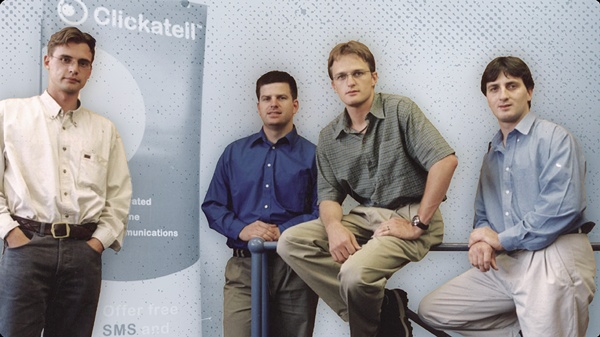
Clickatell began in a small Cape Town apartment in 2000. The founding group included Pieter, his twin brother Casper, Danie du Toit and Patrick Lawson. The company name joined two actions: click on the web, tell through the phone. Even the branding carried a short explanation of what the business was trying to make possible.
De Villiers had already changed direction once. He started his career in optometry and moved into technology, joining Micrologix in 1999 to work on internet opportunities and e-commerce strategy. His childhood had included access to an Apple computer through his father, who travelled internationally. By the time he began reading about internet entrepreneurs, another way of working seemed possible.
The early messaging offer was wonderfully inviting for a website owner and considerably less comfortable for the people paying the bill. Clickatell let sites send SMS messages for free, while mobile operators still charged for delivery. Adoption and revenue were travelling at different speeds. An angel investment in 2001 helped the company move to charging for its service. Enthusiasm had established demand; somebody still had to settle the account.
That distinction would recur throughout de Villiers’s career. A message can look almost weightless on the screen. Behind it sit networks, agreements, engineering and costs. The apartment business was learning how to make that machinery useful to other companies, without requiring every customer to assemble it afresh.
California came with paperwork
The company needed money to grow, and the route to it took de Villiers across the Atlantic. In the early years, he and the other founders tried banks and government agencies before finding angel backers. Cape Town businessman Tony Mallam and Point Break Capital provided funding. By 2005, the business had profits and annual revenue above R50 million.
A takeover offer forced a choice about its future. The angel investors were interested in selling; management wanted to continue. Ethos Private Equity bought out the angels, helping the company remain independent. Ethos and Dave Frankel, co-founder of Internet Solutions, then backed the acquisition of California company MultiMode in 2006. A US operation gave Clickatell a foothold closer to the investors it hoped to reach.
Sequoia Capital subsequently invested. Clickatell became the first African company backed by the firm, a distinction that attached a Cape Town origin to a familiar Silicon Valley name. Yet the move demanded more than an introduction and a handshake. Negotiations over South African regulatory approval stretched across roughly eighteen months. Geography turned out to include a good deal of filing.
De Villiers spent about a decade in the Bay Area. The move changed the company’s access to capital and customers, while leaving him with firsthand experience of the obstacles facing a South African founder trying to build internationally. Those obstacles would later become part of his work outside Clickatell.
- 2000Founded in Cape Town
- 2006MultiMode acquisition; Sequoia term sheet
- 2007US corporation; Series A closes
- 2015Pieter returns to South Africa
An unglamorous introduction to 500 million people
One of Clickatell’s more consequential jobs was also among the least theatrical. Its SMS platform helped authenticate WhatsApp’s first 500 million users. A person entered a phone number, a code arrived, and an account could be established. There was no particular reason for that person to remember the infrastructure company involved. Successful plumbing rarely receives a standing ovation.
For de Villiers, the connection eventually opened onto a richer set of services. Clickatell worked with Absa on WhatsApp banking in 2018. In March 2019, it enabled payments within WhatsApp with MTN South Africa for prepaid recharge. A messaging conversation could now carry a transaction as well as a notification. The business kept following the small practical tasks people needed to complete.
His explanation of chat commerce is grounded in the customer’s next step. Consider a delayed flight. A text alert tells a traveller that something has gone wrong. De Villiers describes extending that message into help: finding another route, receiving a voucher, or reaching an agent. The passenger is already reading the message. Sending them off to hunt through a website adds another chore to a day that is going badly enough.
He also insists on keeping a route to a person. In his account, a complete chat service combines messaging channels, human assistance and checkout. A chatbot that leaves the customer stranded defeats the purpose. The interesting part of the technology is whether the traveller, shopper or account holder can actually finish what they came to do.
Coming home to hear the news sooner
De Villiers returned to South Africa in 2015. He later explained the decision in terms that were less romantic than a homecoming speech: a large part of Clickatell’s commerce and payments growth was coming from Africa, and being in California meant waking up late to the business he needed to understand. He wanted to be closer to that work.
The company retained leadership and operations in North America. His return fitted a business whose opportunities ran across continents, rather than along a single route towards California. In 2022, he described a team spread across South Africa, Toronto, the Bay Area, Atlanta and Nigeria. The founder’s location and the company’s headquarters could serve different purposes.
That February, Clickatell announced a $91 million Series C led by Arrowroot Capital, with participation from Kennedy Lewis Investment Management, Endeavor Global and Harvest. The stated uses included developing chat commerce, expanding in the United States, and building sales and marketing. It was a substantial financing round for a company already more than twenty years into its story.
There is a useful rhythm here. The original problem came from an attempt to sell travel. US capital helped finance expansion. African payments activity helped bring the founder home. Each change followed something happening in the business. Those working decisions explain the chronology.
Funding for chat commerce, US expansion, and sales and marketing.
The other connection he wants to build
In 2013, de Villiers launched SiMODiSA to help accelerate South African startup success. He remains its chairman. The initiative brings business and public-sector participants into research, engagement and policy work. Access to capital is one problem; access to people with the required skills is another. Building a technology company had given him reasons to care about both.
His argument about digital training is deliberately ambitious. He believes the opportunity for South Africa could exceed that offered by mining or agriculture. In writing about the TechXit initiative, he described the possibility of bringing digital work back into the country and attracting work from abroad. These are aspirations about economic opportunity, with training and employment connecting the idea to individual lives.
“Solving the digital skills gap in South Africa requires broad scale collaboration.” The emphasis on collaboration matters. A company can hire for its own vacancies. A national skills pipeline involves employers, educators, policy and the transition into a job. De Villiers also co-founded The Collective X and serves on its board, extending the effort beyond a single initiative.
He became an Endeavor Entrepreneur and later joined Endeavor South Africa’s board, announced in 2025. He has recalled advice from Bill Gates that giving back need not wait until success has arrived. It is an appealingly inconvenient instruction for a busy founder. There will always be another product release available as an excuse to postpone the rest.
A founder with doubts about the success label
Asked for the traits an entrepreneur needs, de Villiers offered a brisk list: “Courage. Grit. Curiosity. People skills.” In the same conversation, he pushed back against casually calling somebody a successful entrepreneur. People have different definitions of success, he said. His proudest achievement was building with co-founders, an executive team and advisers who wanted to do the right thing.
The answer makes room for the other people in a story so often reduced to one chief executive. Clickatell has also publicly photographed him helping in its Cape Town service centre. It is a modest scene, but a fitting one for a founder whose commercial promise depends on what happens when a customer asks for help.
He introduces himself as a father of three and a mountain biker. Those details give some texture to a career measured in messages and payments: family, trails, time spent away from the screen. His company’s stated purpose is to give people their time back. The language becomes easier to grasp when time has something ordinary and enjoyable waiting to fill it.
His reflections also include regret. Looking back in 2025, he said he wished he had taken more risk. He singled out a surprisingly humble source of competition: “the intern and the spreadsheet,” his shorthand for customers who assume messaging infrastructure will be easy to build themselves. Twenty-five years of operation have left him with a sense of how much work a simple interface can conceal.
Give people back their time.
Clickatell’s stated purpose
The next message still has to be useful
At Clickatell’s twenty-fifth anniversary in 2025, de Villiers was talking about AI alongside messaging and payments. He described a company moving towards complete customer journeys, with bots and people working together. The phrasing is contemporary. The underlying concern would have been recognisable to the founders staring at an expiring travel offer in 2000.
His more recent writing about a Cape Town business roundtable concentrates on execution and trust. The people in the room had moved beyond debating whether AI mattered. They were considering responsibility, risk and getting it into daily work. That is a practical test for a founder who has lived through several changes in how businesses reach customers.
The missed flight deal remains an unusually good opening to his story because it contains so little glamour. Somebody has something useful to offer. Somebody else has to receive it in time, understand it, and act. Between those two people lies a business. Pieter de Villiers has kept working on the connection, even as the message has acquired the ability to take a payment and answer back.