A consumer asks an AI assistant for the best home-security system, opens a comparison guide, taps an offer, ignores a text, answers a call and finally books an installation. To most marketing dashboards, that trip looks like several unrelated events. To Centerfield, it is one piece of machinery.
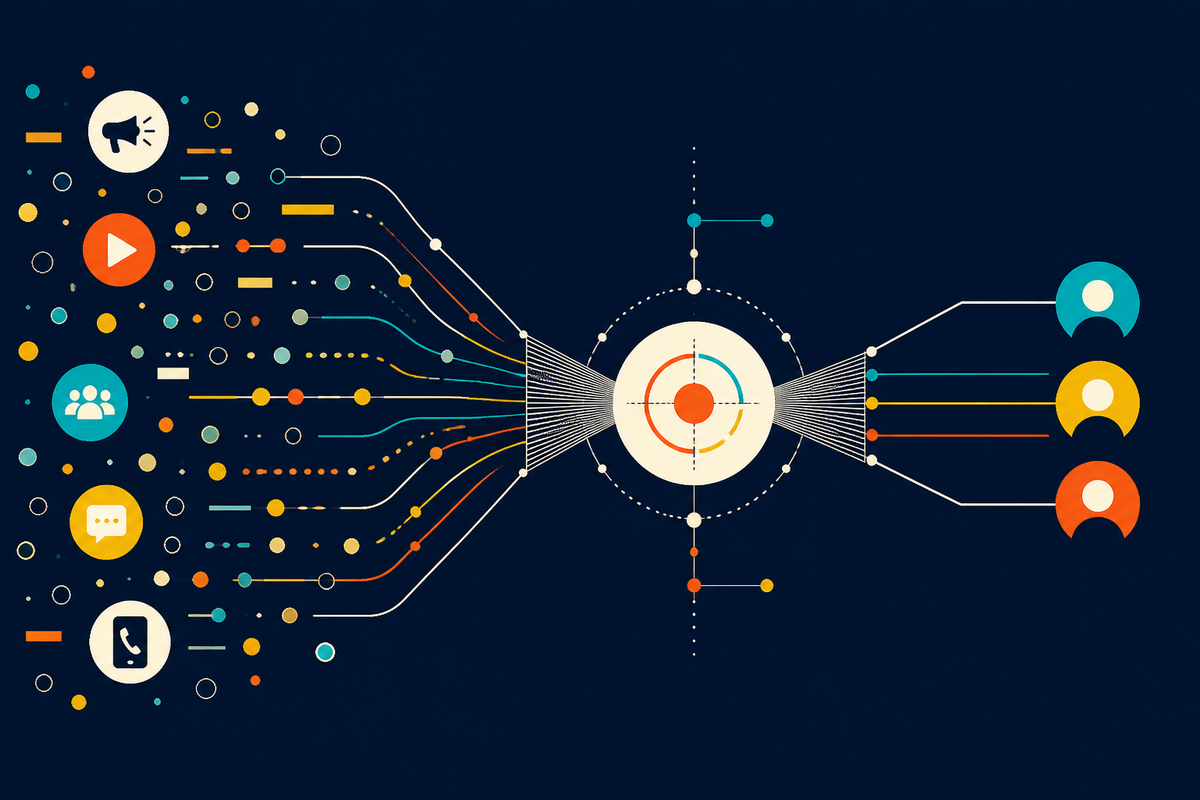
The Los Angeles company has spent 15 years assembling the parts needed to see - and profit from - the whole journey. It owns editorial and comparison sites that attract people already researching a purchase. It buys search and social ads. Its Dugout platform personalizes pages and coordinates follow-up. Its sales operations handle calls, chat, text, email and appointments. Then it sends the result back through the loop so the next campaign can optimize for a customer rather than a click.
That makes Centerfield difficult to file. It is an advertising agency, a software company, a portfolio of consumer media brands, an affiliate network, a lead marketplace and a sales center. The ambiguity is useful. Rivals tend to specialize in one layer; Centerfield makes its case around the handoffs between them.
01 / The machine
One funnel, fewer excuses
Centerfield's public pitch begins with a blunt list of marketing anxieties: Is the brand absent from AI answers? Are paid campaigns wasting money? Is the affiliate channel stuck? Does the sales bot know anything useful? Underneath those questions is one diagnosis. Marketing organizations buy activity from separate vendors, but the customer experiences a single journey. Data gets lost wherever responsibility changes hands.
The closed-loop acquisition model
Dugout is the connective tissue. Centerfield describes the proprietary platform as an orchestration layer for media buying, audience data, personalized experiences, automated routing and sales conversion. A brand can use only part of that stack, but the larger proposition is closed-loop measurement: follow spend through a lead, conversation, appointment and completed sale.
The company often works on outcome-based terms. In home services, it says it may invest upfront and collect payment when agreed results arrive. In insurance, local agents can buy qualified calls or exclusive live transfers matched to geography and product. Affiliate programs generate commissions when shoppers buy. Enterprise engagements mix media, technology and sales services. Different invoices, same governing idea: revenue follows a measurable action.
“Most partners help you buy media. Centerfield helps you grow.”Centerfield's home-services proposition
02 / The audience
The media company hiding inside the agency
The most distinctive part of the model may be what happens before a client ad appears. Centerfield owns or operates more than 90 editorial, comparison and commerce properties. The portfolio includes Business.com and Business News Daily for small-business buyers; BroadbandNow and InMyArea for connectivity; Security.org and SafeHome.org for home protection; Savings.com for coupons; and ConsumerVoice and BuyersReport for product research.
These are not decorative publications attached to a software business. They create high-intent audiences. Someone comparing internet providers or payroll software is already closer to a decision than a generic social-media user. Centerfield can introduce a client before that shopper has settled on a brand, observe what information matters, and continue the interaction through a landing page or sales channel.
Centerfield serves home-service providers, insurers, B2B vendors and e-commerce merchants. Its site displays brands including AT&T, Verizon, Dell, Macy's, The Home Depot, CVS, SHEIN and Purple. The insurance business, strengthened by the 2021 acquisition of Datalot, works with carriers, enterprise call centers and thousands of local agencies. QuoteManage adds Medicare member acquisition and service.
The problems are expensive and ordinary: paid leads that never answer, slow callbacks, generic pages, affiliate programs with little scale, teams optimizing to impressions instead of sales, and compliance requirements that make every call harder. Centerfield's advantage is not that it invented each remedy. It is that one company can operate the media, page, conversation and measurement while using first-party interaction data across them.
03 / The proof
Numbers with important footnotes
Centerfield's proof points are unusually concrete for marketing copy, though they come from different kinds of evidence. A Forrester Consulting study commissioned by the company interviewed four customers and modeled a composite organization. It calculated a 236 percent return over three years. That is not a universal promise; it is a scenario built from a small customer sample. Still, it gives buyers something more useful to interrogate than a trophy shelf.
Other examples are narrower. Centerfield says an agentic calling model produced a 126 percent lift in live connections when AI call screening reduced pickup rates. An internet provider replacing generic SMS with richer RCS messages saw a 60 percent conversion lift from the same consumer base. An early test of Google's AI Max delivered 27 percent incremental conversions for a home-services client. The interesting detail is less the acronym than the operating speed: the company can test a channel and watch what happens downstream.
That ability also explains the human infrastructure. Marketing automation sounds weightless until a phone rings. Centerfield has long operated large sales and retention teams, including offshore operations in Jamaica, alongside media buyers, analysts, engineers and product staff. Its careers materials emphasize performance incentives, internal promotion, mentorship, volunteer days and generous benefits. The company says employees have put it among Los Angeles' top workplaces eight times.
04 / The acquisition habit
Six deals widened the funnel
Centerfield began in 2011 when Jason Cohen and Brett Cravatt combined businesses after meeting through a disagreement between their competing agencies. The origin has the compact logic of a good partnership story: argument, respect, friendship, company. Paid-search leads were the opening act. The 2017 purchase of Qology Direct, backed by $156 million in financing, added large sales and retention operations.
Platinum Equity bought Centerfield in December 2019 and encouraged a methodical acquisition run. Each deal filled a recognizable gap. Digital Ventures expanded consumer sites. Savings.com added coupons and merchant relationships. Business.com brought B2B research and lead generation. Datalot opened a major insurance marketplace. Brainjolt supplied social commerce across dozens of brands. ConsumerVoice added more product-comparison audiences in 2025.
In April 2026, Centerfield Media Parent arranged a $675 million credit facility: a $550 million term loan and a $125 million revolver. The proceeds were designated for refinancing, redeeming debt and general corporate purposes. No public valuation accompanied it. The financing nevertheless shows the scale of the platform and gives the company room to keep treating acquisitions as product development by another means.
05 / The next click
AI search moves the front door
Centerfield's newest service, AI Discovery, responds to a change that threatens its old world while validating its assets. Shoppers increasingly ask ChatGPT, Gemini or Claude to assemble a shortlist. The decision begins inside an answer, before a brand website records a visit. Traditional analytics can show who arrived; they cannot show how often the brand was quietly excluded.
In a 2026 study, Centerfield tracked 1.2 million AI citations across four high-intent categories. It found that independent editorial sources captured a disproportionate share, while brand pages appeared less often. On BroadbandNow, more than 1.1 million sessions provided another clue: AI-referred visitors converted 40 percent better than organic visitors on key events and 60 percent better on monetized click-outs. Centerfield disclosed that it owned several properties in the analysis and framed the results as directional, not universal.
“Visibility is no longer earned at the click. It's earned at the citation.”Centerfield Insights, 2026
The tension is worth watching. Centerfield sells brands a path into trusted third-party coverage while owning part of the editorial ecosystem that AI systems cite. That can be an advantage, but it also makes editorial rigor and disclosure essential. A comparison guide has value precisely because readers believe it can say something a brand landing page cannot. Turn every answer into an ad and the trust asset decays.
Centerfield fits where performance agencies, affiliate networks, customer-data platforms, publishers and outsourced sales teams overlap. Red Ventures and QuinStreet resemble its media-marketplace side. EverQuote competes in insurance demand. Tinuiti and Wpromote contest performance budgets. Twilio and Salesforce sell pieces of the orchestration layer. Centerfield's counter is structural: it owns audience supply, operates campaigns, builds the experience, handles conversations and can contract against outcomes.
For customers, the practical promise is simple. Bring Centerfield a growth target - more installations, policies, software buyers or product sales - and it can assemble the path from discovery to decision. For the market, the company is a bet that customer acquisition is no longer a chain of vendors. It is a feedback system. The firms that see the whole loop will know which half of the advertising worked, and what happened after it did.