Dave Ditzel used to repair the neighbors’ televisions. He was still in grade school, growing up in the Midwest, and a dark vacuum tube could be a useful clue. He collected broken sets, salvaged parts and built amateur radio equipment. The talking part of radio interested him less than making the apparatus work. A successful conversation was apparently an optional accessory.
That preference for building is a useful place to begin a career that passes through Bell Labs, Sun Microsystems, Transmeta, Intel and Esperanto Technologies. The company names suggest a tour of the computer industry. The work suggests something more coherent: a sustained interest in where a computer spends its effort, and whether some of that effort could be spared.
Decades later, Ditzel would help put more than a thousand programmable processor cores on a chip. Between the television and that chip lies an unusually persistent question. How much machinery do you actually need to get the job done?
The attraction of a smaller instruction book
Ditzel studied electrical engineering and computer science at Iowa State, then pursued graduate work at Berkeley under David Patterson. He learned to look across the boundary between programs and the hardware running them. A processor could be admired as an object, certainly. But the interesting question was what happened when someone asked it to do useful work.
In October 1980, Patterson and Ditzel published The Case for the Reduced Instruction Set Computer. Its premise challenged the tendency to make computer instruction sets increasingly elaborate. Complexity brought costs in manufacturing, programming and debugging. A simpler machine deserved a hearing.
RISC, the abbreviation that stuck, offered a different allocation of responsibility between hardware and software. A processor need not provide an ornate instruction for every imaginable task. A carefully chosen set of simpler operations, supported by suitable software, could make a more economical design. There was a practical argument underneath the acronym: judge the finished work, including the cost of getting it done.
The title was admirably direct. It proposed a case, leaving room for argument. Douglas Clark and William Strecker of Digital Equipment Corporation duly supplied one, challenging the paper’s reasoning and calling for complete implementations and measurements. A tidy idea on paper, they warned, would need considerably messier evidence.
This was an engineering debate with consequences. Fewer complications could make room for different uses of a limited chip area. Yet an appealing instruction set still had to survive compilers, memory systems and real applications. The argument could begin in a journal. It would have to continue in machines.
“Designing computers has been a lifelong passion.”
Dave Ditzel, MICRO-55 keynote, 2022
From the argument to the workstation
At Bell Labs, Ditzel worked on processors designed for programs written in C. He helped develop CRISP, the C-language Reduced Instruction Set Processor. The name was practically a miniature specification. For someone interested in the meeting point of software and electronics, the work put both sides of the problem within reach.
He moved to Sun Microsystems in 1987 and became chief technology officer for its SPARC Technology Business. He led work on the 64-bit SPARC instruction set and SPARC processors. The questions that had occupied researchers were now part of a business selling computing systems.
That progression matters. It is easy to tell the history of an architecture as a succession of clever drawings. A workstation requires an architecture to become dependable hardware, with software people can use. Ditzel’s career repeatedly took him through that conversion. Each new setting added another constituency to satisfy.
In 2007 he also founded ThruChip Communications, pursuing lower-energy communication between silicon dies through wireless inductive links. Even the traffic between chips had become a candidate for economizing. A computer designer can spend years improving the workers and still find that moving their messages consumes too much of the budget.
A translator inside the chip
In 1995 Ditzel founded Transmeta. Its challenge was commercially awkward and technically interesting: make a processor that could run existing x86 software while using a different internal design. Compatibility was the admission ticket. Energy efficiency was the reason to attend.
Transmeta’s Crusoe processor, introduced in 2000, used software to translate x86 instructions into the chip’s own instructions while a program ran. The company called its approach Code Morphing. The internal hardware used a very long instruction word architecture, or VLIW, while the translation software handled the conversation with existing applications.
Think of an interpreter standing between a visitor and a workshop. The visitor can keep speaking a familiar language; the workshop can organize its work differently. The interpreter adds work, of course. The engineering wager is that the freedom gained inside the workshop makes that expense worthwhile.
The company also had a conspicuously human side. At a staff dinner in 2000, Ditzel surveyed an assembly of engineers that included unusual hair colors and a dog. “I like this, people getting together,” he said. For a business famous for keeping its work secret, the attraction of company was a pleasing detail.
Crusoe and its successor, Efficeon, demonstrated that dynamic binary translation could be used commercially. Transmeta nevertheless fell short of its business promise. Ditzel later described chips that had arrived ahead of the larger market for low-power computers. Technical feasibility and a sufficiently welcoming market had kept different appointments.
That outcome complicates any comfortable account of invention. A processor can establish that an approach works without establishing a durable company around it. The distinction would return later in Ditzel’s career. It deserves to remain visible beside the designs.
A conceptual guide to three design approaches, not a performance comparison.
Then he joined Intel
In March 2008, Ditzel joined Intel, the company Transmeta had competed against. Anyone hoping for a permanent feud had to revise the script. The work offered an opportunity to attempt a different architecture from inside a much larger organization.
He became vice president of Hybrid Parallel Computing. Looking back, he explained the decision simply: “it was nothing personal.” The attraction was the technical challenge. Employment, in this telling, followed the opportunity to build rather than a lifelong obligation to dislike the competition.
There is a useful limit to what a career chronology explains. A job title identifies the institution paying for the experiment. It says less about the problem that made the experiment worth attempting. Across Ditzel’s moves, that problem remained the relationship between the machine, its software and its energy demands.
A thousand small workers
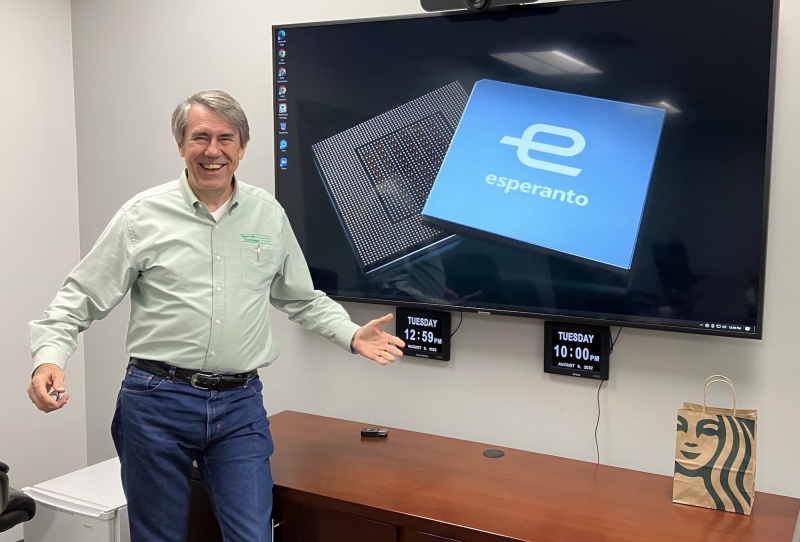
Esperanto, founded in 2014, brought those interests into AI computing. Its processors used RISC-V, an open instruction set standard. That gave the team a shared foundation on which to build its own implementations and extensions, rather than requiring every surrounding piece of software to begin again.
At Hot Chips in August 2021, Ditzel presented ET-SoC-1. The design combined general-purpose RISC-V cores with vector and tensor capabilities for machine learning. The aim was to preserve programmability while accelerating the kinds of calculations that AI applications repeatedly need.
The difference was consequential. A narrowly specialized circuit can be efficient at its intended calculation. Changing workloads may ask something else of it. Esperanto’s approach made many small programmable processors the workers, with specialized arithmetic available to help them. There was flexibility to defend as well as energy to save.
RISC-V processor cores on a single chip.
Many workers, one shared power constraint.
At this scale, getting the design right becomes a substantial part of the invention. The team’s verification effort included FPGA systems used to exercise the design before manufactured chips returned. In a 2022 interview, Ditzel described first silicon that worked and a design that had required one tape-out. A short sentence can conceal an enormous quantity of checking.
The office offered a lighter form of architectural history. Meeting rooms carried processor names, including MIPS, Alpha, STRETCH and CRISP. CRISP gave Ditzel’s earlier work an address inside his later company. Most businesses settle for naming a room after a city. Here, even booking a meeting could require a little computer history.
In his October 2022 keynote, Ditzel looked toward a future in which access to thousands or millions of cores would become ordinary. That was a forecast, with all the uncertainty forecasts carry. Its ambition was consistent with the work already on his desk: assemble useful computing from many comparatively small parts.
The company stops. The designs travel.
Esperanto has since ceased operations. In November 2025, Ainekko announced that it had acquired the company’s intellectual property and selected assets, including chip designs and software tools. It planned to make the technology available through an open hardware and software effort.
A change of ownership cannot retroactively turn a closed business into a commercial success. It can give the work another route into use. Designs, verification knowledge and tools represent years of decisions. Allowing other engineers to inspect and adapt them offers a different kind of continuation.
On August 25, 2026, Ditzel addressed a Palo Alto gathering called Cool Chips - Hot Takes. He revisited the path through RISC, Bell Labs, SPARC, Transmeta, Intel and Esperanto. Parts of Esperanto’s work were continuing through CORE-ET and AI Foundry’s open ET Platform. The retrospective concerned working silicon as well as unrealized plans.
Ditzel now describes himself as retired and working on projects that interest him. His public profile gives his whereabouts with agreeable latitude: “California, Spain or wherever life takes me.” He remains interested in how AI chip companies will compete when they cannot depend on one common instruction set.
The childhood workshop has acquired rather more elaborate equipment. The underlying pleasure is still recognizable: take the apparatus apart, understand where the effort goes, try another arrangement. Sometimes the result becomes a product. Sometimes it becomes an argument other engineers can use. And sometimes, after the company name comes down, the machinery gets another chance to work.