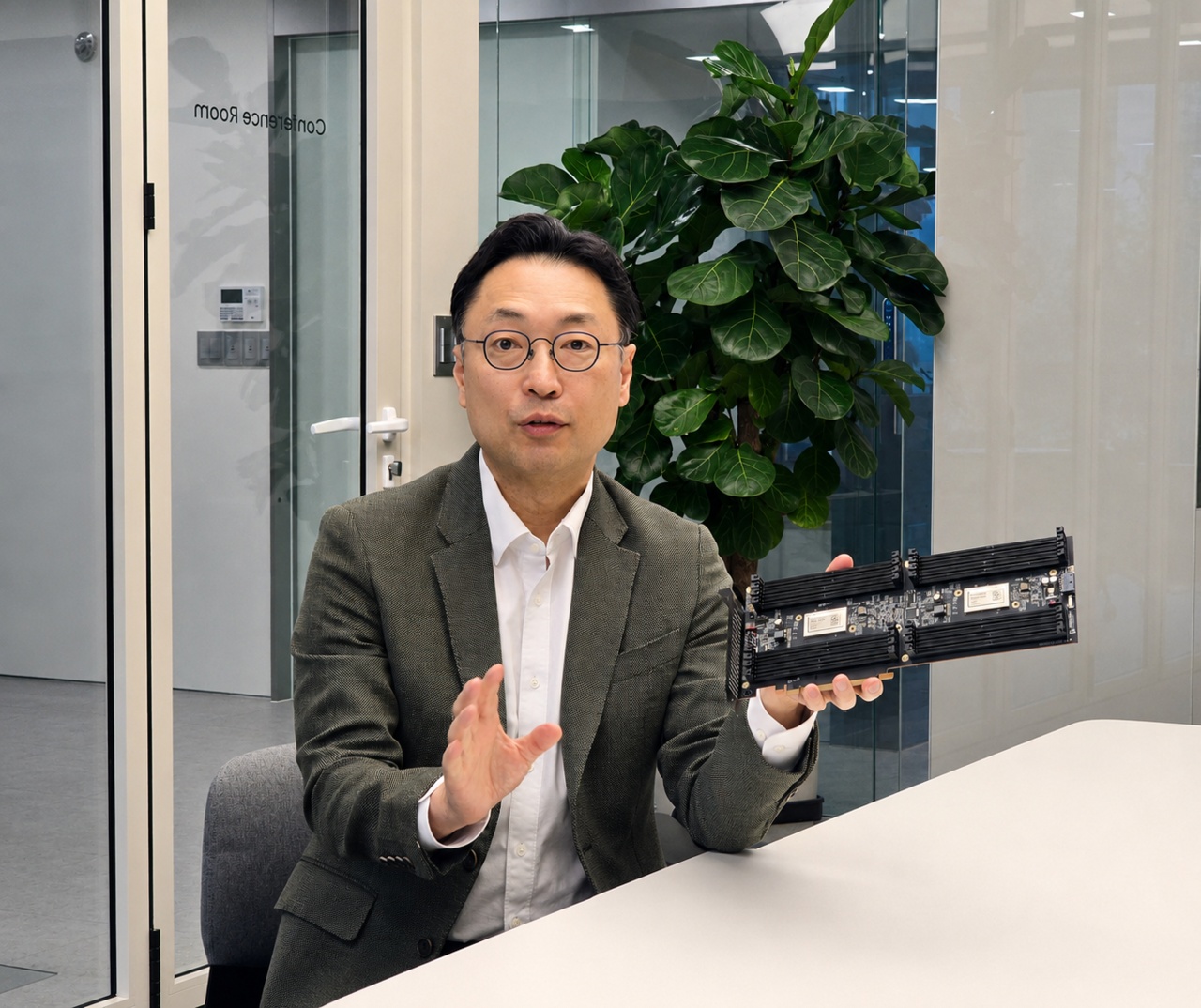
At a media roundtable in Seongnam in August 2026, Il (Will) Park held up a memory expansion card. The photograph has the appealing literalness of hardware: a founder, a circuit board, and something you could put on a table. Park was discussing Primemas’s collaboration with Micron. The object in his hand gave a physical shape to a larger argument about where a computer’s memory ought to live.
It is a useful place to meet him. Park’s career has taken him through processors, systems and memory at IBM, Samsung and SK hynix. In January 2023, he founded Primemas. His startup now asks customers to reconsider two familiar arrangements: how much of a chip needs to be designed again, and how tightly memory capacity needs to belong to a particular server.
These are questions about the bits of computing that rarely get a curtain call. The applications get names people remember. The interfaces have acronyms. Yet an application eventually has to run somewhere, and the somewhere can be surprisingly particular about how much data it will accommodate.
A career on both sides of the bottleneck
Park earned his doctorate in computer engineering at Purdue University. At IBM’s T.J. Watson Research operation, he worked as a lead architect for server CPUs; his professional biography also credits him with leading POWER8 CPU development. He later headed SoC architecture development and engineering at Samsung Electronics. At SK hynix, he became a vice president responsible for memory solutions, design innovation and computer-aided engineering.
The sequence is unusually relevant to his present work. A processor designer considers what a machine can execute. A systems architect considers how its components fit together. Memory work brings another set of constraints into view. Park’s career crossed each of those areas before he put his name to a company trying to connect them.
Read that way, Primemas is a continuation of his engineering career with a different set of responsibilities. A founder has to choose which problem deserves a company. Park chose reusable semiconductor infrastructure, then brought that approach to memory systems. His experience offers context for that choice without requiring a picturesque conversion on a mountain or an invention scribbled on a restaurant napkin.
Leave the plumbing in place
The central Primemas term is Hublet, short for hub chiplet. Its Falcon-1 platform combines common building blocks, including CPUs, memory controllers, interfaces and die-to-die connections. Those functions provide a foundation around which a customer can develop a specialized system. The company describes applications in CXL memory, AI acceleration and servers.
The distinction between the foundation and the customer’s contribution is the point. A chip team may have a specific accelerator to build. It still needs the surrounding functions that let the accelerator participate in a complete system. Primemas’s proposition is to supply much of that surrounding infrastructure in a reusable form.
Primemas frames this approach as a way to widen access to custom silicon. Its vision includes reusing intellectual property and extending hardware life through flexible designs. That places the proposed benefit in the engineering process as well as the finished product. A team gets a different starting point, with more of the surrounding system already defined. Whether it is developing an accelerator or a memory product, it can begin by considering what its own contribution needs to do.
There is an architectural courtesy in the idea: leave another designer somewhere to put the interesting part. The foundation earns its place by making room for work that happens elsewhere. A platform has to be useful before its customers arrive, and adaptable after they do.
interfaces · die-to-die links
for the application
Primemas also describes Kameleon, an FPGA-based companion chiplet intended for prototyping and custom acceleration. Programmable hardware gives the modular idea another dimension: a system can have functions that designers revise and adapt. Falcon supplies the common base; the companion is designed to extend what can be done with it.
That is a design proposition rather than a promise that every project becomes simple. Someone still has to make the pieces work together. Park’s company is choosing which pieces to prepare in advance.
A table in Redwood City
In April 2024, Park and Primemas COO Tarey Gettys co-hosted a Deep Tech Forum in Redwood City. The evening’s subject was the rise of SoC chiplets and the cost and time involved in bringing them to market. The published agenda began with dinner and drinks, continued through opening remarks and a panel, and left room for questions and further conversation.
The panel brought together Purdue professor T.N. Vijaykumar, Google software engineer Tejas Karkhanis and SK hynix technology executive Paul Fahey. It placed Park’s company in a discussion crossing academic computer architecture, software and semiconductor development. There was a practical reason to gather people from different corners: modular hardware needs cooperation between those corners.
Two months later, Achronix and Primemas announced a collaboration using Achronix’s Speedcore embedded FPGA technology. The stated purpose included programmability and testing. Paired with the Hublet, an FPGA chiplet would let customers develop and debug specialized functions within a broader system.
By November, the conversation had become a webinar involving Primemas, Achronix and Blue Cheetah. Park was listed alongside Achronix’s Nick Ilyadis and Blue Cheetah’s Elad Alon, with editor Clive “Max” Maxfield moderating. The components of the conversation mirrored the components of the product: a platform, programmable logic and connections between dies.
For a customer, the boundaries between suppliers still have to add up to a usable product. The webinar’s combination of companies is instructive in that respect. Each represents part of the proposed design, and the discussion puts them together before an audience of potential users. Park appears there in the practical role of explaining how his platform fits alongside the others, with the architecture open to questions.
The forum and the webinar make the ecosystem tangible. There are other people at the table, with their own technology and their own questions. A modular design acquires meaning when someone outside the company can use it.
Memory with a less permanent address
The memory products give Park’s broader argument a specific application. Primemas describes three levels of infrastructure: capacity added to a server, capacity pooled across servers, and larger memory appliances. The names include SLiM, for switchless pooled memory, and JBOM, for Just a Bunch of Memory. Semiconductor terminology occasionally permits itself a small joke.
Each arrangement changes the unit around which a customer plans. An expansion card adds capacity. A pool makes capacity available across machines. An appliance gathers memory into a larger resource. The company’s product range follows that progression, taking the same concern from a component to a system.
Consider the planning question beneath the hardware. If one workload needs more memory, must the answer always involve another complete server? Making memory separately expandable creates another option. How useful that option becomes depends on the workload, the connections and the behavior of the whole system.
“Nobody wants an infrastructure design that’s obsolete in twelve months.”
Il Park · July 2026
In his public discussion of Primemas, Park returns to the difficulty of preparing infrastructure for changing demands. His answer involves giving operators more freedom to expand and share memory. The attraction is flexibility: a design that leaves options for a workload arriving later.
At the Seongnam roundtable, he described close strategic and technical cooperation with Micron. He also set out a larger ambition for Primemas as an AI data infrastructure provider. Selling controller silicon is one part of that business; cards, boards and systems bring it closer to the environments where customers actually use memory.
A project measured in terabytes
Abaco gives the ambition an address beyond Primemas. In August 2026, the company announced work with Micron on a rack-scale system planned for Pacific Northwest National Laboratory. The announced architecture targets more than 100 terabytes of CXL-attached shared and pooled memory. Liqid contributes memory pooling and fabric management; Micron supplies DDR5 memory; Primemas contributes controller silicon and expansion cards.
The physical scale begins with cards such as PMA16. Its sixteen memory-module slots can support four terabytes when fitted with 256-gigabyte modules. The August announcement scheduled cards for shipment to Micron in September for testing, qualification and benchmarking. Those steps belong in the story: a planned system has to become a working installation, then be measured doing useful work.
Abaco also shows why a company organized around reusable pieces can end up discussing racks. The controller matters because of what it enables the card to do. The card matters because of what it enables a larger system to provide. Park’s business extends along that chain.
The room he wants to leave
In January 2026, Primemas’s counsel announced a $72 million Series B financing. For a company founded three years earlier, it was a concrete financing milestone. It also placed Park’s architecture work inside the demanding business of bringing semiconductor products to customers: a design has to be developed, integrated and supported after the funding announcement has passed.
Primemas’s stated ambition is to make custom silicon more accessible through a reusable foundation. That gives Park’s career a coherent next chapter. After years designing and directing work inside established semiconductor companies, he is building infrastructure intended for other teams to use.
Return to the card in Seongnam. It fits in his hands. The proposition around it reaches into how a data center might be organized, and how another engineer might begin a design. Park has chosen to work on the parts that leave room for something else. The interesting outcome will be what people manage to put there.
Follow the circuit
More from Park, Primemas and the people building alongside them.