In December 1963, a telegram reached Ashok Sinha at the Indian Institute of Science. Oxford was offering him a doctoral bursary. He accepted. A more generous offer from MIT arrived later, but his father advised him to keep his commitment. The young metallurgist went to England. A career that would eventually lead to a California solar company had taken an early turn on a question of keeping one’s word.
There is a pleasing distance between that telegram and a solar cell. One belongs to a world of paper messages and patient academic introductions. The other belongs to precision coatings, electrical contacts and factories. Sinha’s working life connects them through a continuing interest in materials: what they do, how to improve them, and how to make the improvement useful outside the laboratory.
He founded Sunpreme after a long career in semiconductors, including Bell Laboratories and Applied Materials. The solar chapter brought familiar manufacturing questions into a different business. Silicon still had to behave. Equipment still had to deliver repeatable results. The customer now wanted electricity from sunlight, preferably without paying a premium for the inventor’s education.
A teacher, a telegram, a different continent
Sinha arrived at IISc in 1962. His mentor, K. P. Abraham, helped him with metallurgical thermodynamics, literature research and applications abroad. He remembered preparing a seminar on metallography at the atomic level. It is an apt early detail for someone whose later business would depend on the economic consequences of things too small for customers to see.
By the summer of 1966, he had completed his Oxford doctorate. Research at Caltech followed. His education had moved from metallurgy into materials science and solid-state work, then toward the processes used to manufacture semiconductor devices.
“The secret is in learning how to learn, with curiosity and enjoyment, and no fear of failure.”
Ashok Sinha, recalling his IISc years, 2007
The phrase offers a useful way into the career. His work crossed institutional boundaries: an academic laboratory, a corporate research organization, an equipment manufacturer, a solar startup. Each setting gave the technical questions a different audience. A researcher might ask whether a process worked. A manufacturer also had to ask how often, how quickly and at what cost.
The machinery behind the chips
At AT&T Bell Laboratories, Sinha spent two decades working in semiconductor technology. His responsibilities included heading VLSI process technology and fabrication departments at Murray Hill, New Jersey, and Allentown, Pennsylvania. VLSI means very-large-scale integration: the business of putting many electronic components onto a chip, with remarkably little room for a casual mistake.
His technical record includes work on interconnects, the pathways that let components communicate. He became an IEEE Fellow for contributions to semiconductor-device interconnect technology. In 1985, the Electrochemical Society’s dielectric science and technology division gave A. K. Sinha its Callinan Award. These are distinctions rooted in the less visible parts of electronics, where electrical behavior depends on the choice and handling of materials.
Applied Materials added the equipment-business perspective. During a 15-year tenure, Sinha rose to senior vice president and general manager of its Silicon Business sector, then a $6 billion business. He retired from Applied in 2006. He had also held a manufacturing technology development leadership role at SEMATECH, the semiconductor research consortium.
That combination helps explain the shape of his next venture. A solar cell is a product, but making it requires a collection of processes. The coatings, contacts and interfaces must work together. A factory has to reproduce their behavior. The bill for achieving that feat eventually lands somewhere, and the buyer has every reason to inspect it.
- MaterialsIISc · Oxford · Caltech
- ProcessesBell Laboratories
- EquipmentApplied Materials
- Solar cellsSunpreme
When the idea needs a production line
Sunpreme put Sinha back on the inventor’s side of a new manufacturing business. A solar-cell patent naming him, granted in June 2011, describes ways of using metallurgical-grade silicon with deposited thin-film structures. The title makes the commercial intention plain: Low-cost solar cells and methods for their production. Cost was in the question from the beginning.
The company’s 2011 expansion plan made the industrial requirements tangible. It proposed an initial 30-megawatt manufacturing capacity in Jiaxing, China, and an expansion project estimated at about $60 million through 2012. Integrated production facilities, equipment and research were part of the plan. Those figures describe a proposed project, with all the work implied by that word.
Initial Jiaxing production capacity proposed in Sunpreme’s expansion plan.
Capacity is a manufacturing measure, not electricity generated.For a founder, such a plan changes the unit of attention. The cell remains important, but now there are machines to install, production processes to establish and money to commit before customers receive a product. The scale of the investment gives a useful corrective to the neatness of a solar-cell diagram. A diagram has excellent margins. A factory must earn its own.
Sinha’s company developed bifacial, double-glass modules built around its Hybrid Cell Technology. Bifacial means the rear can collect reflected light as well as the direct light reaching the front. The attractive simplicity of that idea leaves plenty of work for the people designing the cell, assembling the module and placing it in an installation.
The awkward bargain between metal and light
One of Sunpreme’s later projects concerned copper. Solar cells need conductive contacts to carry current away. Putting metal on a surface that must receive light introduces a practical negotiation: the contact has to conduct, while leaving room for the sunlight that makes the current possible. The geometry matters, and so does the cost of producing it.
In September 2016, Sunpreme announced an approximately $5 million award from the US Department of Energy’s SunShot initiative. The project aimed to develop tools and processes for copper metallization of high-efficiency heterojunction cells and glass-glass bifacial modules. The award came to $4,993,823, with an awardee cost share of $6,976,508.
The approach borrowed from printed circuit board manufacturing, an industry accustomed to making patterned conductors under severe cost pressure. Adapting those methods for solar cells meant pursuing higher throughput along with the necessary precision. It was another crossing of industrial borders, this time between two manufacturing disciplines rather than two countries.
By 2018, Sinha was presenting a full-size hybrid cell at the seventh World Conference on Photovoltaic Energy Conversion. The cell reached a reported 24% efficiency, with copper fingers 20 micrometres wide and 30 micrometres high, producing only 1% shadow. Here was a career’s recurring concern expressed in a few dimensions: material, process, performance.
The figure describes the cell presented at the conference. Moving a result through production remains a further undertaking. That distinction gives the achievement its proper scale while preserving the interesting part: Sinha was still involved in the technical details after years of executive responsibility. The dimensions of a contact could still belong on his agenda.
The panel acquires collaborators
The product also grew beyond the cell. In 2015, Sunpreme launched smart modules combining its bifacial panels with Tigo optimiser technology, developed with JDS Power. The launch concerned the behavior of an installed system, including string configuration and installation costs. Sunlight becomes useful electricity through an arrangement of components; the panel needs compatible company.
A 2018 collaboration with Honeywell Process Solutions extended that system view into monitoring and plant management. Sinha spoke about combining smart power optimisers with data and artificial intelligence to improve customer value. The ambition was to connect module hardware with tools for operating energy assets over time.
These partnerships add another dimension to the founder’s work. A technical company needs its own expertise, but a finished installation brings in capabilities that sit elsewhere. Making the connections is part of the job. Sinha’s path through research, equipment and solar placed him repeatedly at those meeting points between a specialist problem and a larger organization.
IISc remained part of that network long after his student days. In 2003, he showed the institute to Jim Morgan, chairman of Applied Materials. The institute recognized Sinha with its Distinguished Alumni Award in 2005. He also became the first president of the IISc Alumni Association of North America. These connections put a different set of names beside the companies on his résumé: the school that trained him, the mentor who guided him, and fellow graduates building an association far from Bangalore.
Five decades, bound in paper
On November 15, 2025, an IISc alumni Diwali gathering at Sakon included a book release for Sinha’s First Class First: Five Decades in the Semiconductor Business. The program placed the memoir among talks, lunch and entertainment. After a career concerned with thin films and production equipment, there were actual bound copies to put on a table.
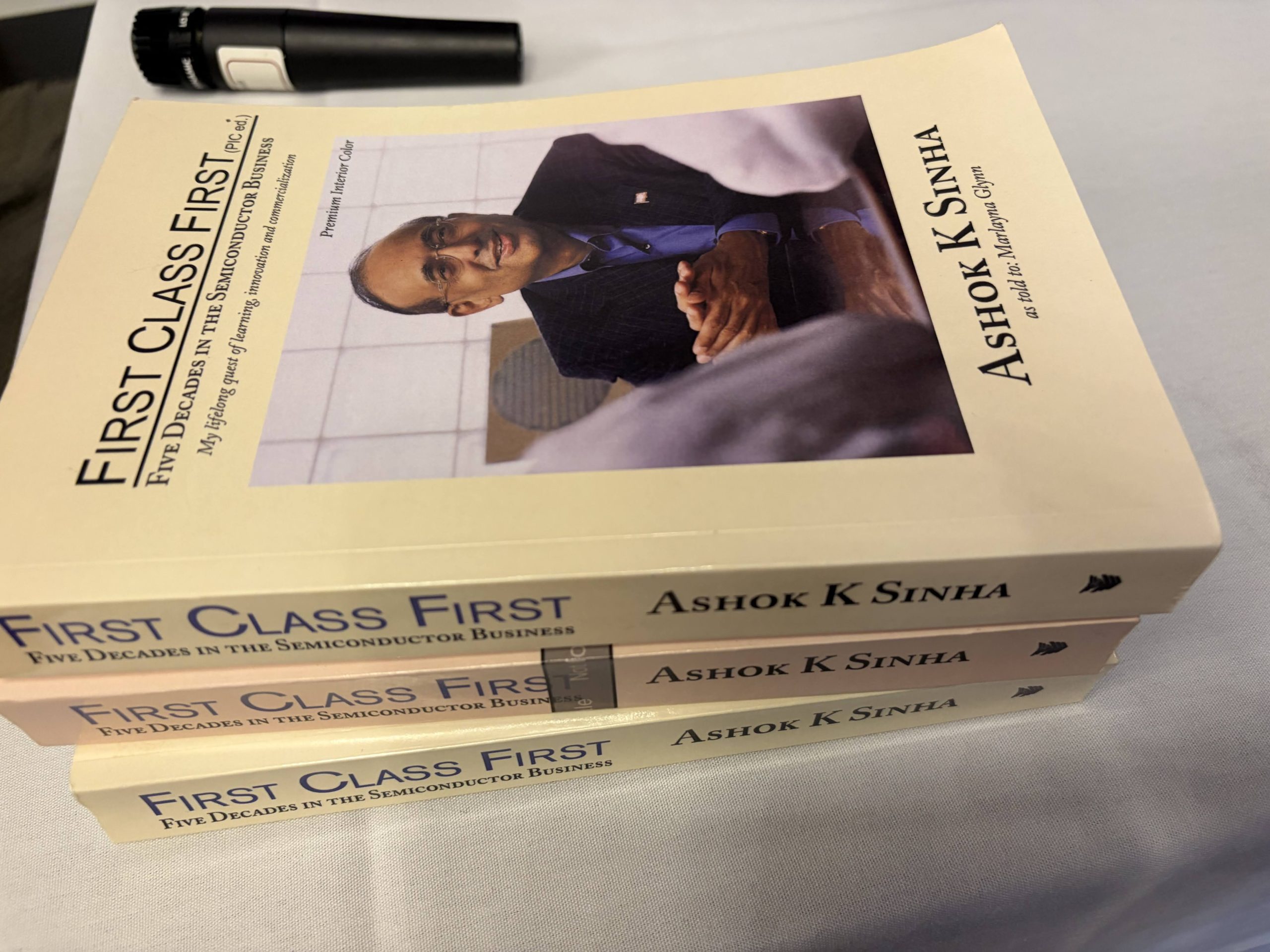
Introducing the memoir, Sinha described experiences across India, the United States, Japan, Israel and China, alongside lessons in leadership, management and spirituality. He called the practical insights collected in it “Ashok-isms.” The name allows a little personal ownership in a career otherwise crowded with institutional acronyms.
The memoir’s stated concern is how to hold to core values while adapting to change. That question reaches back to the young student choosing between academic offers, and forward through the changing demands of research and business. The settings kept changing. Materials science provided continuity; teachers, colleagues and decisions gave the chronology a human shape.
At the alumni celebration, Sinha was introduced as Sunpreme’s former chairman and CEO. The book opens a chapter in which the accumulated experience itself becomes something to pass along. The solar cell needed methods for collecting current. The memoir collects a different kind of output: what its author thinks another person might find useful after the work is done.
Continue the conversation
Explore Sinha on LinkedIn, his research publications and his introduction to First Class First.
Further reading: IISc reminiscences, page 53 · The copper-plating project · 2018 conference highlights · The alumni book event.