David Pogue took a pair of scissors to Michael Zimmerman's battery. This was an unusual courtesy to extend to a visitor, even a visitor making a television programme. A working battery is generally something you charge, discharge and leave intact. Zimmerman encouraged the cutting. The prototype continued to work. For a materials scientist trying to explain a different kind of electrolyte, scissors made an admirably economical lecture aid.
The demonstration appeared in the orbit of NOVA's 2017 programme, Search for the Super Battery. Zimmerman, a Tufts professor and the founder of Ionic Materials, had replaced the familiar liquid electrolyte with a solid polymer. Pogue could see the effect with his own hands. A laboratory idea had become an object capable of answering back.
Zimmerman also described the less photogenic work ahead: reliability testing, scaling production and finding partners to manufacture with lithium metal. When asked about the future, he answered, “Nothing’s 100 percent.” That sentence deserves a place beside the scissors. The demonstration established what a prototype could do. Turning it into something other people could depend on would require another kind of effort.
“Nothing’s 100 percent.”
Michael Zimmerman, 2017
Three degrees, then the inside of things
Zimmerman's training ran through three engineering schools: a bachelor's degree from Rensselaer Polytechnic Institute in 1979, a master's from MIT in 1981 and a doctorate from the University of Pennsylvania in 1988. His doctoral work included research at Cambridge's Cavendish Laboratory. At MIT, he studied within the Fibers and Polymers Division. Fibers were already part of his education long before they became the business of Z-Polymers.
At Bell Laboratories, his work involved semiconductor packaging and materials for early fiber-to-the-home technologies. Packaging sounds like the thing discarded after a purchase. Inside electronics, it is part of the engineering: the materials and processes that allow a device to become a usable product. Zimmerman rose to Consulting Member of Technical Staff, a distinction reserved for the top one percent of Bell's technical community.
He subsequently became Scientific Director for North America at Saint-Gobain, responsible for long-range research and university relationships. The two jobs placed him between scientific possibility and industrial requirements. In that territory, an interesting material has to answer awkward questions about processing, manufacturing and whether it will keep doing its job. Those questions would follow him into the companies he founded.
The company inside the material
In 2002, Zimmerman founded Quantum Leap Packaging, or QLP. Its liquid crystal polymer technology went into electronics, including high-frequency semiconductor packaging. Interplex Industries acquired the business. He later founded iQLP in 2011 as an incubation laboratory for new materials and technologies. The sequence has a practical logic: develop a material, build an organisation around it, then create room for the next material.
The work had more than one destination. Liquid crystal polymer films were relevant to high-speed electronic applications, including antenna and radar systems. Ionic Materials would pursue a different role for polymers, inside batteries. Zimmerman's academic biography counts four startups across his career. These were separate businesses with separate engineering problems, connected by his knowledge of how polymers behave and how to process them.
His teaching continued alongside them. For more than thirty years at Tufts, he has taught materials science and offered students opportunities to do thesis and research work at his companies. He has also been a visiting professor at Imperial College London. A student could encounter materials as a classroom subject and as something being made under commercial constraints. That is a useful education in the distance between a promising result and a finished product.
Mechanical engineering
Doctorate
Electronics materials
Fiber & filament
A roadblock you could hold
At Ionic Materials, Zimmerman focused on the electrolyte: the medium through which ions move between a battery's electrodes. His account of the idea began with frustration at incremental improvements elsewhere in rechargeable batteries. “I realized the electrolyte was the roadblock,” he said. His response was to work on a polymer that could carry ions while remaining a solid.
By May 2018, Ionic Materials was opening an expanded facility in Woburn, Massachusetts. Its supporters included Sun Microsystems co-founder Bill Joy and the Renault-Nissan-Mitsubishi alliance. Pogue attended the ribbon cutting. The battery-cutting footage had acquired a second life, playing repeatedly in the company's lunchroom. Apparently, even a scissors demonstration can become office furniture.
The expansion brought together research, processing, assembly, testing and prototyping. That list is a useful corrective to the idea that invention arrives as a single event. A material may emerge from one insight, but a company needs many activities to make the insight useful. The investors, the equipment and the people doing the testing were part of the battery story too. Zimmerman's polymer had brought them into the same building.
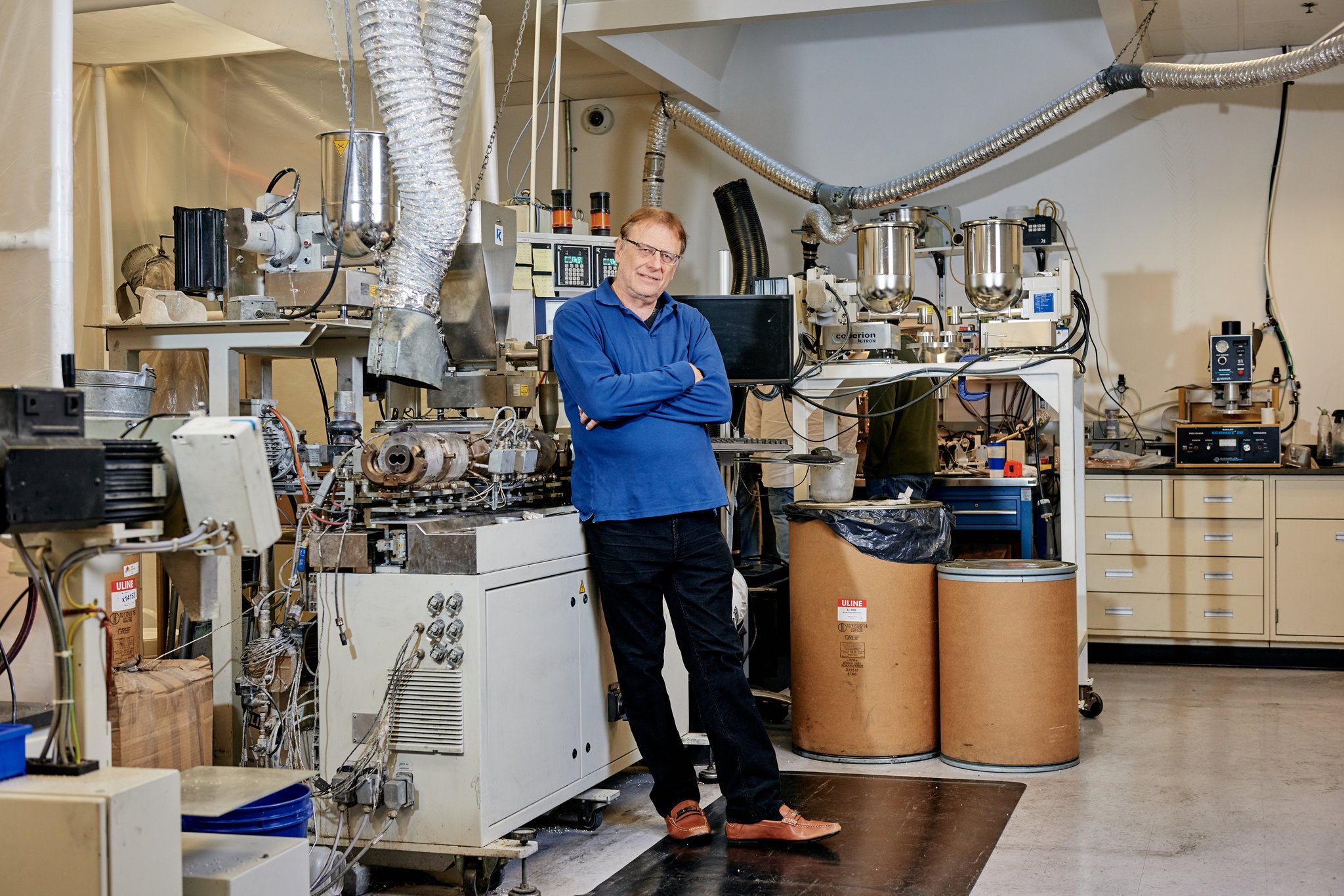
Lowell needed a loom
Zimmerman founded Z-Polymers in 2021. The company was incubated at the UMass Lowell Innovation Hub, developing a material called Tullomer as fiber and filament. Its ambitions included American manufacturing and textiles, with energy applications among the intended uses. A new polymer brought him back to fibers, but now the question included who could turn them into fabric.
The problem became concrete when he needed early prototypes and struggled to find domestic facilities equipped to make them. Advanced Functional Fabrics of America, or AFFOA, helped bridge that gap. Thin woven structures were being developed for fuel-cell applications. In Zimmerman's account, the collaboration gave a small company access to capabilities it could not readily assemble for itself.
The university ecosystem supplied people as well as machines. Z-Polymers employees Keith Smith, Andy Teoli and Matt Guy were UMass Lowell alumni. Guy joined in 2023 as a 3D printing applications engineer. The team used equipment at the Fabric Discovery Center and Core Research Facilities, collaborating with students and faculty. Around Zimmerman, the story becomes a network of technicians, engineers and shared facilities. A fiber does not weave itself, however impressive its chemistry.
- 01Make the material
- 02Build a prototype
- 03Test the application
- 04Scale the process
A development pathway, not a claim that every stage is complete.
A spool widens the conversation
In 2024, Z-Polymers commercially introduced its first Tullomer filament for additive manufacturing. A spool made the material accessible in a form people could put into a printer. In November that year, Zimmerman joined Joel Telling, known online as 3D Printing Nerd, to discuss it on video. The company also invited applications ideas through a contest offering material for projects.
That invitation has a different character from a laboratory demonstration. Pogue could test a specific claim with scissors. Makers could propose objects, choose geometries and see how a filament behaved in their own work. The conversation became less confined to the person who had invented the material. Each proposed application asked a fresh question of it.
In an August 2025 podcast conversation, Zimmerman discussed the challenge of deciding which applications to pursue. The breadth of possibilities created a problem of focus. Desktop printing offers a way to get material into more hands, though the capabilities of the printer and the design of the part still matter. The attraction is tangible: an engineer can make a candidate part and examine it. That is a more demanding encounter than admiring a list of properties.
The work that follows the applause
AFFOA selected Z-Polymers for its PAFF 2.0 accelerator in April 2025. The planned support concerned domestic supply-chain partnerships, manufacturing scale-up and finding textile manufacturers for collaboration. Zimmerman described the next step as “domestic scale-up” and partnerships across the U.S. textile supply chain. The emphasis was on assembling a route to production.
His July 2025 writing on polymer science approached textiles through the performance an application requires. Chemical formulation and molecular structure, in his account, belong in the textile designer's toolkit alongside more familiar manufacturing choices. For Z-Polymers, that work included ultra-fine fibers and thin woven structures intended for fuel cells and electrolyzers. A fabric could be an engineered component inside an energy system.
His public LinkedIn commentary also returns to the economics of use. A cheap kilogram, he argues, can become expensive once tooling, production speed and rejected parts enter the calculation. This is an argument for evaluating a material in the process that uses it. A purchasing decision has to survive the factory, where the price label is only one participant in the discussion.
From a Lowell bench to a Japanese partner
In March 2026, Kureha invested in Z-Polymers through Kureha America as part of the company's seed financing. The companies also entered a joint development agreement. Kureha brought industrial manufacturing and international commercial experience; Z-Polymers brought its liquid crystal polymer platform. The stated aim was to accelerate the development and commercialisation of high-performance fibers.
The announcement described Z-Polymers as moving toward industrial-scale production. That wording leaves room for the work still being done. Filament had already reached the market, while the broader fiber platform was being developed with a manufacturing partner. An investment and a development agreement are steps in that process, each giving the inventor more people and capabilities to work with.
By August 2026, Zimmerman was spelling out the remaining engineering obligations: independent qualification, manufacturing consistency, quality control and application testing. He also explained Tullomer's directional behavior. Alignment helps it carry load along a printed filament, while strength across layers is lower. Designers must account for that difference. He described a role for Tullomer within hybrid structures, rather than a universal replacement for existing materials. The company's next chapter would be written in those choices.
Zimmerman describes higher strength along deposited filament and lower properties across layers. Part design must follow the load.
Schematic illustration; no numerical performance comparison.What the professor gets out of it
There is a personal reward beneath all this processing equipment. Zimmerman has spoken about the satisfaction of building a team, obtaining funding and giving people interesting jobs. “I've been able to develop new ideas and build a team,” he said. The sentence puts colleagues alongside ideas. It gives the founder's career a human scale without asking a molecule to carry the entire biography.
He also talks to students about the risk involved in a startup, and about recognising an appetite for that work in some of them. Teaching and founding offer different ways to extend an idea beyond its originator. One supplies people with knowledge; the other supplies a place to use it. Across Zimmerman's career, those activities have continued together.
The scissors remain a memorable image. So does the loom, and so does the spool that somebody else can load into a printer. Each changes the audience for an invention. At Z-Polymers, Zimmerman is working toward another change of audience: manufacturers who need a dependable material, in useful quantities, for a particular job. The experiment continues when they begin making things with it.