A chief executive can learn a surprising amount from a budget. Who wrote it? Who gets to change it? Who has to explain the result? For Sundaram “Naga” Nagarajan, those questions reach into the machinery of management. At Nordson, division leaders bring forward their own plans. The chief executive asks questions, tests the assumptions, and expects them to deliver. A spreadsheet becomes a revealing document about trust.
That arrangement is an interesting choice for someone whose education concerns the behavior of materials under demanding conditions. Nagarajan studied mechanical engineering in India, completed graduate work at Auburn University, and built his early career in welding. His professional life has moved from the physical problem of joining materials to the organizational problem of holding a dispersed industrial company together. Both require attention to what happens at the point of contact.
He became Nordson’s president and chief executive on August 1, 2019, succeeding Michael F. Hilton. The company, based in Westlake, Ohio, makes precision equipment used by other manufacturers. Its name may never appear on the cereal box or electronic device a consumer carries home. Its equipment helps those objects become possible. It is a business with considerable reach and remarkably little need to introduce itself at the supermarket.
How do you keep a global company focused while letting its divisions make the calls?
Before the corner office, the welding arc
His 1991 doctorate at Auburn supplies a wonderfully specific clue to his beginnings. His dissertation was titled Modeling and Sensing of Thermal Phenomena in Arc Welding Processes, directed by Bryan A. Chin. He had arrived at the doctorate with a South Gujarat University bachelor’s degree and a 1988 Auburn master’s. Long before quarterly earnings calls, there was a research problem involving heat, measurement, and an industrial process.
The sequence matters because it gives his later vocabulary some substance. Precision, process, and measurement are ordinary working terms in the world he came from. His qualifications eventually included an MBA from Wright State University, alongside the materials-science master’s and doctorate. The combination put technical training and business training on the same résumé, with years of manufacturing work between the university milestones.
His early work involved developing welding consumables at Hobart Brothers. The business became part of Illinois Tool Works in 1996, beginning a long association with the group. By 2006 he was group vice president of ITW’s Welding Group; in 2008 he became group president of Welding International. Larger responsibilities followed. His last ITW assignment was executive vice president of its Automotive OEM segment, a business with $3.3 billion in revenue when Nordson announced his appointment.
This was a gradual education in scale. Welding and automotive manufacturing bring different customers and buying patterns, but both demand equipment and components that perform as promised. Nagarajan arrived at Nordson with experience running global operations and serving varied industrial markets. He also arrived as an outsider taking responsibility for a company with an established history. The task included understanding what was working before deciding what needed to change.
- 1991Doctorate at Auburn
Welding consumables - 2008ITW Welding
International - 2015ITW Automotive
OEM segment - 2019President & CEO
Nordson
A welcome sign, then a harder question
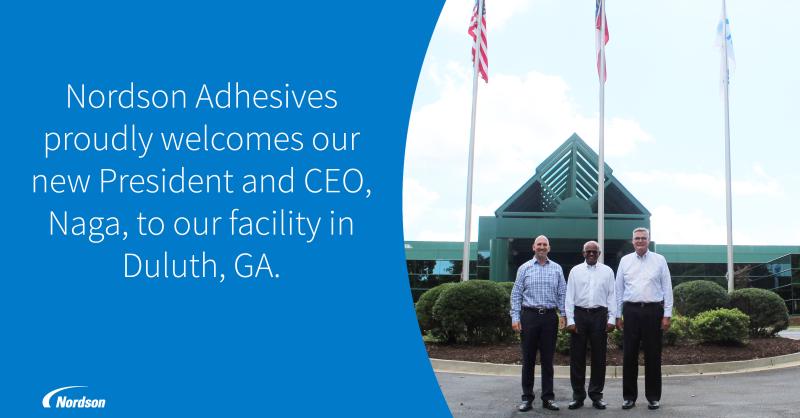
A photograph from his first weeks at Nordson places him outside the adhesives facility in Duluth, Georgia, standing between two colleagues beneath the flagpoles. The accompanying welcome celebrates employees, customers, and technology. It is an unceremonious introduction to a large job: three people outside a building where the work happens. Corporate arrivals rarely require a red carpet when there is a perfectly serviceable pavement.
Nordson had been founded in 1954 around airless spray technology. Over the decades, its reach widened into dispensing, coatings, and inspection. Nagarajan’s challenge was to carry that accumulated knowledge into another period of growth. An inherited business comes with advantages that a new leader can damage by treating every established habit as a problem waiting for a speech.
In his early assessment, the difficulty was that strong profitability coexisted with slowing growth. The practical question became how to get the business moving faster while keeping its direct relationships with customers. The division budget offers one answer. The people who know a market have a hand in choosing its products, customers, manufacturing arrangements, and priorities. They also have to account for the consequences.
“Entrepreneurial culture starts with who gets to make the decision.”
Sundaram Nagarajan · 2021
The sentence strips a fashionable management word down to something observable. Look at the decision, then look at the person allowed to make it. Giving a manager responsibility is easy to announce. Giving that manager room to decide makes the announcement rather more expensive.
The discipline behind the freedom
Nordson launched its Ascend Strategy in 2021. Its three connected elements are the NBS Next growth framework, an owner mindset, and winning teams. Behind the corporate names is a comprehensible proposition: identify promising customers and products, put resources behind them, and equip the people closest to the work to act. Local authority sits within a shared method for choosing where effort goes.
NBS Next uses data to distinguish the customers and products contributing substantially to revenue and profit. The intention is to invest more heavily in those opportunities and simplify the rest. There is a useful tension here. A division can have freedom over its choices while still being expected to justify them. The framework makes that justification more concrete than a stirring declaration that everything is a priority.
By 2022, Nagarajan was describing divisions using the framework to allocate scarce resources during supply constraints. He also reported its adoption beyond the pilot businesses during visits to North American and European sites. That detail is less glamorous than unveiling a strategy. It is also where a strategy starts becoming a working practice: teams have to know which order, customer, or product deserves attention when capacity is limited.
A later example makes the consequences easier to picture. In 2024, Nordson’s X-ray inspection team introduced the Quadra Pro manual system in under a year. Customer feedback helped simplify the product, and reported lead times fell from six months to two weeks. Those are company results rather than a personal invention by the CEO. They nevertheless offer a tangible test of the operating approach he has championed: can a team turn its knowledge into a faster response?
NBS Next identifies customer and product opportunities.
An owner mindset puts decisions close to the work.
Team development builds the capacity to carry it forward.
A wider circle of obligations
There is another side to Nagarajan’s public career. He serves on Wesco’s board and is involved with Greater Cleveland Partnership, Manufacturers Alliance, Hawken School, and Indo-American Community Services. Earlier commitments included the American Welding Society Foundation and the Hobart Institute of Welding Technology. The connections run through industry, education, and civic life, rather than stopping at Nordson’s organizational chart.
His support for Loyola University Chicago’s Baumhart Center reflects an interest in how business strategy connects with social purpose. In a short video, he discusses why people want to work for companies with aims extending beyond the immediate business. That concern has a practical bearing on an industrial employer. Recruiting a capable engineer involves a promise about the work and about the organization in which that work will take place.
The community connection is longstanding enough to show up in the schedule as well as the biography. The May 2026 IACS Executive Leadership Conference listed Nagarajan as moderator for a fireside conversation with Avient chief executive Ashish Khandpur. It is a different position from delivering an earnings presentation: asking another leader questions, helping a room examine the future, and participating in a professional network that includes the next generation of executives.
His public comments on succession are similarly forward-looking. “I will do my best to develop an internal candidate,” he said. For an executive recruited from outside Nordson, that is a noteworthy ambition. It means building leadership capacity that can survive his own departure. The calendar of a CEO is full of immediate demands; preparing somebody else to take the job requires attention to a date that may still be uncertain.
The next generation of leaders needs room to practice before it inherits the job.
An implication of Nagarajan’s stated aim to develop an internal successor.The next test is already on the order book
By August 2026, Nordson had reported quarterly sales of $818 million for the period ending July 31, up 10 percent from a year earlier. Backlog was 35 percent higher. The company raised its full-year sales forecast to $3.035 billion-$3.075 billion. That last number remained a forecast. The quarter supplied evidence of progress; the annual outcome still depended on work to be completed.
The earnings discussion returned to familiar territory: customer requirements, delivery, and the applications a manufacturing business can serve next. Nagarajan described early consideration of industrial applications connected with defense and data-center construction. He framed them as early possibilities. For someone selling precision to other manufacturers, the distinction between a promising application and a shipped order is consequential.
His route offers a useful way to understand the job he now holds. The dissertation, the welding businesses, the automotive assignment, and Nordson’s divisions all involve making complicated work repeatable. At the corporate level, he has to decide what should be standardized and where judgment should remain local. Too many instructions can slow the people with the useful knowledge; too few shared expectations can make a large organization difficult to steer.
The budget comes back into view. A division leader writes a plan. Nagarajan questions it. The leader takes responsibility for delivering it. There is room in that exchange for ambition, disagreement, and an awkward conversation at the next review. After decades working with machines and materials, he has placed a substantial bet on what happens when people are trusted with a decision and expected to answer for it.
Quarter ended July 31, 2026. Values rounded. Full-year sales guidance of $3.035bn-$3.075bn was a forecast as of August 19.