A customer with only one supplier has a reason to worry. A supplier with no competitors has a reason to celebrate. Johnson Lee has spent part of his career trying to reconcile those two perfectly reasonable positions. His solution involves an invitation that executives do not ordinarily rush to print: let other companies into the business.
When Lee returned to Tufts in April 2026, the E Ink chief executive described a company willing to license technology and sell materials to competitors. Buyers wanted options. Providing those options could help the market grow. “If there’s no competition, we’re going to create it ourselves,” he said. In a business lecture, that is a sentence capable of making someone put down their sandwich.
It also offers a way into Lee’s career. The familiar object is the e-reader, its page quietly waiting for a thumb. The less familiar story concerns the people, contracts and factories required to get that page into the world. Lee has worked on those connections for two decades. Some of his decisions make more sense when viewed from the customer’s side of the desk.
A screen with time on its hands
Start with a useful peculiarity of the material. Electrophoretic displays move charged pigment particles using an electric field. The particles produce an image by changing what the viewer sees at the surface. E Ink’s electronic paper reflects the light around it, much as a printed page does.
Its other trick is persistence. An image can remain after power to the display is removed. Bistability is the technical name. On a reading device, the display needs energy to change the page; holding the page requires none. Radios, processors and lighting can still use electricity. The distinction matters when someone promises a screen that consumes nothing: ask which part of the device they mean.
This suggests a particular sort of customer. A price may sit unchanged for hours. A room sign may keep the same message all afternoon. A page should wait patiently while its reader gets distracted. Lee’s opportunity lies partly in finding places where information needs to remain visible between updates. A display can earn its keep while apparently doing very little.
An education below the library
Lee’s first experiments at Tufts concerned a different kind of information. Arriving in 1994, he encountered the internet, learned about computers and began coding in the library’s basement lab. He built software to gather online news tips and track and trade stocks. In his alumni statement, the useful education extends well beyond the classroom.
After graduating in 1998, he launched a startup. His previous occupations include founder and CEO of Ohfish Communications Inc. Tufts identifies his degree as a BA in economics; E Ink’s governance disclosures also list electrical engineering. The basement experiment is a fitting early scene for someone whose later work would sit between technical possibility and commercial demand.
In 2006, he joined the business now called E Ink Holdings as director of research and development for ePaper systems. His subsequent assignments included applications engineering, quality control, the ePaper business unit and business development. These are different ways of discovering whether an invention survives contact with a customer. A clever material still needs to be integrated, manufactured and delivered.
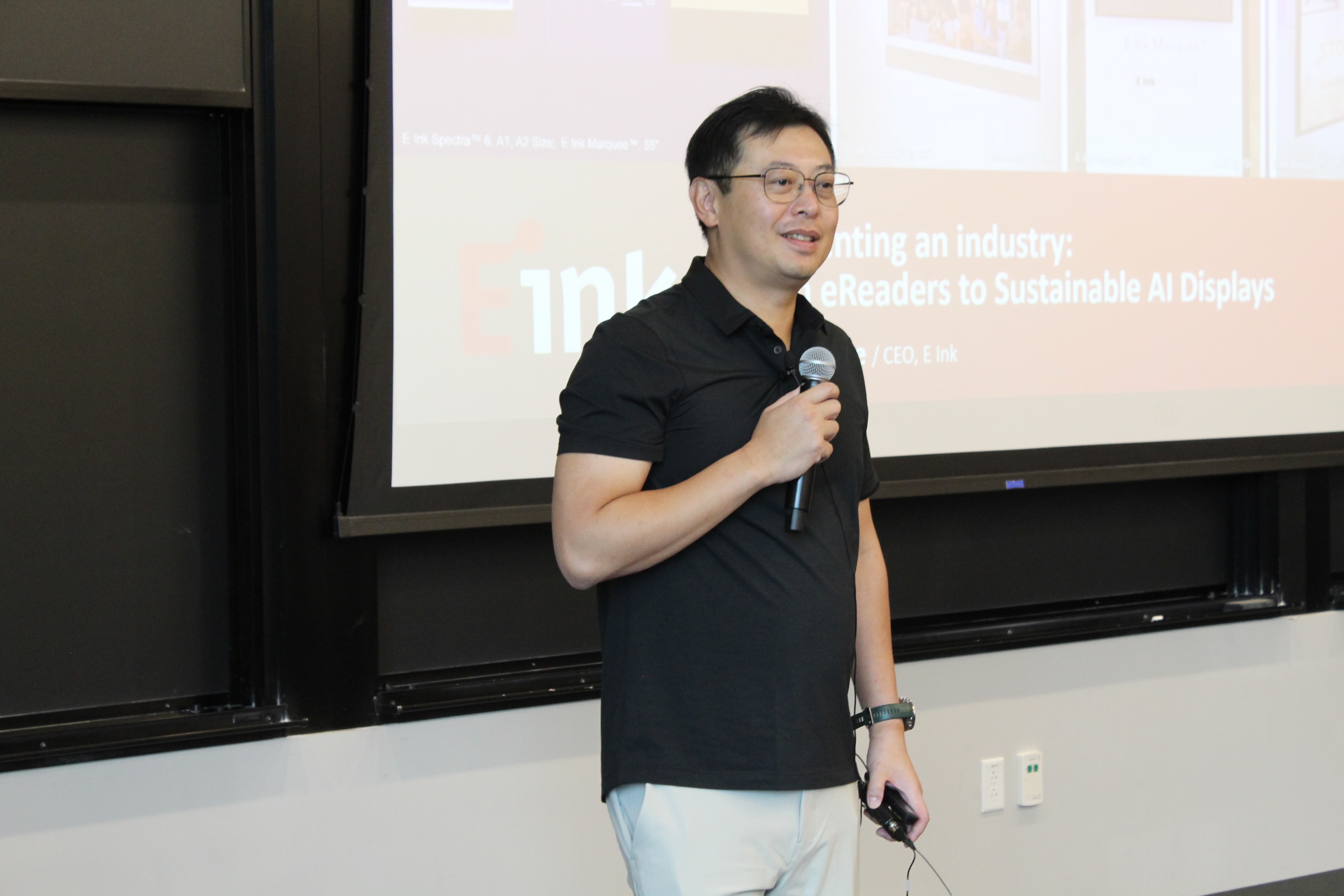
He was involved when Taiwan’s Prime View International acquired Massachusetts-based E Ink in 2009. The two businesses already knew each other as customer and supplier. Their combination brought together people accustomed to working from opposite ends of an order. Lee became president in June 2014 and CEO in December 2019, after responsibilities that had expanded across sales, operations, research and finance.
The shelf is a stern customer
Reading devices gave electronic paper a recognizable home. They also left the business dependent on a particular application. Retail offered another route. An electronic shelf label can receive a new price without a worker replacing a printed ticket. Across a store, that apparently modest convenience becomes an operating decision involving installation, maintenance and the frequency of price changes.
Lee has described the move into shelf labels as diversification. By 2016, the company had identified them as a development priority. To expand, E Ink needed businesses capable of making the modules and systems that retailers would actually purchase. The material was only one part of the transaction. Someone had to make the rest of the machinery work.
There were awkward intervals. In the first quarter of 2024, E Ink’s net profit fell 25 percent from a year earlier as customers worked through excess inventory during a transition to improved color labels. A product can have a persuasive purpose while its customers have cupboards full of the previous version. Manufacturing has a way of inserting that detail into a growth story.
Waiting for the mangoes
Former E Ink executive Harit Doshi supplied a memorable comparison for another application. Lee was incubating a signage business, and Doshi took the general manager role. The team developed 32-inch and 42-inch electronic paper displays, formed partnerships and raised funding. Growth required patience. Doshi recalls Lee repeatedly asking about progress.
His answer was a mango tree. It takes years to grow; once established, it can produce fruit for years. That was Doshi’s analogy, offered to the executive waiting for results. It neatly captures the problem of a new display market: engineering, commercial relationships and customer adoption have different clocks. A management team has to pay for all three while waiting for them to agree.
By March 2026, Lee was discussing a much larger physical commitment. E Ink planned up to NT$8 billion in capital expenditure for the year, compared with NT$5 billion the year before. A new H6 production line in Hsinchu was intended for large displays. Those were announced plans. They show the scale of the capacity decision behind a market often introduced with a handsome demonstration panel.
Capital expenditure • 2026 announced upper limit, not completed spending.
Room for the other supplier
Lee’s licensing experience also came from an uncomfortable manufacturing constraint. At Hydis, the Korean LCD business he has chaired since 2012, the company lacked the next generation of factories needed to keep competing through production. Its business shifted toward licensing. Intellectual property offered a route to revenue when a new factory was beyond the practical plan.
The ePaper module model addresses a related question: where should E Ink put its own resources? In the retail and connected-device market, partner manufacturers can use its display materials and compete for module business. E Ink retains a different, more integrated approach in consumer electronics. The arrangements reflect different markets, with different buyers and ways of getting products made.
The attraction for customers is straightforward. Choice gives a buyer alternatives when delivery, price or product requirements change. For a materials supplier, more capable manufacturers can mean more routes into applications it could never serve alone. The arrangement still requires commercial discipline. Sharing a market involves deciding which work to keep and making the work offered to partners worth their trouble.
“Get E Ink everywhere”
Johnson Lee, 2022
Lee’s compact description of his ambition leaves plenty of work concealed inside “everywhere.” A partner needs usable technology, a reliable supply and a reason to invest. Customers need a product they can buy again next year. His strategy is interesting because those mundane requirements occupy the center of it. They determine whether an attractive new application becomes a repeat order.
Paper, dressed for the evening
Some destinations are less mundane. E Ink and BMW have spent years developing color-changing vehicle surfaces. At the Beijing Auto Show in April 2026, the BMW iX3 Flow Edition demonstrated Prism integrated into the bonnet. E Ink described the implementation as series-ready following automotive testing. It was a development milestone, with the demands of vehicle engineering attached.
Then came Paris. On September 29, 2026, Kunihiko Morinaga’s ANREALAGE presented six color-changing dresses using E Ink Prism 3 in its Spring/Summer 2027 collection. Each carried approximately 1,000 to 2,000 individual elements, arranged like scales. The material that makes a reading page possible had found its way into a garment. Paper had acquired rather ambitious evening plans.
Cars and clothes ask different things of a surface. Their appearance also belongs to a designer, a driver or a wearer. For Lee’s every-surface ambition, that means letting other industries set the requirements. The applications make a colorful demonstration of the partnership model: a materials business supplies a capability, and someone with another craft decides what to do with it.
The next bill comes due
The current push reaches behind the finished display as well. In September 2026, E Ink invested in NewCopper, a startup developing conductive copper ink, and Lee joined its board. Copper offers a lower-cost alternative to silver in printed electronics, though oxidation has complicated its use. The investment creates an opportunity to evaluate the material alongside E Ink’s coating processes.
That is a less photogenic extension of the business than a dress, but a revealing one. Scaling electronics depends on materials that can be made consistently and integrated into production. NewCopper brings Lee back to the distance between a promising laboratory result and something a manufacturer can use. Even an ambition as expansive as every surface eventually encounters a coating line.
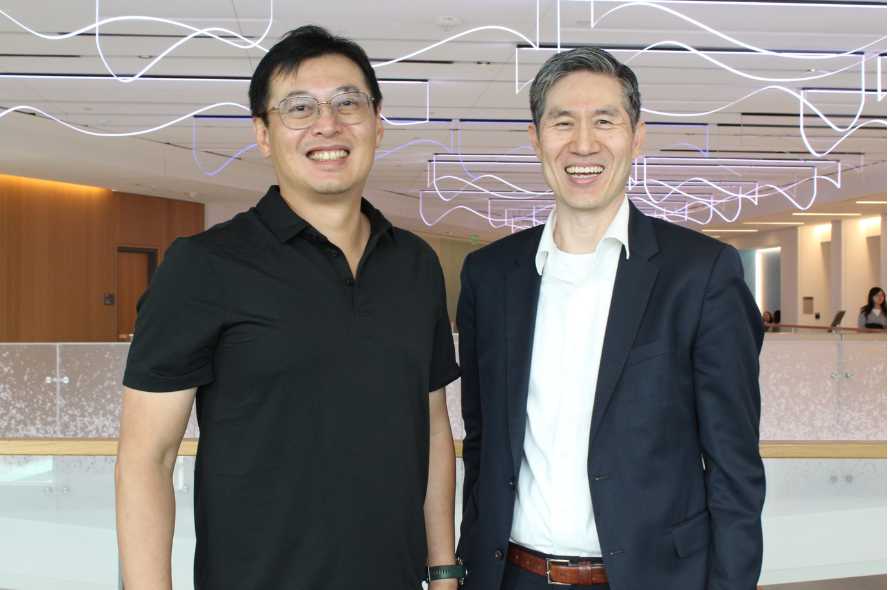
At Tufts, his discussion turned toward the electricity demands of AI and the place of low-power technology. The campus visit ended with a gift from the engineering dean: a cutting board handcrafted by students in the Nolop FAST Facility. After a lecture about programmable surfaces, Lee received a surface whose appearance required no programming at all. It was an agreeable reminder that a material earns its place by being useful.
Keep the conversation going
- Watch: Johnson Lee’s 2026 Tufts lecture
- Johnson Lee on LinkedIn
- E Ink: company and technology
- Lee’s Tufts alumni statement
- A conversation with Johnson Lee, 2022
- E Ink’s NewCopper investment, September 2026
- E Ink and ANREALAGE in Paris, September 2026
- E Ink’s blog
- E Ink on YouTube · company channel
Reported through October 22, 2026.