Stephen Chen left a senior job in the phone business without a startup idea. That detail is worth keeping. The co-founder and CEO of URSROBOT did not walk out of Compal carrying a secret blueprint for the future of grass. His retirement as executive vice president took effect on June 1, 2018. The next chapter still needed a subject.
He eventually chose a task with an unusually reliable supply of repeat customers: mowing. Grass has a useful quality for anyone building a business around cutting it. It declines to consider the matter settled. A finished lawn is simply a lawn that will need attention again.
Today, Chen leads a company building outdoor service robots, including the NEXMOW commercial mowing range. His route there offers a more interesting story than the familiar tale of an inventor waiting for everyone else to catch up. He had already tried approaching robotics from the technology end. He would later acknowledge that the order had been wrong.
The retirement with no script
Before URSROBOT, Chen had been general manager of Compal Communications, the handset company that became part of Compal. During that earlier career, he had pursued service robots, then withdrawn. His explanation was blunt: impressive laboratory technology had been turned into products and pushed toward customers. The missing first step was a sufficiently clear customer problem.
After leaving Compal, he took on a convening role in Taiwan’s service robot alliance in 2018. Robotics became the field for his next venture. URSROBOT followed in 2019. The important change was in sequence: identify demand, understand the job, and develop the technology to do it.
That admission gives his second attempt a particular character. Experience did not merely supply confidence. It supplied a mistake worth avoiding. A robot could be technically accomplished and still leave the person paying for it wondering what, exactly, had improved.
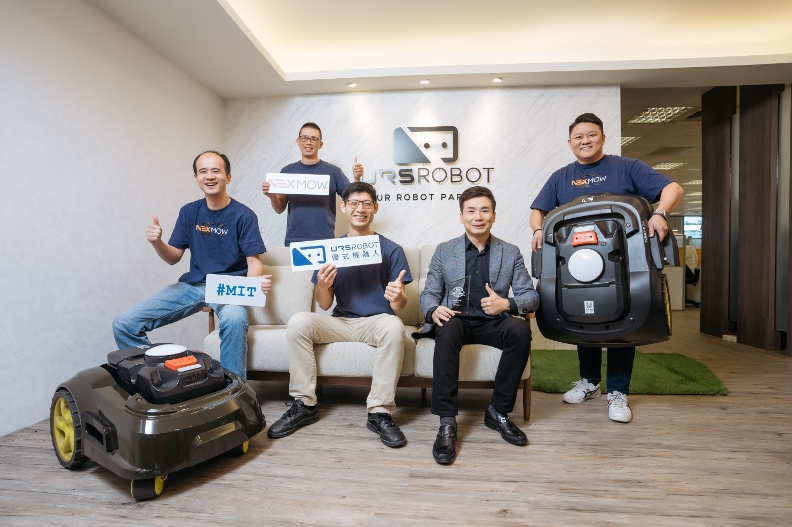
A lawn is an exacting customer
The company brought together people with more than two decades of communications and smart device experience. Its team could draw on software, connected devices and the difficult business of making hardware behave consistently. Chen’s public account of the opportunity places robotics after the computer and communications eras, another field in which those capabilities might find work.
The choice of commercial mowing kept that large ambition attached to an ordinary purchase decision. A landscape crew needs a machine that fits into a working day. It must get to the property, cover the assigned ground and leave people able to complete the other jobs that make the visit worthwhile.
By September 2020, the young company’s machines had been tested at more than 25 Taiwanese sites, including the Lanyang Museum and the National Science and Technology Museum. These were places with their own grounds and practical demands. The development process had moved outside, where the customer’s property could answer back.
Chen described Taiwan as a useful proving ground for the American commercial market. Rapid growth in humid weather and uneven surfaces left after storm cleanup complicated the work. He spent more than a year developing locally before that overseas push. The garden, it turned out, had a fairly demanding examination paper.
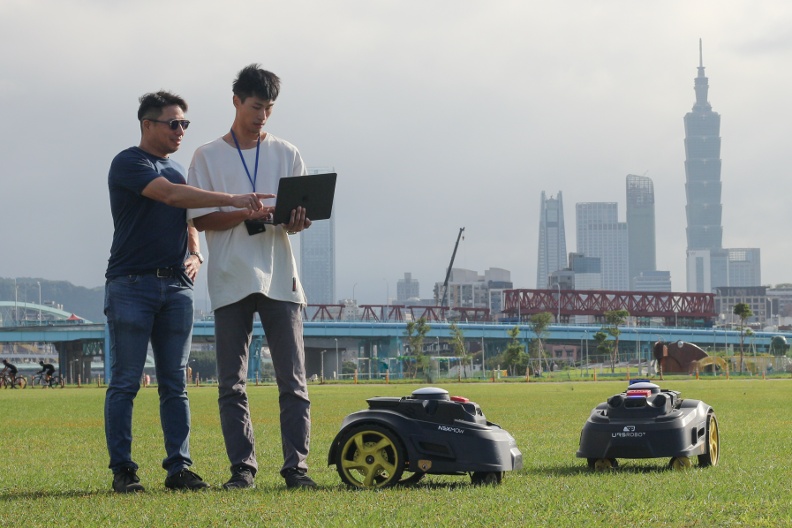
Keep the map. Move the mower.
The NEXMOW approach makes particular sense when viewed through the eyes of a crew visiting several properties. The M1’s published specifications describe virtual boundaries stored in the cloud, allowing machines to move between sites without installing boundary wire. The map stays available even when the mower leaves.
Its navigation combines cellular connectivity and real-time kinematic positioning, known as RTK. The manufacturer specifies two-centimeter positioning accuracy. That number describes the system’s stated capability; a property still presents the practical questions of terrain, obstacles and deployment.
The same data sheet lists a removable battery, up to six hours of runtime and app controls for cutting height. Those details concern the working day as much as the cutting blade. A battery that can be exchanged changes how an operator thinks about the next assignment. A saved boundary changes what has to be repeated on a return visit.
- 01MapSave a virtual boundary.
- 02MowDeploy the robotic crew.
- 03MoveTake it to the next site.
A simplified illustration of the company’s commercial mowing workflow.
URSROBOT’s description of the business explicitly places its robots alongside professional landscapers. People can redirect their time to other duties while the machines handle mowing. For Chen, that makes the unit of progress larger than a single autonomous vehicle. The relevant question is what happens to the whole crew’s work.
“At its core, the landscape industry is a service business.”
Stephen Chen, 2022
He used that formulation when discussing the landscaping industry in 2022. His wider argument connected equipment, education and collaboration to the needs of people and the places they maintain. It is an instructive emphasis for someone whose earlier robotics effort had started with what the laboratory could produce.
The people between invention and purchase
Chen’s attention to distribution is another part of the story. In July 2023, URSROBOT announced a group of American dealer partners. Among the named businesses were Gardenland Power Equipment, Automated Outdoor Solutions and Pape Machinery Agriculture and Turf.
He explained that the search had included two aims: local sales and service, and feedback on product design. A dealer could help sell a mower, then help explain why the next version needed to be different. That is a useful arrangement when a product must satisfy people who already know their work.
In a March 2024 update, Chen described visits to dealers in Dallas, Atlanta and Auburn. His account paired those conversations with changes to slopes and terrain handling, mowing patterns in the app, and obstacle avoidance. The topics were specific. Nobody needed a philosophical debate about whether a lawn ought to contain an unexpected object.
The connection between listening and revision is the interesting part. He was describing product development as an ongoing exchange with the people deploying the machines. The company’s premise could survive that exchange; individual decisions about hardware and software still had to earn their place.
A familiar chip, a different job
The next generation took Chen back toward an industry connection his career makes easy to understand. NEXMOW M2 used Qualcomm’s QCS6490 processor for edge AI, including computer vision for detecting objects and avoiding obstacles. URSROBOT announced its Equip EXPO debut in Louisville in October 2024.
The company also described an eCrew system capable of managing up to ten M2 units simultaneously. That is a stated fleet capability, rather than a promise that every operator should buy ten. The attraction is flexibility: several smaller machines can be coordinated around a property’s work.
The fleet capacity announced in October 2024. A product specification, not a sales figure.
In January 2025, URSROBOT brought M2 to the Taiwan Pavilion at Eureka Park during CES. A subsequent company update included comments from both Chen and Qualcomm business development executive Erick Hong. The collaboration placed a connected hardware veteran and a semiconductor supplier around a surprisingly earthy assignment.
For all the exhibition lighting, the use case remained recognizable. A machine needed to see what was in its way, choose a route and keep working. Chen’s move into robotics had carried his communications background into a setting where the finished result could be inspected by walking across it.
Back to university, with three robots
On August 25, 2025, Chen’s work made a return to National Taiwan University, where he had studied electrical engineering. The university’s sports office and mechanical engineering department began a collaboration with URSROBOT. The company would provide three mowing robots for campus maintenance and teaching.
The machines were also intended as platforms for the department’s intelligent vehicle design course. Students and faculty could modify hardware and software, bringing their own designs to equipment doing a real job outside. Chen described student creativity and practical engineering as forces that could keep the campus experiment developing.
There had been an earlier return, too. NTU’s 2021 electrical engineering colloquium schedule listed him for a talk whose Chinese title used surfing as a metaphor for catching the next wave. It is a pleasing choice for an executive who had moved from phones to machines that travel at lawn speed. The metaphor concerned a career and an industry; the timetable makes no claim about his abilities on a surfboard.
The 2025 partnership also set out plans to explore patrol robots with sensing and camera systems. Those plans extended the campus work beyond mowing while keeping it tied to identifiable tasks. The machines already had somewhere to go, people to work with and a setting in which proposed improvements could be tested.
Chen began this chapter without a subject. He now has an unusually concrete one: the work waiting outside, and the people responsible for finishing it. At his old university, three robots offer students the chance to alter a machine, watch the result and try again. The lawn will be available for the next lesson.
Follow the work
URSROBOT · company websiteStephen Chen · LinkedInWatch · URSROBOT product video on YouTubeThe early venture · 2020 interviewFieldwork in Taiwan · 2023 interviewM2 and Qualcomm · October 2024 announcementThe campus collaboration · National Taiwan UniversityThe video presents the company’s products. Chinese-language interviews and university coverage are linked above.