There is a particular indignity in a golf ball. It is small, ordinary, and liable to be left exactly where a mower wants to go. A human operator sees it and steers around it without a thought. A robot that stops for every one turns a labor-saving plan into a scavenger hunt. URSROBOT says users of its first NEXMOW mower asked for fewer such interruptions. Its follow-up, the M2, uses a camera system to identify and avoid little surprises, with golf balls serving as a pointed demonstration. The interesting part is not the ball. It is what the ball reveals about selling autonomy to people who have a schedule to keep.
- URSROBOT builds wire-free robotic mowers for professional landscapers and grounds teams.
- A saved map can direct up to ten mowers in one area; the crew can move to trimming, inspection or other work.
- Published starting prices run from $5,649 for M1 to $7,899 for M2, before a charging station or cloud fee.
- The M2 adds vision-based obstacle avoidance after early field experience exposed needless stops.
A map instead of a buried wire
The company began in Taiwan in 2019, founded by people with experience in communications and smart devices. Stephen Chen, its chief executive and co-founder, was looking at an old outdoor chore through a connected-device lens. URSROBOT opened a San Jose office in 2022 to handle American sales and support. The first concrete application of its broader outdoor robot ambitions was mowing - a job with predictable repetition and an audience of employers who must find people to do it.
A traditional robot mower often lives inside a fixed perimeter. NEXMOW's commercial proposition is more portable. A worker uses a Virtual Marker to define a boundary and keep-out zones; the map is saved in an app. RTK satellite positioning and 4G connectivity then help the mower follow planned lines rather than wander. For a contractor who cuts property belonging to someone else, avoiding a buried boundary wire is more than technical neatness. It means less installation on a client's land and a better chance of moving the same equipment to the next job.
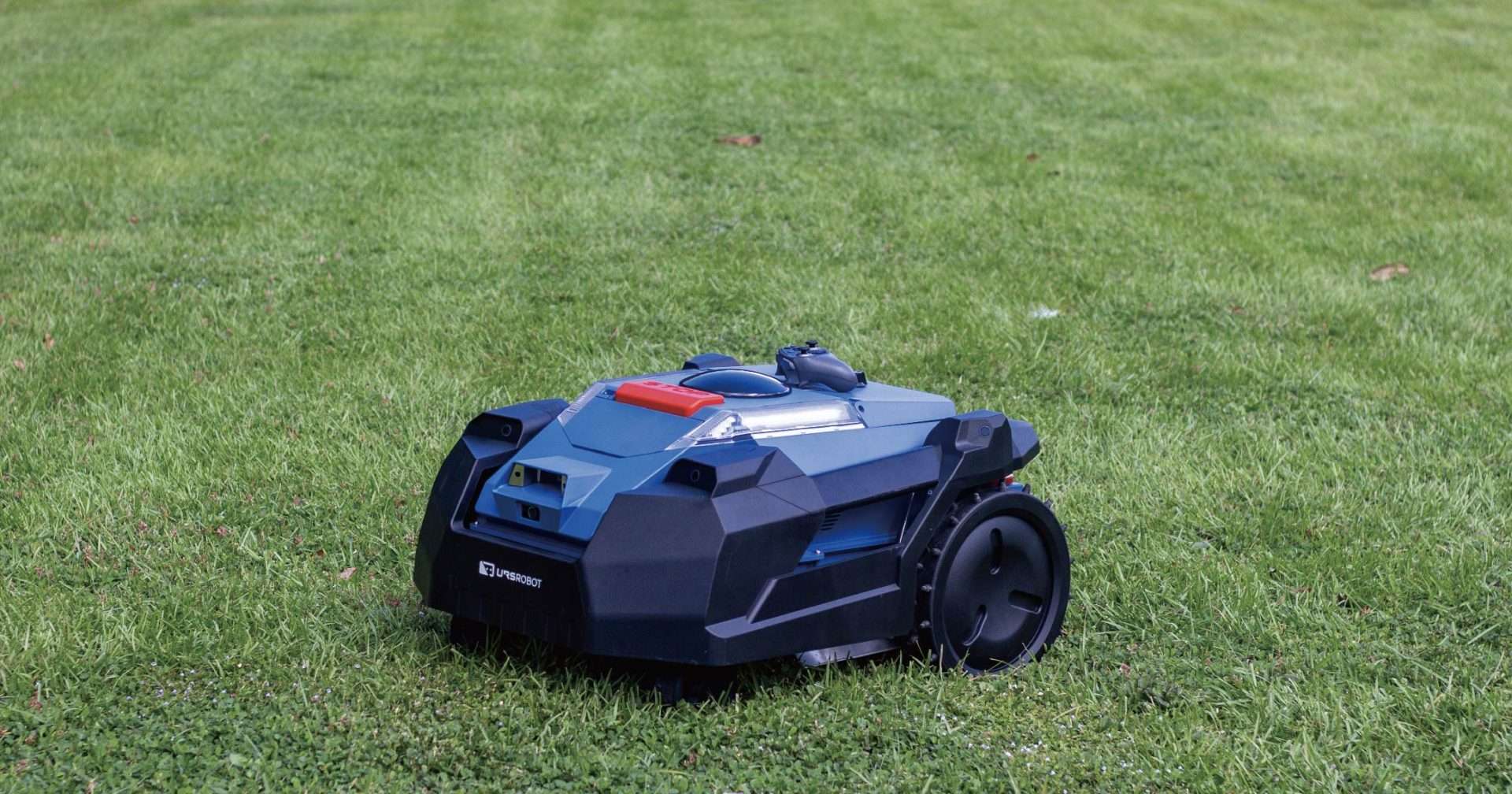
The first mower, M1, is listed from $5,649. M1S starts at $6,779 and is specified for steeper slopes and a lower minimum cut. M2 starts at $7,899 and adds AI vision, alongside bumper and ultrasonic sensing. Each has a 13.8-inch cutting width. These are not miniature ride-on mowers; they work by returning to a defined task repeatedly. URSROBOT says as many as ten can work in one mapped area. That is the important number, because one small deck can look faintly comic beside a sports field. Ten coordinated decks begin to look like a staffing decision.
The machine is only half the sale
The buyers are professional landscapers, golf courses, schools, campuses, municipalities and property managers. They are buying a way to reassign a repetitive task. BellaVista Landscape Services reported using a NEXMOW on a nine-acre client property three days a week. At Dublin Ranch Golf Course, superintendent Danny Fielder says the machines have been useful in wet winter conditions when he cannot get other mowing equipment onto the course. At Del Mar High School, plant manager Alonso Rodriguez says an M2 fleet can work near classrooms during school hours without noise complaints and leave his crew more time for landscaping and safety checks. These are customer accounts, not controlled studies, but they show what the product is being asked to do.
“We couldn’t do it without them, especially in the winter when we get so much rain that I can’t get any other mowing equipment on the course.”Danny Fielder / Dublin Ranch Golf Course
It also explains why URSROBOT needed dealers. Its 2023 US launch named nine retail equipment partners, including SiteOne Landscape Supply and Gardenland Power Equipment. Chen said the company wanted local sales and service, along with product-design feedback from people who knew the customers. A mower that cannot be repaired conveniently is not an especially good employee. Distribution, maintenance and training are therefore part of the product, even if the most photogenic part has wheels.
The website lists a Virtual Marker from $2,241. It also says mower prices exclude a charging station and cloud fee. The public price ladder gives a buyer a starting point, but the business case is a full-site calculation: how many mapped areas, how often they are cut, how long batteries last on that terrain, who watches the fleet, and what those freed labor hours can earn elsewhere. An unattended machine has no economic magic if someone spends the day rescuing it.
Then came the golf ball
The first generation's field work made a subtle distinction visible. Detecting an obstruction is not the same as handling it gracefully. URSROBOT says M1 users wanted less downtime, less damage from unexpected objects and more dependable navigation. The company collaborated with Qualcomm Technologies on outdoor robotics, and the M2 uses its QCS6490 processor for camera-based detection and avoidance. URSROBOT introduced the model at Equip Expo in 2024 and showed it at CES in 2025, saying then that mass production was planned for spring 2025.
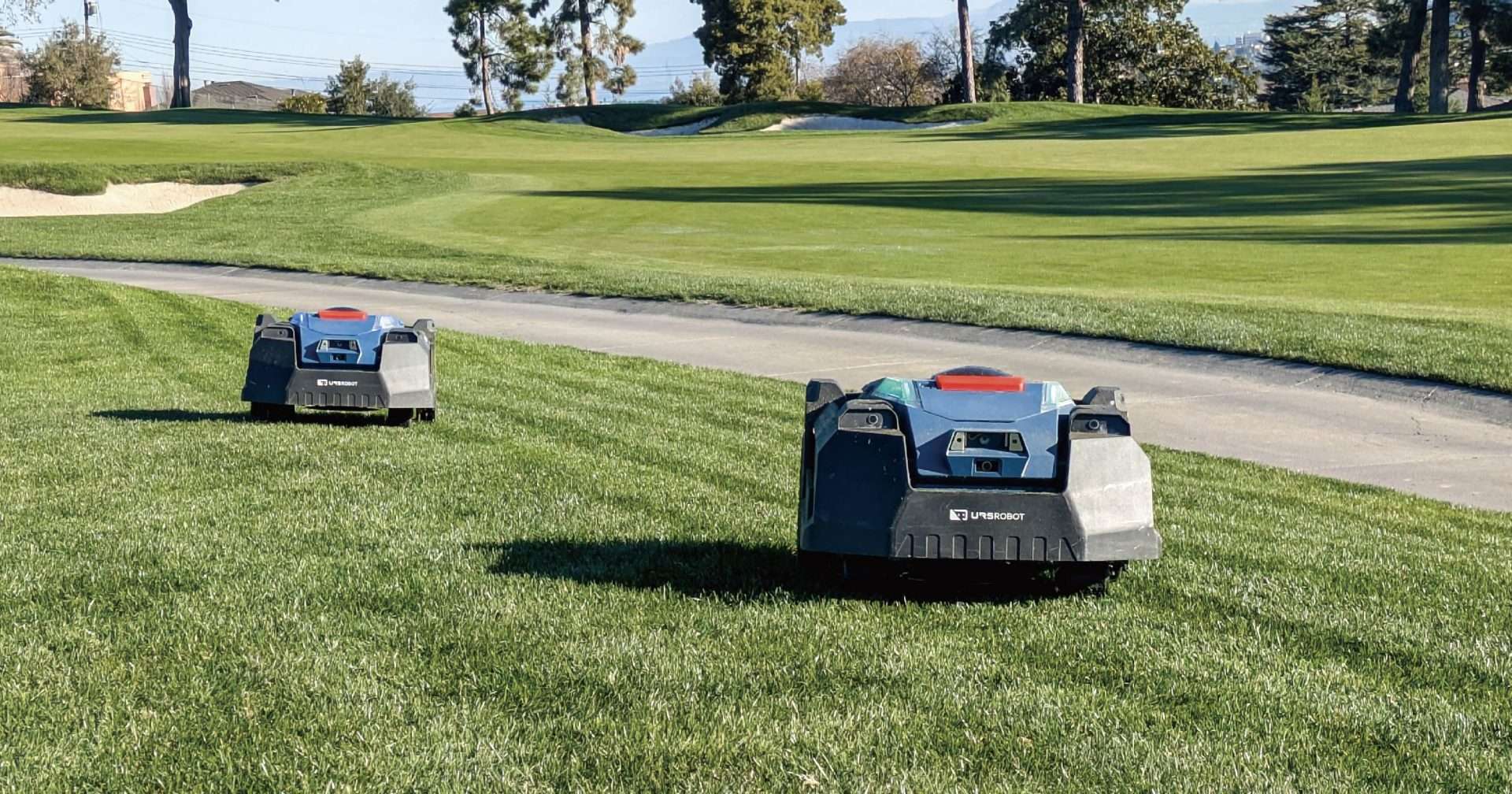
That progression is a small lesson in industrial design. The first claim that attracts attention is freedom from wires. The second-generation feature that may keep a customer is not stopping for every golf ball. Of course, cameras and sensors do not make a public landscape risk-free. A prospective buyer still has to inspect sight lines, slopes, traffic, signal coverage, people and animals on the site. URSROBOT's own support material describes signal problems, rain sensors, emergency stops and battery checks. Real grounds work remains gloriously specific.
Nor is URSROBOT alone on the turf. Professional crews can keep conventional mowers; fixed robotic systems may suit properties that welcome permanent installation; other autonomous mower makers compete for the same budget. URSROBOT's distinct bet is mobility and coordination: map the property, save it, deploy a small fleet, and monitor it through connected software. It is strongest where grass needs frequent, repeatable cuts and the crew has other valuable jobs waiting. It is weaker where mapping and supervision consume more time than mowing would, or where terrain and connectivity defeat reliable operation.
The useful idea hiding in the grass
There is a copyable principle here for anyone building automation. URSROBOT did not merely take a household gadget and enlarge its ambition. It studied the working day around the task: contractors move between sites, crews juggle duties, a school wants quiet, a golf course wants grass cut in conditions that frustrate heavier equipment, and a dealer must be able to service the machines. The product is a mower. The design problem is a work system.
That is why the company's broader language about outdoor autonomous mobile robots is less revealing than a humble golf ball. The ball is a reminder that an autonomous device succeeds in the small moments when nobody has to walk over and help it. It is also a warning against counting only how many minutes the blades spin. The metric worth watching is what the people around those blades can now get done.
- Company website and NEXMOW product range
- LinkedIn, Instagram and YouTube channel
- Dealer network announcement and M2 at CES
- Product videos: NEXMOW demo 1, demo 2 and demo 3