The idea began with a lawn. At Penn State, Gregg Ratanaphanyarat watched people spend the warm months mowing, the fall raking, and the winter clearing snow and spreading salt. He and fellow student Dawei Ding built a modular machine for that parade of chores. The prototype, Gregg later recalled, was a rectangle of metal with wheels and plug-in tools. It belonged in the great tradition of student inventions: ambitious enough to make every season look like a market.
Then a property manager looked at it and offered a different specification. The manager had problems with cost and accountability. Make the robot bigger, the team was told, and there might be a customer. A machine imagined for households had stumbled into a business with much larger lots and a recurring bill for keeping them clean.
The short version
- Viabot provides autonomous outdoor sweeping for large commercial properties.
- Its current machine, Viabot One, launches, sweeps, empties, charges and reports on its own.
- Customers buy a managed service; Viabot installs, maps, monitors and maintains the system.
- A $24 million Series A announced in September 2026 is funding national expansion.
That customer request made Viabot a more interesting company. Instead of asking whether a robot could do every job in a yard, it asked whether a property team could depend on one every night. The distinction sounds modest until the machine is expected to work around curbs, parked cars, scattered litter, darkness, weather and the inevitable bag someone left beside a bin.
The pitch that bought nobody
Gregg's first investor pitch, by his own account, was a 30-minute explanation of why robotics was cool delivered to 30 or 40 friends. It raised nothing. He later admitted that he had barely discussed the business model, the market or why anyone would rely on the device. There are quicker ways to learn that a customer is not buying your enthusiasm, though perhaps fewer as memorable.
The founders went through the HAX hardware accelerator and spent 90 days in Shenzhen. Before the program, they had contacted golf courses and shopping-mall managers. The conversation with a property-management company supplied the missing commercial brief. Viabot moved from consumers to business customers and began selling the result as robotics-as-a-service: the customer pays for cleaning capability while the company remains responsible for the machine behind it.
“We have accountability problems and cost problems. If you can make this robot larger, we're in. We want the service.”Property manager, as recalled by CEO Gregg Ratanaphanyarat
The company publicly launched in 2021 with RUNO, its earlier modular platform, $6.1 million in announced funding and a named deployment with Cushman & Wakefield at Bay Area properties. RUNO could sweep and dump debris. Its sensors also made limited security monitoring possible. The idea was to add work to a machine already moving through a site, instead of dispatching a different robot for each small task.
The machine has a night shift
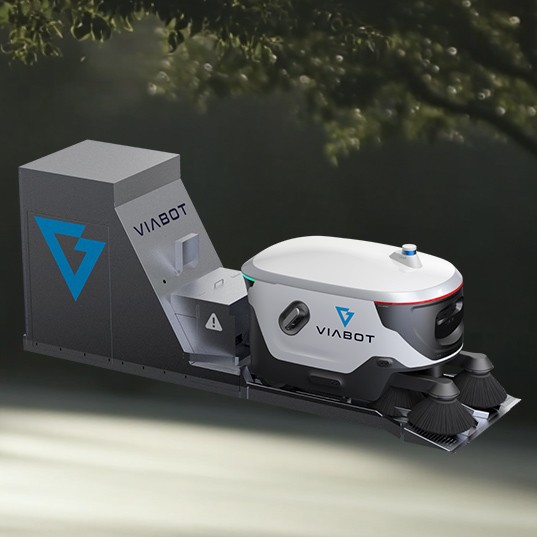
Today's Viabot One is pitched as a sweeper that completes the entire cycle without an operator. Viabot delivers the robot and dock, maps the site, programs routes and sets the schedule. The machine leaves its dock, sweeps debris, returns to empty into a standard rolling trash can and recharges. The dock uses an ordinary 120-volt outlet. Robot and dock together fit within one parking space.
One cleaning loop
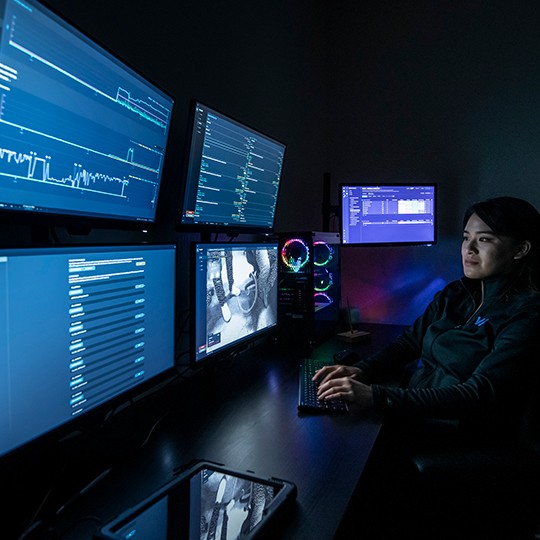
The company says Viabot One can collect dust, gravel, leaves, litter and debris up to 10 inches across, with scheduled sweeping runs of up to six hours. Cameras, lidar, depth sensors and positioning systems help it navigate. Its dashboard shows cleaning history, coverage, route duration, alerts and site activity. Property staff can change schedules or request a special cleaning. Those are less photogenic features than a robot in motion, but they are the ones a facilities manager will use on a Tuesday morning.
The property team still has a job: empty the 65-gallon trash can and occasionally wipe down the robot. Viabot says it handles repairs, parts, worn brushes, filters, remote monitoring and technician visits as part of the service. That matters because a sweeper's value disappears quickly when it sits broken beside the curb. The company is selling the continuity of the chore as much as the novelty of automation.
The second job rides along
As the robot sweeps, it maps and observes the site. Viabot describes the added service as “soft security”: supplementary awareness such as loitering detection and asset monitoring, with alerts that a human team can review. In early RUNO days the company discussed flagging a car left in one place for days. The distinction is useful. A sweeper can add a second pair of eyes along its existing route; it cannot replace a site's security plan.
That dual use is a commercial advantage because the sensors are already on a machine doing a paid job. Gregg explained the arithmetic in a 2020 interview: a robot built only to scan plates might struggle to earn enough to justify its cost. A sweeper that already earns its keep can offer monitoring as an added service. The cleaning contract gives the machine a reason to be there in the first place.
A service business wearing a robot
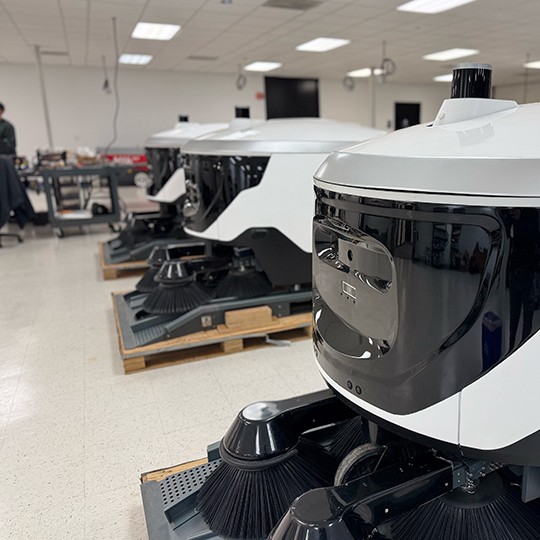
Viabot's buyers include big-box retailers, universities, real-estate owners and property managers, utilities and other operators of extensive outdoor sites. Cushman & Wakefield is a publicly named early partner. The company says its current platform services 25 million square feet of commercial property across eight U.S. states: California, Florida, Indiana, Missouri, Nevada, North Carolina, Texas and Virginia. Its website reports more than 5.1 billion square feet cleaned cumulatively. Those are company-reported measures with different meanings: one describes a serviced footprint, the other repeated passes over time.
Public pricing is unavailable. The practical comparison is with the existing line item for contracted sweeping or grounds labor. A prospective customer can ask Viabot to map a site, estimate coverage and propose service terms, then compare the offer with current cleaning cost, frequency and performance. Gregg has said some early robotics-service contracts required one to five years of payment upfront to manage the manufacturer's cash flow. That is a reminder that removing a robot purchase from a customer's budget does not remove the cost of building robots.
The most convincing test is ordinary: Does the lot look consistently clean in the morning? Did the robot cover the awkward corners? How often did a human have to intervene? Do the reports match what staff can see? A compact, open retail lot with predictable routes may be a good fit. A constantly rearranged worksite, cramped passages or conditions the machine cannot safely navigate would call for a more careful pilot. Viabot's own product description still leaves trash-bin emptying with the customer.
What the parking lot taught
In September 2026, Viabot announced a $24 million Series A led by Walden International, with CDIB Capital Group and Stalwart Ventures joining several existing investors. Viabot put total capital raised at $43 million and said the money would grow sales and engineering, improve Viabot One and expand the service. It also said real-world deployments had produced contract renewals and profitable unit economics. Those claims are encouraging, though the company has not published customer-level economics.
The founder's early lesson is easier to verify and easier to borrow. He began by explaining the machine. A customer explained the job. The company then built the business around a repeatable, paid chore and all the mundane arrangements that keep it repeatable: a dock, a bin, an outlet, route maps, reports and a support team. The robot still has to sweep. The insight was learning who needed the sweeping done, and what “done” would have to mean.