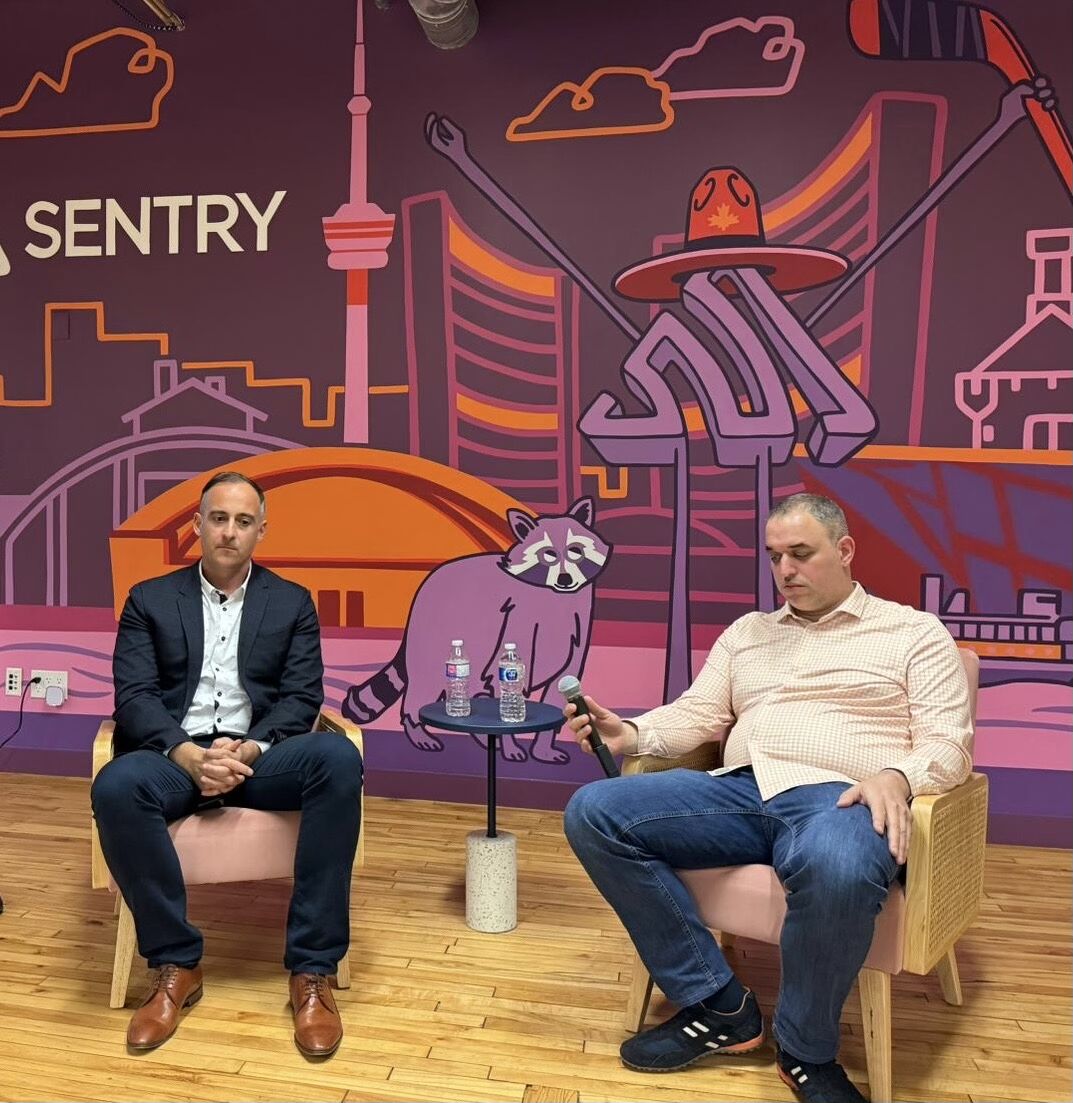
When Jim Keller recalled encouraging Ljubisa Bajic to spend a year building an AI computer in a basement, Bajic supplied a useful correction. “We were in a basement!” The location was his own house in Toronto. By the time they retold the story in 2021, five years after Tenstorrent began, Bajic was speaking from that same basement again. A company can travel a considerable distance while its founder stays within reach of the stairs.
The small team had built an FPGA prototype, using reprogrammable hardware to demonstrate an idea before committing it to manufactured silicon. Keller supplied the first angel investment. An office eventually followed. What makes the episode interesting is the relationship between the modest setting and the scale of the question: could machine learning justify a different kind of computer?
Bajic had already spent years designing chips at AMD and Nvidia. He understood the established machinery from the inside. Starting again gave him permission to rearrange it. His career since then offers two substantial attempts at that rearrangement: Tenstorrent, founded in 2016, and Taalas, founded in 2023. Both concern AI computation. They make different choices about how much freedom a computer should have.
“We were in a basement!”
Ljubisa Bajic, recalling Tenstorrent’s beginnings, 2021
Before AI, there was a screen to keep up with
An earlier piece of work puts that interest in efficiency in perspective. In March 2006, an ATI patent application named Bajic and James Fry as inventors of a method for reducing a graphics processor’s power consumption. The problem was wonderfully ordinary: a computer could render frames faster than its display needed them. All that activity could consume power without delivering a corresponding improvement to the person watching.
Their proposed approach coordinated rendering rate, clock speed and voltage. When circumstances allowed, the graphics processor could slow down and use less power while maintaining the displayed image quality. A chip receiving permission to calm down is an agreeable change from the usual instruction to run faster.
This does not make a graphics patent a blueprint for Taalas. The workloads, circuits and commercial setting are different. It does provide an early, concrete example of Bajic working on the gap between activity and useful output. Later AI hardware would put that gap under a much harsher spotlight.
His professional route included a long spell at AMD, a senior architecture role at Nvidia and a return to AMD before founding Tenstorrent. These were practical apprenticeships in the consequences of architectural decisions: what software can express, where data must move and which parts of a machine spend their time waiting. A computer diagram looks tidy. Its electricity bill is less sentimental.
Keller knew what he was backing
Keller’s explanation for investing was unusually specific. Bajic understood GPUs, the software that used them and the mathematics behind AI. He had also led software work. For Keller, that combination mattered because an accelerator has to be usable as well as fast. Hardware and its programming tools need to grow up together.
In 2021, Keller described Tenstorrent’s software team as including people experienced in FPGA compilers and computer-aided design. Those disciplines are concerned with translating intentions into machinery. They are a fitting background for a company trying to make neural networks run on an unfamiliar architecture.
The partnership also complicates the tidy portrait of a solitary founder. Bajic founded Tenstorrent with Ivan Hamer and Milos Trajkovic. Keller came first as an investor, then joined as president and chief technology officer in 2021. The story has several engineers at its center, with different kinds of experience and overlapping responsibilities.
The company’s technical argument appeared in public as well as in product announcements. Bajic and Jasmina Vasiljevic presented “Compute substrate for Software 2.0” at Hot Chips in 2020. A larger group, including Bajic, subsequently co-authored the IEEE Micro paper of that name. The premise was that rapidly expanding AI workloads warranted a new computing architecture. Publishing the argument gave other engineers something more substantial to examine than a founder’s enthusiasm.
A computer with a sense of timing
Tenstorrent’s early architecture combined computation with communication. Its building block, Tensix, brought mathematical operations, local memory and packet handling together. The chip could be understood as a network of smaller computing elements, with information moving between them as work progressed. That made the routes between calculations part of the design, rather than an afterthought.
Another ingredient was dynamic computation: deciding during execution how work should proceed. Conditional execution could avoid spending effort where it was unnecessary. The ambition extended beyond one chip to connected systems. In the Hot Chips presentation, the architecture’s software and hardware were parts of the same scaling argument.
Bajic also made a geographical argument. Asked why Toronto rather than Silicon Valley, he pointed to a founding and engineering group that had studied and worked there, alongside local strengths in graphics, parallel computing and AI. The choice of city followed people and accumulated knowledge. A headquarters address can be a technical decision in disguise.
The network widened. In 2022, Bajic and Keller spoke to Serbian technologists around the opening of Tenstorrent’s Belgrade office. They also appeared at MIT Technology Review’s Future Compute conference. The question kept returning: how could the machinery become more capable without merely becoming bigger? By April 2023, Tenstorrent described a business of nearly 300 employees across nine locations. The basement had acquired a rather extensive set of extensions.
- 2006Graphics power-management patent filed
- 2016Co-founds Tenstorrent in Toronto
- 2023Steps back; co-founds Taalas
- 2026AMD announces agreement to acquire Taalas
The title changed. The interest did not.
Early in 2023, Bajic and Keller exchanged executive roles. Keller became CEO; Bajic became CTO and president. Bajic explained the change through his longstanding interest in the technical work: “Technology has always been both my passion and our priority.” He identified the BUDA software stack, Wormhole hardware and future machine-learning systems as areas requiring his attention.
In April, he stepped back from full-time work at Tenstorrent, remaining involved in an advisory capacity. The company credited him with leading its growth and the creation of Grayskull and Wormhole. He said he looked forward to seeing the team carry the business into its next phase and planned to explore new projects.
Taalas followed in 2023, co-founded with Drago Ignjatovic and Lejla Bajic. Both had been early engineering leaders at Tenstorrent. The new company therefore carried an established working history into a different architectural proposition. Familiar collaborators could spend their time on the unfamiliar problem.
Its March 2024 public launch came with $50 million raised across two rounds led by Pierre Lamond and Quiet Capital. Bajic described AI as an essential good and argued for making it broadly available. The proposed mechanism was direct: translate deep-learning models into silicon. A general-purpose processor earns its keep by accepting different jobs. Taalas asked how much could be gained by knowing the job in advance.
One model gets its own machine
The distinction becomes clearer when you imagine a model as a score and a programmable processor as an orchestra. The orchestra can play tomorrow’s program too. Taalas aims to build an instrument around a particular score. That analogy explains the exchange of flexibility for specialization; it does not make the engineering easy, or every workload suitable.
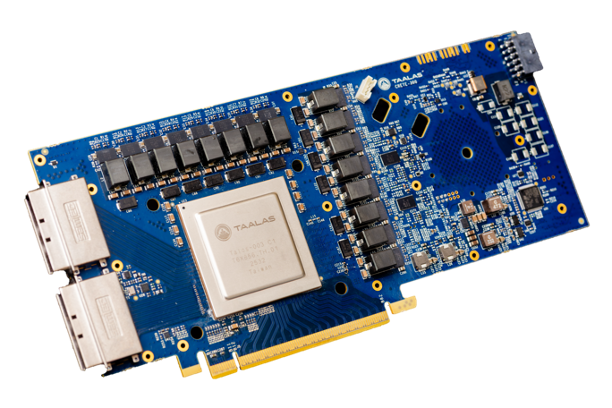
The HC1 technology demonstrator runs Meta’s Llama 3.1 8B model. Taalas lists a 6-nanometer manufacturing process, a die area of 815 square millimeters and 53 billion transistors. The board is tangible evidence of how far Bajic’s second company has taken the idea. Its job is inference: producing outputs from a model that has already been trained.
Taalas reports 17,000 tokens per second per user for this model under its published test conditions. Tokens are pieces of text, rather than a fixed number of words. The model, context, precision and workload matter to interpreting that figure. It is a result for a particular implementation, rather than a universal speed rating for artificial intelligence.
Bajic’s February 2026 account also acknowledged a cost of the first design: aggressive quantization, using lower-precision representations, reduced quality relative to GPU benchmarks. The useful story contains both observations. The system generates text quickly, and its numerical choices affect the text it generates. Speed does not cancel the need to inspect the answer.
The broader attraction is reducing the hardware devoted to moving and accommodating a model. Taalas’s stated aim is to bring its storage and computation together and simplify the surrounding system. The commercial question follows naturally: which models will be used enough, for long enough, to deserve their own silicon?
Supports different models
in custom silicon
Built around a chosen model
Taalas-reported HC1 result for Llama 3.1 8B. Published February 2026, with 1k input / 1k output sequence lengths. Model quality and precision affect comparisons.
The long route back to AMD
On August 6, 2026, AMD announced a definitive agreement to acquire Taalas. The announcement described plans to incorporate its inference technology into AMD’s accelerator roadmap and develop systems alongside Instinct GPUs. The deal remained subject to customary closing conditions and regulatory approvals in that announcement.
For Bajic, it connected a new company to an old employer. His explanation emphasized the resources and reach that joining AMD could provide. There is a practical logic to the combination: highly specialized inference hardware can sit within a wider collection of computing tools. Customers rarely have the courtesy to bring only one kind of problem.
His ambition is easiest to understand at the scale of an interaction. Waiting for a coding assistant can interrupt the work it was meant to help. Making an answer cheaper can change how often someone is willing to ask. In his 2026 writing, Bajic compared AI’s expensive early machinery with the history of computers becoming ordinary, accessible objects. “AI needs to do the same.”
That leaves a more revealing portrait than the familiar contest between a startup and a large chip company. Bajic keeps examining what a machine must do, then asking which of its obligations can be removed. A graphics processor need not outrun its screen. An AI chip might not need to accommodate every model. Each choice gives something up to make another thing possible. The basement was a place to begin. The enduring occupation is deciding what belongs inside the computer.