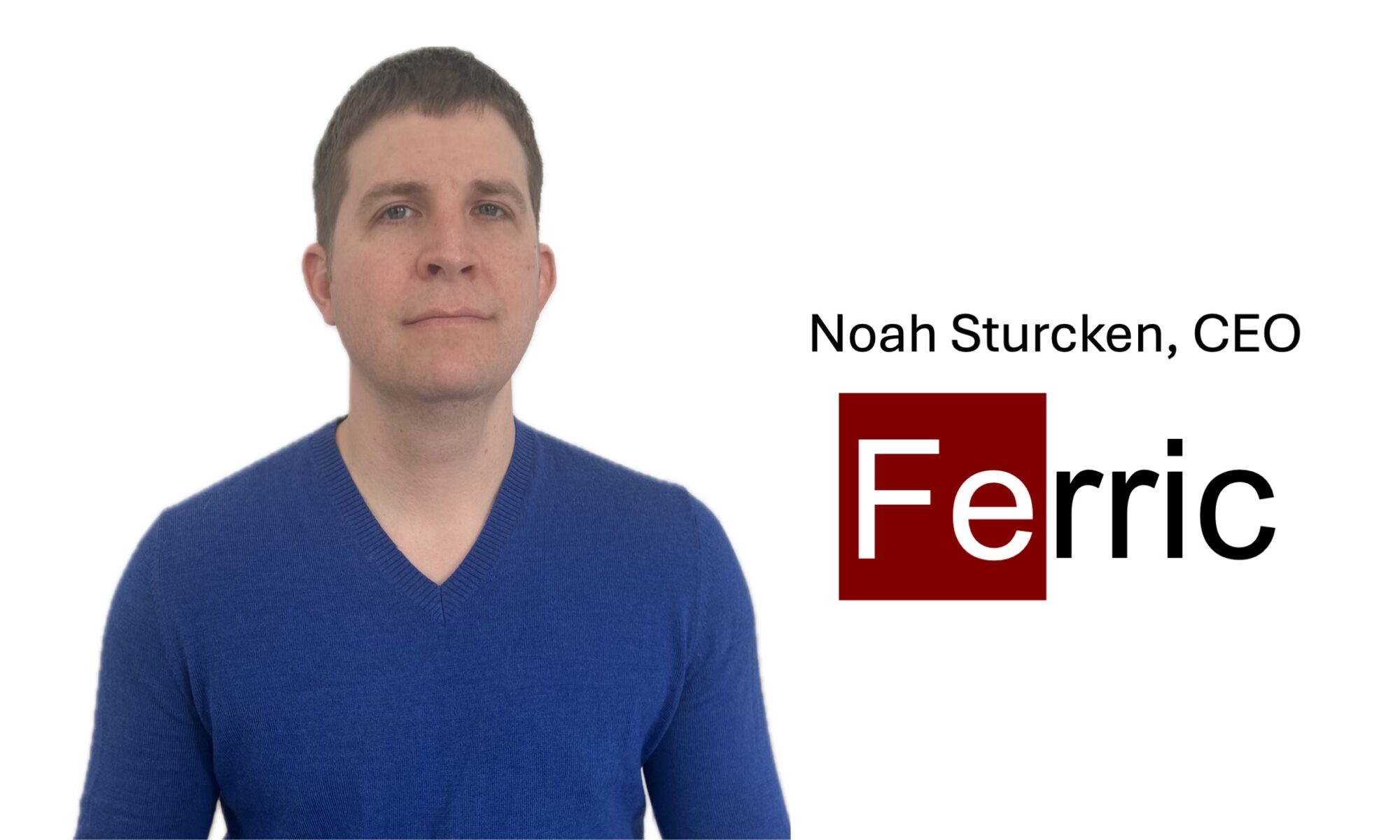
There is a quiet rule in computing that almost nobody outside a chip lab argues about: the power supply is allowed to be ugly. Big, hot, bristling with capacitors and inductors, it sits beside the processor like a generator parked next to a sports car. Noah Sturcken spent a doctorate deciding he would not accept that, and then he spent a company proving he was right.
Sturcken is the founder and CEO of Ferric, a semiconductor company headquartered at 150 West 30th Street in Manhattan - not Santa Clara, not Austin. Ferric builds what the industry calls integrated voltage regulators, or IVRs: power converters small enough to sit inside the chip package itself, shoulder to shoulder with the processor they feed. The pitch on the company's own front door is blunt. "We build the world's smallest, most efficient power converters. They power the future of computing - and all digital electronics."
The strange specific that explains the whole thing is a sliver of thin-film magnetic material. For decades, the inductor - the bulky magnetic component every switching power converter needs - was the reason power supplies could not shrink onto silicon. Sturcken's contribution was to integrate that magnetic core directly into the chip, in CMOS, where conventional wisdom said it could not go. Take away the bulky external part, and suddenly the converter can ride inside the package, delivering power across millimeters instead of centimeters.
A dissertation with a balance sheet
Ferric is, almost literally, Sturcken's PhD turned loose on the world. He earned his Ph.D. and M.S. in Electrical Engineering at Columbia University, where the integrated voltage regulator was his research project. Before that he was an undergraduate at Cornell, finishing summa cum laude. Between the academy and the startup he spent time at AMD's Research and Development Lab, where he kept developing IVR technology inside one of the largest processor makers on Earth, and earlier still at BAE Systems.
Most dissertations end up on a shelf. This one ended up in a fab. The thread running through all of it - Cornell, Columbia, AMD, Ferric - is a single technical obsession: get power closer to the transistor, with less loss, in less space. He now holds more than 40 issued patents and has authored over 15 publications on the subject. That is not a man who pivoted into power electronics. That is a man who never left.
Our collaboration provides a streamlined path for integrating Ferric IVRs into some of the most sophisticated and power-hungry processors ever made.
What "smaller" actually buys you
The numbers sound like marketing until you sit with what they mean. A Ferric device can push 160 amps out of a footprint roughly the size of a grain of rice cluster. The company says its regulators are more than ten times smaller than the conventional solutions, and that they can strip away up to 74 percent of the components crowding a processor's power network. The board gets emptier. The chip gets cleaner power. The whole system gets denser.
How an IVR collapses the distance
Why does proximity matter so much? Because every centimeter a current travels across a board is a centimeter where voltage sags, heat builds, and efficiency leaks away. Modern AI processors swing their power demand violently and instantly. Feeding them from the edge of the board is like watering a garden with a hose full of kinks. Ferric's answer is to move the tap into the package, so power arrives with, in the company's words, minimal distance and loss.
Right problem, right decade
Sturcken did not pick power delivery because it was fashionable. It became fashionable around him. The explosion of AI compute turned a sleepy, unglamorous corner of electronics - voltage regulation - into one of the hardest bottlenecks in the data center. Hyperscalers are now measuring power delivery in efficiency points they cannot afford to lose. Ferric frames its impact as up to a 30 percent energy reduction in those environments. When the cost of a data center is increasingly the cost of feeding it, a smaller, cleaner regulator stops being a component and starts being strategy.
In June 2025, that thesis got a marquee endorsement. Ferric and Marvell Technology announced a collaboration to develop optimized integrated power solutions for Marvell's custom silicon platforms - the XPUs at the heart of AI and cloud infrastructure. For a company that started as one researcher's idea about magnetic films, being designed into some of the most power-hungry processors ever built is the kind of validation that does not fit on a slide.
Figures per Ferric product and company materials. Size and component bars show Ferric as a share of conventional.
Three chips, one idea
It is one thing to publish a paper about integrated magnetics. It is another to ship parts with names and datasheets. Ferric's catalog reads like a series of escalating dares against the laws of board space. The Fe1766 claims an ultra-high current density of 4.5 amps per square millimeter, delivering 160 amps from an 8 by 4.4 millimeter package at roughly 93 percent conversion efficiency. The Fe1736 is a sixteen-phase buck converter pushing 56 amps from 20 square millimeters. The Fe1728 is a flexible eight-phase part that can split into as many as four independent outputs, still landing around 90 percent efficiency.
The through-line in every one of those parts is the same buried magnetic core Sturcken chased through his PhD. Multi-phase buck converters, multi-output regulators, high-frequency regulation - the vocabulary is dense, but the payoff is simple. Each device does the job of a small crowd of discrete components, and it does it in a fraction of the area. The efficiency numbers matter because at data center scale, a few percentage points of loss is a power plant's worth of waste heat.
That is the unglamorous truth Sturcken built a company on. Nobody buys a laptop or rents a GPU because of its voltage regulator. The regulator is invisible until it is the thing standing between you and more compute. By the mid-2020s, that is exactly what happened: the regulator became the wall. Ferric spent years building the door.
A New York chip company, on purpose
Ferric is roughly fifty people, operating in a semiconductor industry that usually clusters on the West Coast or in Asia. Sturcken built it in Manhattan instead, drawing a team that combines academic expertise in magnetic materials with veterans from AMD, TSMC, Xilinx, and other names that make the people who understand power electronics nod. Collectively the team holds more than forty patents. It is a small company solving a problem that the largest companies in the world cannot route around.
The funding has followed the proof. In February 2026 Ferric closed a Series B of about $32.1 million, lifting its total raised to roughly $79 million. For a hardware company - where capital is patient and fabs are unforgiving - that trajectory says the market has decided integrated power is not a curiosity. It is infrastructure.
Geography is part of the personality here. Semiconductor founders are supposed to gravitate toward the places with the deepest pools of chip talent and the friendliest proximity to foundries. Sturcken planted Ferric on West 30th Street, a few subway stops from the Columbia lab where the technology was born. The choice keeps the company close to its academic roots and to a city not known for silicon - a quiet bet that the best place to build the smallest power converter in the world was wherever the idea actually came from.
We build the world's smallest, most efficient power converters. They power the future of computing - and all digital electronics.
The record, lightly framed
"Ferric is thrilled to collaborate with Marvell in providing pre-validated IVR power solutions to their XPU customers."
The continuation of a Columbia PhD research project, taken out of the lab and into the fab.
More than 10x smaller than conventional solutions - small enough to live inside the package.
Cornell summa cum laude, then a Columbia doctorate, then AMD's research lab. The same idea, the whole way.
There is a tidy irony in the company's name. Ferric means iron - the magnetic heart of the very inductors the world insisted could never be integrated. Sturcken named the company after the thing everyone said was the problem, then made it the solution. That is roughly the whole story: take the part that does not fit, and refuse to leave it outside.
Catch him mid-stride and the picture is clear enough. A researcher who turned his thesis into a balance sheet. A founder building chips in a city that does not build chips. A power-electronics lifer who happened to be working on exactly the right problem at the exact moment the world ran out of room for ugly power supplies. The processors get all the attention. Sturcken builds the smallest thing in the rack - the part that makes the biggest thing possible.