Dan Schulman thought he knew what the survey would say. PayPal paid competitively. Surely its own employees would provide a reassuring example of the company’s promise to make money easier to manage. Then a 2019 assessment of hourly and entry-level workers returned a less convenient answer: 65 percent of respondents said they ran out of money between paychecks.
For a payments executive, this was an awkward place to discover a payments problem. The people helping customers move money were struggling to keep enough of their own. A market-rate salary had sounded like an answer. It had turned out to be the beginning of a question.
That episode offers a useful way into Schulman’s career. He has moved between telephone companies, an online travel business and financial services, usually with an interest in what ordinary people experience at the other end of a transaction. His most revealing decisions begin where a corporate explanation stops being satisfactory.
In October 2025, he became Verizon’s chief executive. A year into the job, the question has acquired new weight. How does an executive known for investing in employees lead a turnaround that cuts thousands of jobs? How much does a customer care about an impressive network if dealing with the company remains a chore? Schulman’s new chapter makes his earlier convictions worth examining closely.
The view from a New Jersey stroller
Born in Newark in 1958 and raised in Princeton, Schulman grew up in a family where public responsibility was part of the conversation. His grandfather organized garment workers in New York. His mother took him to civil-rights demonstrations while he was still small enough to travel in a stroller. His father was a chemical engineer.
He has described his parents’ counsel as an encouragement to be himself. It is modest advice for someone who would eventually spend much of his working life representing enormous companies. Yet it helps explain his preference for connecting business decisions to personal convictions, rather than treating the executive suite as a place where those convictions should be checked at the door.
He studied economics at Middlebury, graduating in 1980, then earned an MBA at New York University’s Stern School in 1986. The degrees supplied a formal vocabulary for markets. His later work would keep returning to a less tidy subject: the individual trying to afford a place in one.
Eighteen years at the phone company
Schulman joined AT&T in 1981 and spent 18 years there, eventually becoming president of its Consumer Markets Division. He then moved to Priceline in 1999, serving as president and later chief executive. By 2001, Richard Branson had brought him into Virgin Mobile USA as its founding CEO.
The sequence matters. He learned inside an established telecommunications business before moving into companies with a reason to challenge established habits. At Virgin, prepaid mobile service offered a different route into owning a phone. The customer could buy service in advance. The business had to make that arrangement attractive enough to win a place in a crowded market.
Over eight years, Virgin Mobile USA grew from its early stages into a public company. Sprint Nextel acquired it in 2009 at a total value of $688 million. Schulman then led Sprint’s prepaid group before moving to American Express in 2010, where his remit included alternative mobile and online payment services.
Branson became an influence on how he thought about business purpose. Their work together also put Schulman in contact with the problem of youth homelessness. During his Virgin years, he spent 24 hours on the streets of New York to understand something of that experience. A day could offer only a glimpse, but the willingness to leave the office would reappear in his approach to financial services.
- 1981AT&T
Learning the scale - 2001Virgin Mobile
Building prepaid - 2014PayPal
Moving money - 2025Verizon
Returning to telecom
The price of standing in line
Schulman joined PayPal in 2014 ahead of its separation from eBay. In July 2015, it became an independent public company. He arrived with experience in reaching people outside the usual customer base, and with an idea expressed in five plain words: “It’s expensive to be poor.”
The phrase describes a business opportunity and an uncomfortable fact about access. People with less money can spend more of it on basic transactions. They can also spend hours accomplishing tasks that others finish with a few taps. Schulman went to check-cashing locations and money-order centers, stood in lines and listened to conversations. Moving money had a time cost as well as a fee.
He also challenged an internal PayPal habit. The service had steered customers toward the funding instrument that cost the company less. His customer-choice initiative allowed people to choose how they wanted to pay. In his account, the stock fell nine percent when the change was announced. A courteous gesture to customers had earned a rather discourteous market response.
He stayed with the decision. By 2018, he reported 70 million additional customers over the preceding two years, almost doubled transactions and fewer customer-service calls. Those figures do not establish a single cause for growth, but they explain why he considered the decision consequential. The economics of convenience could improve when customers had more control.
“It’s expensive to be poor.”
Dan Schulman
The employees behind the payment button
The paycheck findings brought that concern inside the company. PayPal’s response included wage increases where needed, stock awards and financial education. It also began using net disposable income: the money left after taxes and essential living expenses. The target was 20 percent.
The measure changed the question being asked. A salary could compare favorably with another employer’s salary while leaving too little room for savings. A benchmark could be correct and still miss the person it was supposed to describe. The new approach required the company to look at what happened after the payslip arrived.
Schulman’s argument was also commercial. Employees who could make their own finances work would be better placed to serve customers. He wanted other companies to examine their workers’ circumstances, too. The idea reached beyond a generous gesture by one employer; it challenged a familiar definition of adequate pay.
His principles could also affect where PayPal did business. In April 2016, the company withdrew plans for a Charlotte operations center that would employ more than 400 people, following North Carolina legislation restricting protections for LGBT citizens. Schulman treated equal treatment as a condition of becoming an employer there. That decision carried a tangible consequence: jobs the city had expected would go elsewhere.
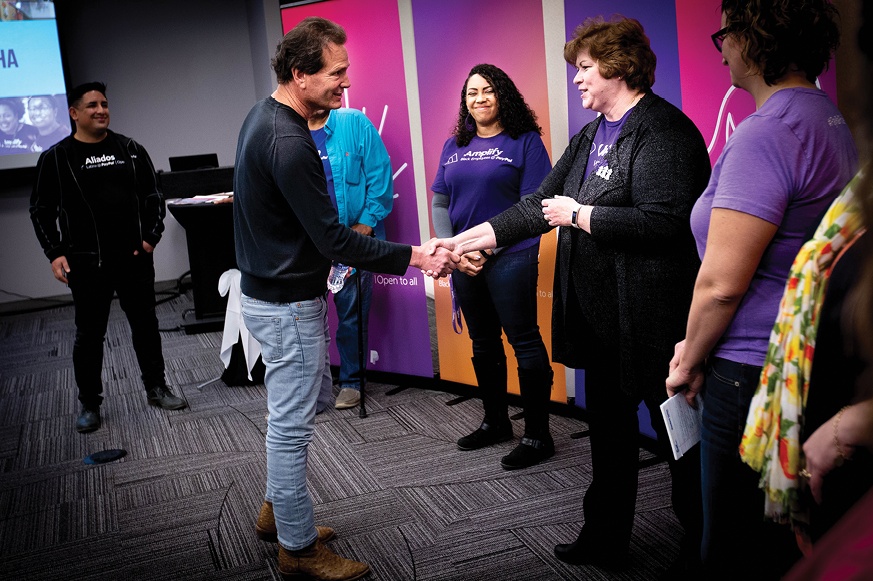
Sometimes the CEO asks the questions
There is another Schulman besides the executive explaining a strategy. In 2018, he launched Never Stand Still, a video and audio interview series. The title came from a lesson in martial arts. He has practiced Krav Maga for years, and the connection between movement and competition is one he likes to make.
The guest list widened the conversation beyond payments. With Nasdaq’s Adena Friedman, he discussed opportunity and the experience of leadership. With Yo-Yo Ma, he explored learning in small increments; the cellist demonstrated how patterns could make a larger task manageable. With Marc Benioff, a longtime friend, he listened to stories about early jobs and teenage software projects.
Schulman jokingly called Benioff PayPal’s chief quality officer because his friend used the platform and reliably supplied suggestions. There is a certain convenience in a customer complaint delivered by another CEO: it is unlikely to languish in a queue. Schulman also mentioned that he had once been a truck driver, an early job that sits pleasantly beside the longer list of executive titles.
The conversations show the subjects that hold his attention: how people learn, where they begin, what makes them change direction. They also provide a break from the tidy inevitability of a résumé. A title records where someone arrived. A conversation can reveal the detours.
Back at Verizon, the arithmetic gets harder
Schulman had served on Verizon’s board since 2018 and became its lead independent director in December 2024. His appointment as CEO in October 2025 therefore brought an experienced board member into the operating role. He succeeded Hans Vestberg as Mark Bertolini became chairman.
He set out to increase customer focus, reduce costs and improve returns. In November, he announced more than 13,000 job reductions. The company also created a $20 million Reskilling and Career Transition Fund for departing employees. His explanation linked the changes to a cost structure that constrained investment in the customer experience.
The contrast with his PayPal record is difficult to ignore. Investing in employees and eliminating positions can each appear defensible within a particular business plan. Together, they demand more explanation than a slogan provides. A transition fund may help people prepare for another job; it does not make the loss of the present one disappear. The consequences belong in any account of his leadership.
There are early signs of commercial progress. In the second quarter of 2026, Verizon reported 184,000 postpaid phone net additions and 348,000 broadband net additions. Mobility and broadband service revenue grew 2.8 percent year over year. Total operating revenue, however, fell 0.7 percent as equipment revenue declined. The figures make a more useful picture together than any isolated victory lap.
Net additions measure connections gained after losses. They are company-wide results, not a measure of one executive’s contribution.
A year in, still impatient
By September 2026, Schulman was describing his temperament with little ceremony: “I’m a pretty intense guy. I’m very impatient.” He wanted a less hierarchical, faster-moving Verizon. He also saw an opportunity in supplying fiber connectivity for the expansion of AI data centers.
He said he was pleased with the direction of travel while acknowledging how much remained to be done. That is an appropriate place to leave a turnaround still in motion. Customer growth has to persist. Efficiency has to reach the person trying to resolve a bill. Employees have to live with the decisions made in its name.
The PayPal survey remains a useful reminder for this chapter. Schulman had expected evidence that his company was doing well by its people. He got evidence that it needed to do better. At Verizon, a similar willingness to hear an inconvenient answer may matter as much as the confidence with which he delivers his own.
Keep the conversation going
Profiles & conversations
- Schulman’s official Verizon biography
- LinkedIn essays and updates · Instagram · Facebook
- Listen to Never Stand Still
- Watch: leadership and career advice with CNBC
- Watch: Schulman on successful leadership
- The customer-choice conversation
- Verizon’s second-quarter 2026 results
- Schulman’s November 2025 employee letter
- Schulman discusses his Verizon plans