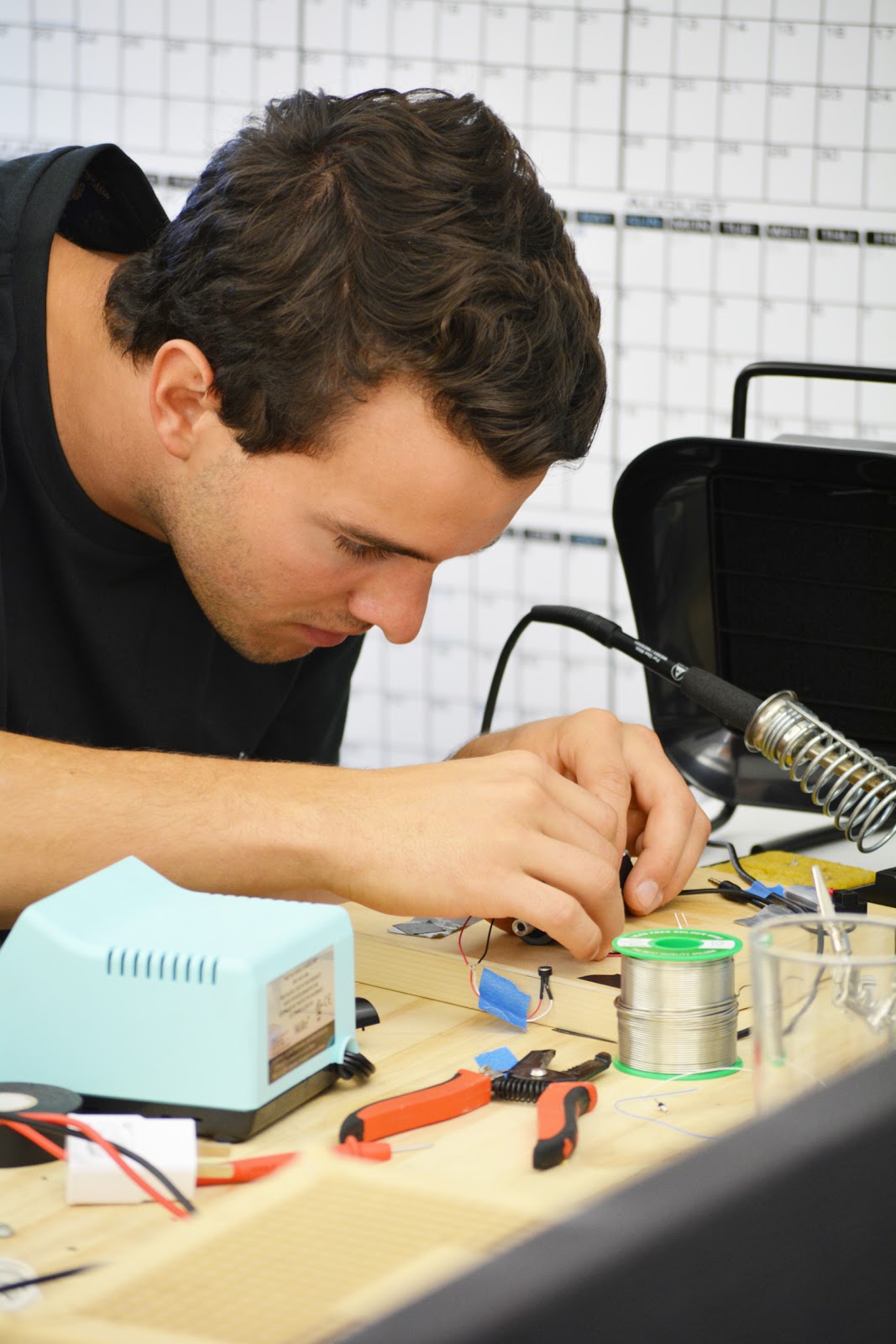
Connor Landgraf is bent over a workbench, holding a soldering iron. There are pliers in front of him, a spool of solder beside his hands and enough loose cable to discourage anyone who prefers a tidy origin story. The photograph catches a useful part of his working life. Before a company can become a name on a conference program, somebody has to make the pieces connect.
Landgraf would acquire plenty of opportunities to explain what he was building. He became the co-founder and chief executive of Eko Health. He appeared on a Forbes list, received an alumni award and led a company through successive rounds of financing. Yet the workbench picture offers a more interesting starting point than the customary photograph of a person standing beside a company logo.
It raises a question that follows him from childhood through Berkeley and into the executive job: what else must a person learn once he knows how to build?
A taste for taking things apart
Landgraf credits his father, an engineer, with encouraging his interest in creating things. The family influence came before the startup vocabulary. Making something was already appealing before there was an investor to persuade or a company to name.
He was homeschooled and went to junior college before Berkeley. Looking back on those early years, he connected that education with learning how he learned. Robotics and programming caught his attention. Both offered the particular pleasure of making an instruction produce a result, then changing the instruction when the result proved disappointing.
There is a nice economy to that beginning. A child interested in building becomes an engineering student. The career seems almost obliging. Then other people enter the picture, and the straight line starts acquiring junctions.
By 2013, Landgraf was completing his undergraduate degree at Berkeley. His senior project, developed in Professor Amy Herr’s capstone course, became the beginning of a venture with two fellow students. A classroom assignment had acquired a future that would require considerably more than handing it in.
The student with two kinds of homework
Engineering was only one part of his campus life. In 2012, Landgraf was president of the Associated Students of the University of California. That August, he joined the university’s leadership on stage at the Greek Theatre to welcome an incoming class. Some 3,000 new freshmen and transfer students attended the convocation.
A student government title can look decorative years later, tucked between a degree and a first job. At the time, it came with a schedule. Landgraf carried a full course load while serving as president. His annual stipend was $4,000. The title evidently did not include a dispensation from homework.
He also appeared at the rededication of the Bechtel Engineering Center, alongside university leaders, donors and Berkeley’s bear mascot, Oski. It is a campus photograph with a generous cast. Landgraf occupied the student representative’s place in it, already accustomed to standing where different interests met.
None of this makes student politics a prerequisite for entrepreneurship. It does suggest why his education is worth looking at from two directions. He was studying technical problems while participating in an institution’s public life. One asked what could be made. The other involved people with their own views about what ought to happen next.
Three people, different strengths
The venture brought Landgraf together with Tyler Crouch and Jason Bellet. Crouch studied mechanical engineering; Bellet studied business. Their different backgrounds gave the group a practical division of strengths, with engineering, strategy and communication all represented.
Landgraf had encountered Bellet through campus political events. He noticed his organizing ability before inviting him into the venture in 2013. There is something reassuringly ordinary about that detail. A consequential business relationship began with observing someone do another job well.
Bellet already had a consulting career at Deloitte in view. Working with Landgraf and Crouch changed his plans. A company was taking shape within the overlap of their university lives, drawing on abilities they had developed in different corners of the same campus.
The interesting unit here is the group. Founder portraits tend to draw a bright circle around the chief executive, leaving everyone else somewhere beyond the edge. Landgraf’s own account of collaboration gives that circle a wider circumference. The person who can explain an idea has a contribution to make beside the person who can engineer it.
Three paths through Berkeley. One founding team.
The award with homework attached
In June 2013, the team received a $100,000 Founder.org award. Eko had entered Berkeley’s SkyDeck accelerator after winning the VentureLab competition. For a venture emerging from university, the award brought resources at a moment when there was still much to learn.
The program included a year of hands-on mentoring and monthly business reviews. Guidance covered recruitment, management, intellectual property, performance measures and fundraising. The list reads like a second curriculum, assembled for students who had accidentally given themselves an organization to run.
Landgraf credited SkyDeck’s mentors, advisers and resources with helping the team learn and grow. The acknowledgment matters alongside the dollar figure. Money could support the work. Experienced people could help the founders understand which work needed doing.
Early support also changes the company’s calendar. An award creates room to keep going, then adds expectations about what will happen during that time. Monthly reviews are a particularly efficient reminder that enthusiasm has appointments to keep.
- 2013Bachelor’s degree; Founder.org award
- 2014Master of Engineering
- 2015Forbes 30 Under 30
- 2016Berkeley’s Mark Bingham Award
Recognition comes with a calendar
Landgraf completed his Master of Engineering in 2014, following his bachelor’s degree the year before. In 2015, Forbes included him in its 30 Under 30 list. Berkeley recognized him in 2016 with the Mark Bingham Award for Excellence in Achievement by Young Alumni.
The alumni award arrived two years after his master’s degree. The university was already honoring work that had begun while he was still one of its students. It makes for an unusually short trip from classroom to alumni recognition, although the company’s longer education was continuing.
By 2017, he was listed as a session leader in Berkeley’s entrepreneurship program. The program placed him around subjects including compelling ideas and company culture. A founder who had benefited from an accelerator’s advice was now on a schedule designed to help other people get started.
These appearances describe a continuing relationship with the institution. Berkeley supplied coursework, collaborators, public responsibilities and early business support. Landgraf then returned as someone whose experience could be useful to the next group. The connection survived the graduation ceremony.
Learning to run the room
The later financing rounds give a sense of how far the venture traveled. Eko raised a $20 million Series B in 2019, a $65 million Series C in 2020 and a $41 million Series D in 2024. Those are company financing amounts, each attached to a new stage of organizational responsibility.
The 2024 round included existing investors and additional backers. Its announced plans included strengthening the company’s presence in the United States and expanding internationally. The ambition now concerned how an established organization would reach further.
People became an increasingly explicit part of the executive work. In 2022, Eko appointed Kim Nolan senior vice president of people. Landgraf emphasized the importance of attracting and retaining colleagues, connecting that responsibility with long-term company success.
He had discussed mission and hiring in a 2019 podcast conversation, too. The concern runs through the career: first finding co-founders, then bringing more people into an enterprise that needs them to understand why its work matters. At a workbench, a connection is visible. Inside an organization, making one can take rather more conversation.
“the most essential skill”
CONNOR LANDGRAF, ON STORYTELLING
The sentence that has to travel
Landgraf’s appreciation of Bellet points toward the part of this education that is easiest to underestimate. In describing his colleague’s contribution, he described storytelling as central to almost any innovation. He was talking about making technical ideas approachable enough to engage other people.
That is a revealing emphasis for someone trained in engineering. The explanation belongs inside the work. An idea has to become intelligible to a collaborator, then to someone deciding whether to commit resources, then to the next person joining the company.
By 2026, Landgraf was still Eko Health’s chief executive. The distance from student project to established company can be measured in years, funding rounds and titles. His story also allows a smaller measurement: the widening range of people with whom he has had to make something work.
The chronology gives the company thirteen years of distance from the 2013 project. That span matters more than the quick succession of early honors suggests. Graduation happened. The award ceremonies ended. The work kept returning in new forms, with decisions about colleagues and direction joining the technical questions. There is no final exam for that part of the job, and no degree that settles it. Landgraf’s title has remained recognizable while the organization around it has changed.
Return to the soldering iron. The photograph has no room for a financing announcement or an alumni award. It shows a person concentrating on a connection. The job has become more complicated since then. There are more people at the table now.
Keep the conversation going
More from Landgraf and the people who worked alongside him.