At the Blue Note in New York, Florent Peyre heard a management problem being solved without a single slide. Roy Hargrove was playing with his quintet. The musicians passed the melody around, made space for one another and found their way back together. Peyre drew an analogy with founders: their job included keeping time while someone else took the solo.
He wrote about the evening in January 2017. Placemeter, the computer vision company he had co-founded, had recently been acquired by NETGEAR. Another venture was ahead of him. For a moment, though, his account of work came down to people listening to people. The business vocabulary could wait outside with the coats.
Nearly a decade later, the ensemble is considerably larger. In July 2026, Small Door and Bond Vet announced their merger, with Peyre appointed CEO of the combined business. The Small Door co-founder now has two organizations to bring together. His old jazz analogy has acquired rather more demanding acoustics.
A career in the space between
Peyre’s route to this point began in France. He studied at Sciences Po, graduating in 2000, and trained in law at the University of Paris I: Panthéon-Sorbonne. His early employers included Ernst & Young and Lagardère. By 2007, his career had taken him to New York and a business development role at Hachette Filipacchi Media U.S.
Publishing, online retail and technology followed one another. He moved to Gilt Groupe in 2010, working on strategy and business development. These were jobs in the space between organizations: finding a partner, negotiating terms, making a plan that people on both sides would accept. A good idea still needed someone willing to stay in the room.
One negotiation he recalls lasted fourteen months. It involved a venture-backed business and a publicly traded company, with multiple stakeholders to keep aligned. The resulting contract ran to more than sixty pages. He does not name the companies in his account, but describes a division becoming profitable overnight and gaining broader distribution.
The detail that survives all that paperwork is his reaction: a smile that lasted for days. You can almost weigh the relief against the contract. Fourteen months of discussion had finally become something people could use.
“I couldn’t stop smiling for the next few days.”
Florent Peyre, recalling a fourteen-month negotiation
The city outside the window
In 2012, Peyre co-founded CasaHop with Paul Berry, an attempt to make exchanging homes easier. The venture proved harder to grow than anticipated, and he moved on that October. Placemeter followed, alongside Alexandre Winter. The sequence matters: the startup chapter included an early disappointment before the acquisition that would eventually make the résumé.
Placemeter asked a question familiar to anyone who has walked across town only to discover a queue: why was information about physical places so awkward to obtain? An online business could study its visitors. A shopkeeper had a much less convenient view of the people passing the window. A city had its own questions about how streets were used.
The company used video and computer vision to turn movement into data. In a 2015 interview, Peyre described uses ranging from understanding pedestrian activity around a bakery to helping people make sense of a busy park. His interest was in the ordinary decisions that better information might improve. The city was full of activity; the task was making that activity legible.
Getting there required changing the approach. During Techstars in 2013, the team shifted away from its initial deployment model. Peyre’s account of that period is candid about the difficulty of abandoning work already done. Persistence could get a company moving; attachment to the wrong method could keep it stuck. The distinction looks wonderfully tidy after the decision.
NETGEAR acquired Placemeter in 2016. Peyre explained the fit in practical terms: his company had analysis technology, while NETGEAR’s Arlo business had cameras. Each brought something the other could use. The deal joined software expertise to a physical product, another example of his career crossing the boundary between a digital system and the world outside it.
The trouble with watching the other band
Peyre’s writing includes a less flattering account of attention. In 2013, he described setting up alerts on competitors, checking their websites for changes and following their posts. Sometimes he went further, watching the new LinkedIn connections made by a rival’s salesperson. Competitive intelligence had become a hobby with very poor opening hours.
He recognized the trap. Every announcement could make another company seem faster, better connected or more successful. There was always a fresh reason to worry. The habit supplied an endless stream of observations without necessarily improving the next decision.
His remedies were deliberately close to home: talk things through with a co-founder, spend time with customers and ask sales and support colleagues what they were seeing. Those conversations offered a way to test whether a competitor’s move actually mattered. They also brought him back to the people buying and using the product.
The useful thing about the admission is its specificity. He was willing to describe his own excessive monitoring, rather than issue a vague instruction about focus. An entrepreneur can know perfectly well that comparison is unhelpful and still refresh the page. Writing down the habit makes it harder to dress up as strategy.
What deserves the next few years?
After the Placemeter chapter, Peyre paused over a different question. What should he choose next? In December 2016, he wrote about the clarity that experience had brought him. He had a better sense of what interested him and what did not. He also worried that quick judgment might get in the way of taking a worthwhile risk.
He wanted to spend his remaining working years on projects that made him happy. It was a plain statement in a world fond of more elaborate explanations for ambition. A new project needed to hold his interest deeply enough to deserve the years it would consume.
That pause gives the following career move some texture. A company exit can appear to be a neat full stop. For the person involved, it also creates an unusually open calendar. The question becomes personal before it becomes commercial: which problem would you willingly return to tomorrow?
“Too few years left to spend them on things that get you unhappy.”
Florent Peyre, December 2016
A friendship becomes a front door
Small Door grew out of a relationship with a longer history. Peyre and Josh Guttman met in 2009, when Peyre worked at Hachette Filipacchi and Guttman was at Outbrain. Their paths crossed again through Placemeter, which Peyre pitched to Guttman during his time at SoftBank Capital. Years of conversation preceded their partnership.
The business they went on to build brought membership, design and physical locations together. Small Door’s West Village premises were already attracting attention in late 2019, with light wood, plants and an interior more suggestive of a hospitality business than an institutional waiting room. The setting made the founders’ interest in experience visible before anyone explained the model.
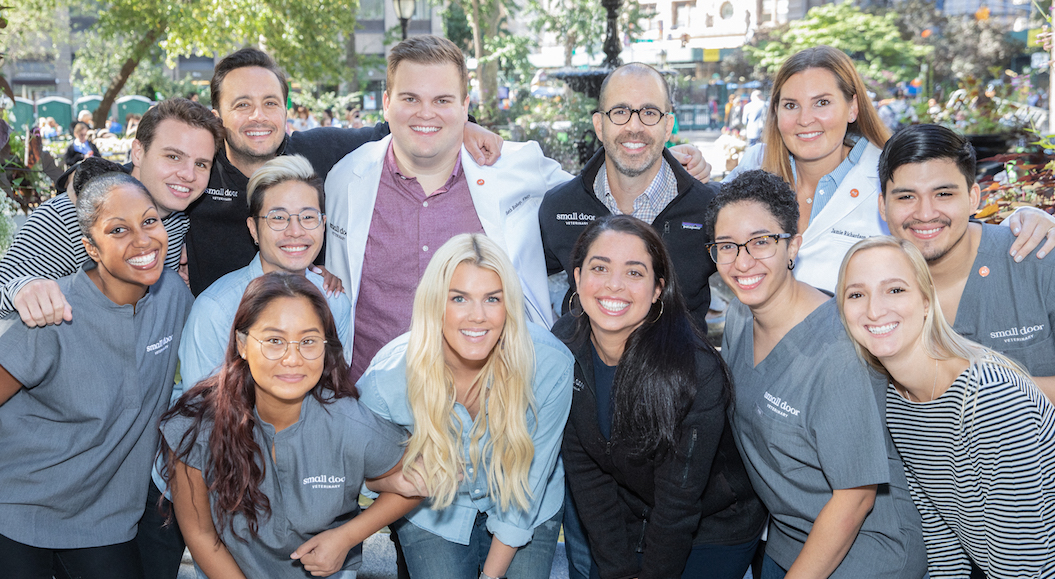
Physical places carry associations that an app cannot simply borrow. A neighborhood address becomes part of someone’s route, and eventually part of their expectations. Peyre’s move into this business brought him back to the question Placemeter had approached from another direction: what happens when people arrive, and does the experience make sense to them?
There was a personal geography, too. When Small Door opened in Williamsburg, he celebrated the return to a borough where he said he had lived for twelve years. Brooklyn was an old stomping ground. Expansion, in that instance, had an address in his own history.
Brooklyn, without the photocopier
Peyre has not always welcomed Brooklyn’s expansion as an idea. In a 2016 essay about cities, he objected to the spread of interchangeable shopping experiences and the habit of describing somewhere as the next Brooklyn. His travels had brought him to cities with very different histories, only to encounter familiar brands and familiar ambitions.
Returning to Paris, where he grew up, he was irritated by the imported image of bagel cafés and burger joints. Yet he also objected to treating the city as an architectural specimen that could never change. He wanted reinvention with an awareness of what was already there.
That leaves an interesting question beside his later work building a network of physical locations. How much consistency makes a place dependable? How much makes it anonymous? His essay gives the question a personal edge. A founder can appreciate a repeatable experience and still wish cities would resist becoming copies of one another.
The ensemble gets larger
The July 2026 merger with Bond Vet brings those questions to a new scale. The announcement placed Peyre at the head of a combined business with more than 1,000 team members. Both brands would retain their names in the near term, with a more unified experience planned over time. Financial terms were not disclosed.
A transaction can establish ownership and appoint a leader. People still have to learn how to work together afterward. Earlier in Peyre’s career, that work meant keeping stakeholders aligned through months of negotiation. Now it includes colleagues who bring their own habits, relationships and experience into the same organization.
The Blue Note offers a modest place to leave him. In that room, Peyre noticed how musicians made space without losing the thread. His career has supplied plenty of occasions to negotiate, change direction and start again. This next chapter asks him to keep listening while more people join in.
Follow the conversation
More from Peyre, plus interviews and reporting behind the career.
Personal essays ↗LinkedIn ↗Twitter / X ↗Pinterest: liquid appetite ↗Small Door ↗Watch: 2015 Placemeter interview ↗The Placemeter acquisition ↗July 2026 merger announcement ↗Career and dealmaking on Wellfound ↗