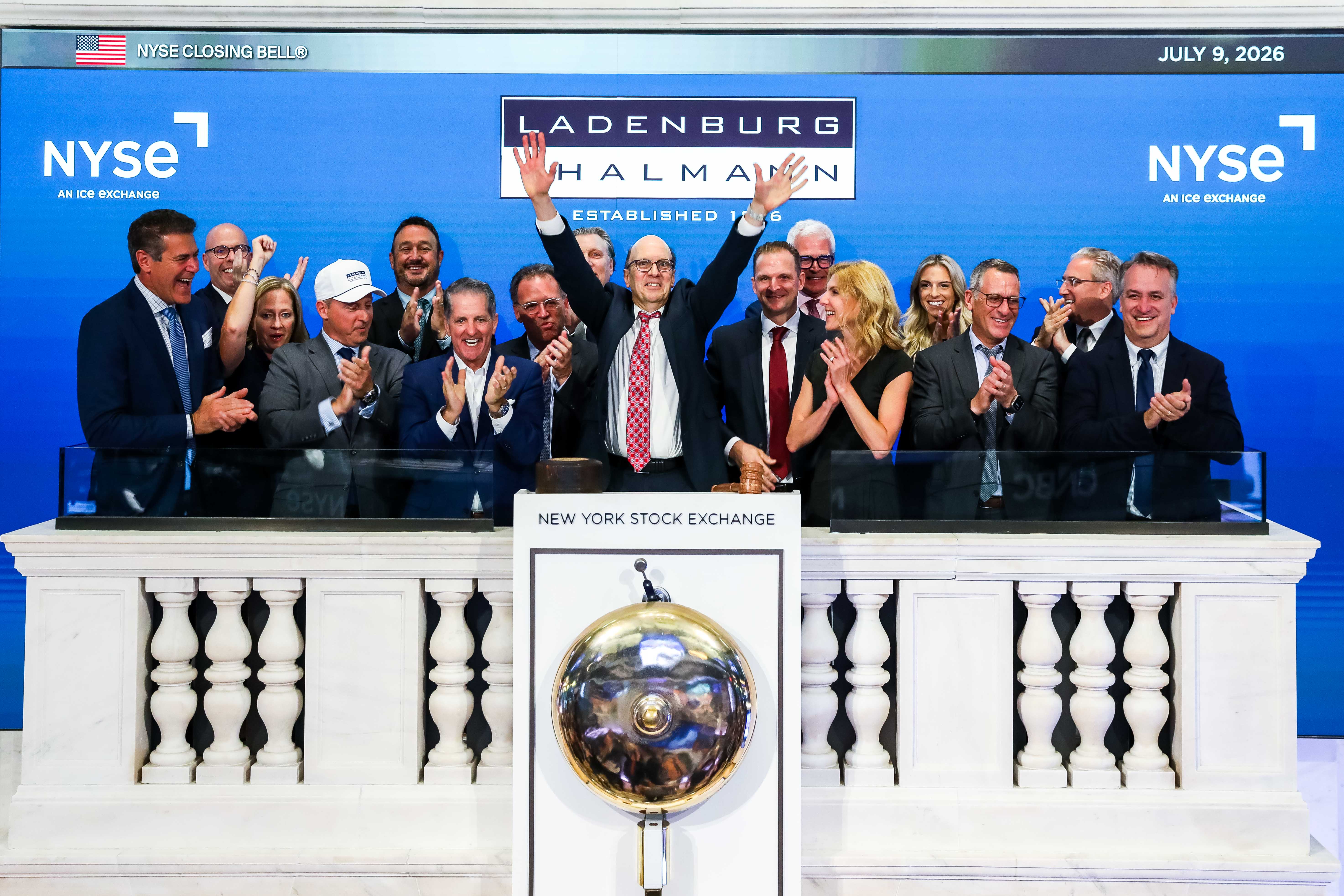
In December 1879, Ernst Thalmann paid $13,550 for a seat on the New York Stock Exchange. Picture the purchase for a moment. No factory. No railroad. Just permission to enter a room where other people could trade. Ladenburg Thalmann had opened three years earlier. Buying access was already part of the business.
- Ladenburg connects middle-market companies with investors and advises on corporate transactions.
- Its research universe includes roughly 150 companies, with a $350 million median market capitalization.
- Specialist knowledge and investor distribution explain the pitch. Fees and dilution explain the trade-off.
Almost 150 years later, the room has changed. Securities move electronically. A biotechnology company can present to investors without anybody boarding a train. Yet the awkward question remains: who understands this business well enough to put money into it? Ladenburg’s current services offer an answer built around research, introductions, transaction advice and execution.
A seat becomes a network
The firm began with Adolph Ladenburg and Ernst Thalmann in New York. Its early work connected American enterprise with European capital. The historical record on its website includes railroad financing and gold shipments. These were tangible, sometimes heavy, things. The banker’s contribution was organizing the people willing to finance them.
History also contains an enforced change of direction. Following the Glass-Steagall Act in 1933, Ladenburg ceased commercial banking and concentrated on investment banking. Regulation changed the permissible business model. The useful lesson is narrower than a sweeping claim about survival: an established firm still has to decide which activities fit the rules of its market.
The revealing number is $350 million
Today’s Ladenburg Thalmann & Co. Inc. is a New York investment bank owned by Osaic Holdings. It serves companies seeking financing or transaction advice, institutions seeking investment ideas and execution, and private clients seeking wealth services. Investment advisory services sit with the separate Ladenburg Thalmann Asset Management entity.
The bank’s equity research page lists 12 analysts, approximately 150 covered companies and a median covered-company market capitalization of $350 million. That last number locates its attention more precisely than the phrase “Wall Street.” This is a research universe with a substantial middle-market presence, where explaining a company to the right audience can matter.
Median covered-company market capitalization
Its sector map is specific: healthcare and life sciences; yield-oriented equities such as business development companies and real estate investment trusts; energy, power and infrastructure; and technology, media and telecom. Each requires different questions. A drug developer’s clinical timetable and a property company’s income stream demand different kinds of scrutiny.
Knowing the science has a use
In April 2026, Aydin Huseynov moved from Ladenburg’s equity research operation into biotechnology investment banking. He had spent four years covering the sector at the firm. His qualifications include a medical degree, an MBA and the CFA designation. His announced banking remit includes analyzing clinical and market data and advising management teams on development and regulatory considerations.
Two months later, Ladenburg added biotechnology research managing directors Rick Bienkowski and Caroline Palomeque. Bienkowski holds a doctorate in genetics and molecular biology; Palomeque studied neuroscience before earning an MBA. These appointments make the investment in expertise visible. People who can interrogate the technical argument help investors and executives discuss the same company with greater precision.
“They each bring significant experience in biotechnology equity research, combining scientific expertise with deep fundamental analysis.”Michael Gideon, co-CEO, on the June 2026 research hires
The same expansion extends beyond medicine. Floris van Dijkum’s arrival in July 2025 added dedicated REIT research coverage. For a prospective client, the practical question becomes whether the people covering its industry can understand the details that drive a financing decision. A long company history supplies context; current expertise has to do the work.
The price of an introduction
Consider enVVeno Medical’s October 2023 private placement. Ladenburg acted as exclusive placement agent on approximately $28 million in gross proceeds. The investor group was led by Perceptive Advisors. The financing included shares, prefunded warrants and additional warrants tied to clinical and regulatory milestones. The structure connected immediate funding with the possibility of later capital.
The placement agent received a cash fee of 7% of gross proceeds, a $50,000 expense allowance and warrants to purchase 241,130 shares. On a roughly $28 million raise, the cash fee alone works out to about $1.96 million. Those were this transaction’s terms, rather than a universal Ladenburg tariff.
Here is something a finance director can copy: compare usable proceeds, cash fees, expenses and potential dilution together. Ask what later funding depends on. A completed placement does not make a clinical trial succeed, and a warrant that could bring in money is still contingent capital. Access solves one problem while leaving the operating risks intact.
Who gets value from the room?
Ladenburg’s offering includes public and private capital raising, M&A advice, restructuring and fairness opinions. Its institutional operation supplies trade execution and access to company management. Corporate roadshows and conferences give those introductions a format. For Innovation EXPO25, the announced plan paired technology demonstrations and investor meetings with marketing support from B2i Digital.
The alternatives depend on the job. A company can compare sector-focused banks, larger investment banks and direct investor relationships. Ladenburg’s case rests on matching specialist attention with distribution. A venture too early for institutional capital may need a different route; a company seeking financing still needs terms it can afford. Neither an introduction nor a familiar name settles those questions.
One final distinction matters. Advisor Group completed its acquisition of Ladenburg’s former diversified public parent in February 2020. The announced enterprise value was about $1.3 billion. That figure belongs to the broader transaction, rather than a current valuation of the investment bank. The present company is easier to understand through the work: learn the business, find the audience, negotiate the financing.