The useful clue is hidden in an old photograph. Danielle Rago and Honora Shea sit in a pair of Eames lounge chairs, looking less like the founders of a publicity agency than two people waiting for a gallery talk to begin. This is fitting. One came from architecture and curation; the other from writing and contemporary art. When they met at a poolside exhibition during Palm Springs Modernism Week in 2014, neither appears to have been searching for the standard agency idea: clients arrive, press releases leave, invoices follow.
They were interested in a stranger transaction. Why did some architects with sharp ideas remain invisible while familiar names absorbed the attention? Why could designers speak fluently about mass timber, housing, waste, or public space to one another, then sound remote to everyone else? Their answer, formalized as This by That in Los Angeles in 2016, was to become a translator with an address book.

It began with a second life for an installation
The origin was not a pitch deck. Rago was helping an architect with an installation that had already appeared at Coachella and asked Shea to help find it a new home. They collaborated, then began assisting other young practices with installations and products. By the fall of 2016, the improvised arrangement had enough shape to become a company.
The founders did not initially know what that company should be. They had both written, so they put editorial relationships to work first. Press was the visible pain and the fastest place to show a result. Soon, though, the work spread upstream. A portfolio needed an argument. A project needed a narrative. A small studio needed to say, in a few sentences, what it alone noticed about the world.
“The image is the architects’ currency, the word is ours.”This by That, on its text-led rebrand
That line explains the division of labor neatly. An architecture studio supplies plans, spaces, photographs, research, and a point of view. This by That finds the sentence connecting them. Then it takes that sentence to editors, collaborators, and potential clients who can do something with it.
design thesis
story
& projects
The clip is not the finish line
Consider The LADG, a Los Angeles practice whose lake-house renovation drew on the Whitney Museum. The architects wanted a mainstream audience but, as principal Andrew Holder later put it, they felt adrift in a changing media landscape. This by That translated the studio’s internal conversation into a pitch for a general reader. The result was a standalone feature in the Los Angeles Times Home & Garden section - access that Holder said had previously eluded the firm.
A conventional agency could call that a completed job. This by That kept following the logic. If a story can make an architect intelligible to an editor, the same clarity can make that architect intelligible to a developer, a curator, a homeowner, or a cultural institution. Public relations and business development were not neighboring services. They were consecutive rooms.
The Playground
This by That matched Architensions with a Coachella commission. Four colorful towers, 42 to 56 feet high, opened in 2022 as a place for collective play.
Canal Projects
The agency paired Worrell Yeung with an arts organization renovating 6,000 square feet inside a landmarked cast-iron building.
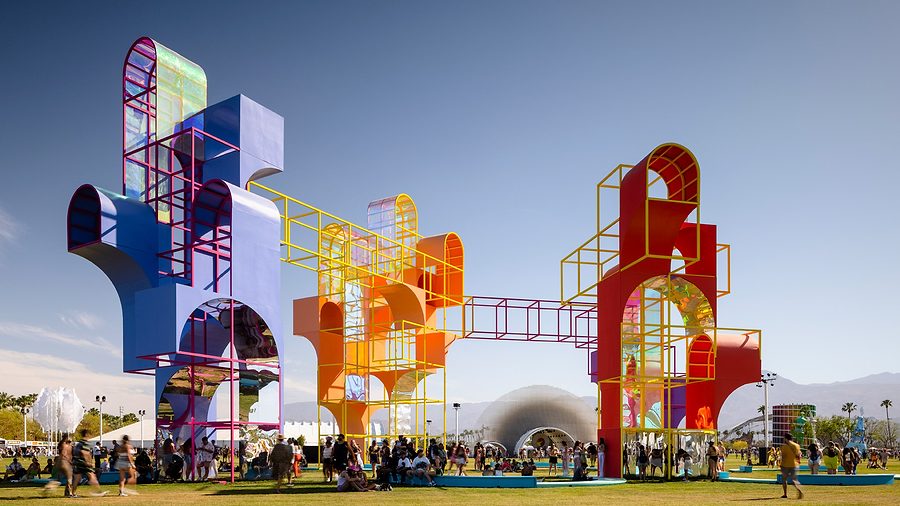
The two cases reveal the agency’s real product. It does not merely recommend a fashionable office. It curates a fit between an ambition and a practice: the right architect for a temporary public spectacle in the desert; the right architect for a contemporary gallery inside an old industrial shell. Its site describes the search range as everything from interiors and public art to ground-up buildings.
A roster is also an editorial decision
This by That calls its architects progressive, a useful word only if it has edges. Here it means small and independent practices that experiment with material, form, craft, housing, sustainability, and the civic life of buildings. The agency’s current-and-past list runs beyond 60 names, including ALA Studio, CO Adaptive, Future Firm, MKCA, Schaum Architects, Studio J. Jih, Worrell Yeung, and Young & Ayata.
The smallness matters. Specialist firms compete against large communications agencies, in-house marketers, and the architect’s familiar temptation to “just post it.” This by That offers intimacy and pattern recognition instead. It knows which editor needs a house, which institution is looking for a public gesture, and which part of a complicated practice deserves to become the opening paragraph.
The model has limits. It depends on work with an actual thesis, strong visual material, leaders willing to articulate their choices, and a market in which press or introductions can influence commissions. A mediocre project cannot be narrated into importance. Nor is specialist matchmaking useful to a client who has already selected an architect on price, procurement rules, or an existing relationship. The method works when distinction exists but has not yet become legible.
What another small firm can borrow
The transferable lesson is not “hire a publicist.” It is to treat communication as part of practice rather than decoration applied after the photographs arrive. This by That’s work suggests a compact operating sequence:
- Name the recurring inquiry. A list of projects is inventory. A clear question linking those projects is a position.
- Translate the consequence. Explain what changes for a resident, a neighborhood, a material stream, or a public institution.
- Choose the audience before the outlet. A trade publication, city newspaper, museum, and developer each need a different doorway into the same work.
- Let attention compound. Save the evidence, language, and relationships from one story and use them to qualify the next opportunity.
There is a social corollary. Architecture’s visibility problem is not evenly distributed. This by That has offered pro-bono support to Design Advocates, a New York network serving nonprofits and community organizations, and created Studio Visits - free one-hour consulting sessions for emerging BIPOC-led practices. This does not dissolve architecture’s entrenched inequalities. It does recognize that the ability to explain a practice, meet an editor, or enter the right room is itself a form of professional infrastructure.
The company changed its mark when its job changed
For years the agency was often rendered This X That. The X nodded to collaboration, a fashionable symbol of the 2010s, and to the mark for a two-by-four. People called it This and That, This X That, or simply This That. Eventually, the joke became a liability. As the company expanded from press into narrative strategy and matchmaking, precision mattered more. The visual identity shifted toward a text logo and the spoken “by.”
It is a tiny change with a revealing motive. The agency wanted to be understood correctly because understanding correctly is what it sells. Its recent work includes the launch of former NFL player Michael Bennett’s Studio Kër, campaigns around Studio Cadena’s Domino Square, and a steady press ledger for practices across the United States. The PR Net included This by That in its Next Gen selections in 2024 and 2025. The refreshed company site now says the Los Angeles-born business is based in New York City.
Yet the old X still captures something true. This by That occupies the crossing point: image and word, designer and client, private practice and public culture. The firm does not design the gallery or the tower. It designs the conditions under which a less obvious architect might be trusted to do so.