Sacha Samotin knows the occupational hazard of winning on Jeopardy!: nobody wants you on their trivia team. Or, more precisely, everybody might want you, which creates a problem for everyone else. At Applecart, the solution is to make the co-founder play alone. A television victory has become an office rule.
There is something pleasingly awkward about that arrangement. Samotin helps run a business built around the value of connections. Then the quiz begins, and his colleagues remove his. The person whose company studies the people around a decision-maker becomes, for the evening, an audience of one.
His route to that peculiar distinction runs through the House of Representatives, a university research job and a company founded with another undergraduate. Along the way, he kept returning to questions about people who exercise power: how they get there, how they think, and whose opinions reach them.
A face for every name
Before Applecart, there was Capitol Hill. As a congressional page, Samotin had to learn members of Congress by name, photograph and district. For a teenager, that is a substantial quantity of adults to keep straight. Most school assignments mercifully contain fewer elected officials.
He later described the task to Alex Trebek, who tested whether the information had stayed with him. It had. The exchange supplied a compact introduction to Samotin: someone whose early work required close attention to the people inside an institution, down to the face attached to each name.
By 2011, at the University of Pennsylvania, that attention had become a research project. A Seltzer Family Digital Media Award gave him access to recording equipment for interviews with current and former House members and staff. Working under political scientist Matthew Levendusky, he planned to explore leadership qualities and personal histories.
The award provided a year’s exclusive use of $1,000 in technology. In Samotin’s case, the proposed tool was an audio recorder. The premise was straightforward: ask people who had worked inside Congress to talk about their own experience.
His early career also included work for Jon Huntsman’s presidential campaign, as an assistant to the campaign manager in 2011 and 2012. His interest in political leadership ran alongside the daily work of campaigning. Before there was an Applecart product to explain to prospective clients, there had been a candidate seeking votes.
The project put biography beside authority. A congressional title tells you the office someone occupies. An interview can ask how the person arrived there. That distinction offers a useful way into Samotin’s subsequent career, where formal positions and informal relationships keep appearing together.
The question in the classroom
Samotin met Matt Kalmans one summer when both were undergraduate research assistants to Penn professor John DiIulio Jr. A political science class introduced research on voter turnout and social pressure. The finding that caught their attention concerned the influence people exert on one another.
It was the sort of classroom idea that can follow students outside the classroom. If relationships could affect whether someone voted, what other consequential actions might they shape? Samotin and Kalmans began pursuing the business implications, founding Applecart in 2013 while still undergraduates.
The underlying question had an appealingly ordinary quality. A person may ignore an advertisement and pay attention when a friend brings up the same subject. An executive has colleagues and advisers. A policymaker has trusted contacts. The job title does not abolish the social life around it.
In their tenth-anniversary reflection, the founders made that premise explicit: people holding powerful positions remain susceptible to familiar human influences. Their company would work on reaching them through the networks around them. A student encounter had become a continuing partnership, with a research question attached.
An audience with an inner circle
Applecart calls its approach Decision Maker Marketing. The company maps personal and professional relationships using publicly available data, helping clients reach both particular stakeholders and people connected to them. The relevant audience might include an executive, a policymaker, an investor or an analyst.
Consider a simplified example: an organization wants an executive to encounter its message. The executive belongs to a wider professional and personal network. A campaign can seek to reach that network as well. The illustration below shows the idea; the people and relationships are hypothetical.
This changes what counts as a useful audience. A large number of impressions says little about whether the people involved in a particular decision have encountered a message. Samotin’s business starts with a narrower set of names and asks how to reach the relationships around them.
There is a modest observation beneath the technical work: rank does not make someone self-contained. Even people paid to exercise independent judgment hear things from other people. Applecart has built products around making that familiar social fact useful to corporate communications and marketing teams.
A very good answer, a very small team
On June 22, 2015, Samotin faced five-game champion Brennan Bushee on Jeopardy! The Final Jeopardy category was “The Future of Television.” Samotin correctly identified Lost in Space, bet his entire $9,800 and finished with $19,600. Bushee also answered correctly, but Samotin’s wager put him ahead.
The victory provides a satisfying digression in a business biography. It also comes with a warning against turning every personal detail into a management principle. Knowing a television answer is enjoyable on its own. It need not be evidence of a secret formula for running a company.
His interests extend comfortably beyond work: Yankees baseball, Star Trek memorabilia and cookbooks. At home in Manhattan, he lives with his wife Laura and their cats, Tory and Bertie. These details give the résumé some furniture. The office trivia rule gives it a punch line.
Counting the noes
When Samotin talks about starting a business, his advice can be surprisingly tolerant of disappointment. In a 2023 conversation, he suggested treating rejection as something to count toward a target. Set out to collect enough noes, and each unsuccessful request becomes part of the work rather than a verdict on the whole enterprise.
The attraction of this advice is its practicality. A founder controls whether to make another approach. The answer belongs to someone else. Counting attempts that receive a refusal supplies a measure of progress during stretches when an ordinary success tally would look rather bare.
He also described difficulty raising money early as a useful experience. Capital creates decisions about how to spend it, and those decisions can arrive before a company knows enough about what it needs. For Samotin, the delay had value because it postponed some of those problems.
“Growth at any cost is not the priority.”
Sacha Samotin, 2023
His emphasis on growing a team at a sustainable pace belongs beside the fundraising story. Money, hiring and the work a company can actually support have to bear some relationship to one another. The advice has an unglamorous advantage: it remains relevant after the announcement photograph is taken.
The work after the idea
Inside Applecart, Samotin oversees product, engineering, talent acquisition and HR. Those responsibilities put him close to both what the company builds and the people doing the building. They also make the transition from an undergraduate idea concrete: software needs development; employees need hiring; the organization needs to function.
Samotin graduated from Penn magna cum laude. By the time he and Kalmans appeared on the 2021 Forbes 30 Under 30 list for Marketing and Advertising, Applecart had moved well beyond a student undertaking. The recognition put their names together, as the company’s leadership still does.
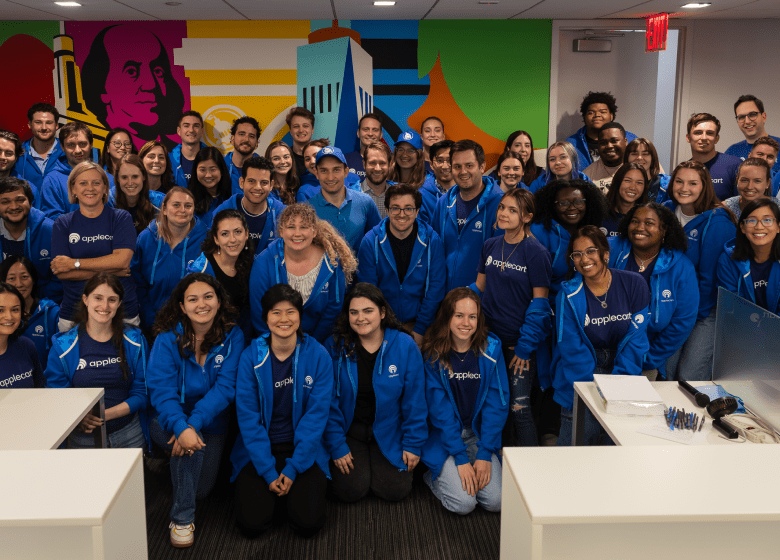
The paired title, co-CEO, is worth noticing without making a mythology of it. Samotin’s publicly listed operating responsibilities offer one view of how the partnership has developed. A business that began with two research assistants now requires distinct teams and continuing decisions about who should join them.
Back behind the microphone
In 2024, Samotin and Kalmans began hosting Decision Makers, conversations about how leaders reached their positions and what they learned about making decisions. Guests have included former congressman Sean Patrick Maloney, KKR’s Ken Mehlman, former White House communications director Kate Bedingfield and former congressman Steve Israel.
A February 2025 episode featured Jim Wilkinson, a former deputy national security adviser for communications. The guest list crosses government, communications and business, the same territories that recur in Applecart’s work. The format gives the hosts room to ask about the experience behind an official biography.
There is a continuity with the student who wanted to record congressional interviews in 2011. More than a decade separates the projects, but both make room for a person’s account of how authority works. Samotin’s career contains the act of selling access to an audience and the quieter act of listening to one.
The circle gets larger
In January 2026, Applecart announced a $100 million minority investment from Blackstone Growth. The transaction brought Blackstone and communications executive Risa Heller onto a board that already included Samotin, Kalmans and Ariel Emanuel. Emanuel had joined through Applecart’s 2018 Series A.
The announcement marked a further turn in the founders’ relationship with the corporate world. Their company was now serving senior leaders at major enterprises, agencies, nonprofits and trade associations. Samotin’s responsibilities still involved the practical machinery of product and people behind that expansion.
The distance from the House page program to this point is considerable. Yet the early exercise remains a fitting image: put a name to a face, understand the person’s place in an institution, pay attention to the people nearby. Applecart added technology and a business model. Samotin still has reason to study the room.