During an integration project at 3Play Media, Chris Antunes joined the engineering team to write code and help move the work along. The co-founder and co-CEO could have confined his contribution to a meeting. Instead, he worked on the thing itself. It is a small episode, but a useful introduction to someone whose business depends on what happens between a promising piece of technology and a finished piece of work.
Antunes leads operations and product innovation at the company he started with three MIT Sloan classmates in 2008. Its work includes captions, transcripts, audio description, subtitles and dubbing. These are the words and voices that travel with a video, helping it reach people beyond its original presentation or language. A viewer sees the result. Antunes’s territory includes the machinery, people and decisions required to produce it.
That division of attention has become more interesting as artificial intelligence has become better at generating convincing first attempts. A machine can supply words quickly. Someone still has to decide whether the words belong there, whether the timing works and whether the result deserves to be published. Antunes has spent much of his career building a business around that interval.
The apartment with a corporate visitor
The company began with an unusually concrete assignment. MIT OpenCourseWare had lectures to caption. Antunes, Josh Miller, C. J. Johnson and Jeremy Barron developed a system that used speech recognition to generate a draft, then made that draft easier for a person to correct. Their early work covered 100 hours of video from five MIT courses. The customer’s problem arrived before the founders had a mature business to sell.
After Sloan, the founders worked from a small apartment in Somerville, Massachusetts. Their desks held copies of JavaScript for Dummies. They called colleges and universities to find customers. When Yale representatives announced a visit to the company’s headquarters, the founders lit candles and hosted them in the apartment. Corporate hospitality, at this stage, came with a match.
Yale became an early major customer beyond MIT. The episode has the comic proportions of a startup story, but the underlying transaction was serious: an institution needed a dependable way to caption its material, and a young company needed to show it could deliver. The apartment was temporary. The requirement to turn an awkward process into a repeatable service would stay.
MIT OpenCourseWare gave the founders a real captioning job to build around.
A better place to make corrections
The early technical insight was modest enough to be easy to overlook. Speech recognition could provide a useful starting point without producing a finished transcript. The opportunity lay in reducing the effort required to fix its mistakes. Better editing software could remove repetitive work and keep text synchronized with the video as people corrected it.
That approach gave the business two jobs at once: improve the technology and make the human work more productive. The founders developed their prototype with MIT’s Spoken Language Systems Group. Antunes graduated from Sloan with an MBA in 2008; his earlier education included economics at Harvard. His eventual remit would bring product choices and operational execution together.
The same time data also made transcripts useful beyond the caption file. Viewers could follow highlighted words as a video played, search the text and click a passage to jump to that moment. A lecture could become easier to navigate as well as easier to follow. The words were doing several jobs, which is a respectable workload for something generally confined to the bottom of a screen.
There is a practical continuity between that early editing interface and Antunes joining an engineering project years later. Both put attention on the work between input and delivery. The interesting question is how a useful capability becomes something a customer can order, receive and use again. A successful demonstration supplies the beginning of that answer.
A simplified illustration of the original process, rather than a promise about every current service.
Two chief executives, different desks
Antunes shares the chief executive role with Miller. Their responsibilities have a clear emphasis: Antunes leads operations and product innovation, while Miller oversees the teams bringing the company’s services to market. The arrangement gives their partnership a practical shape. Customers’ expectations and the systems needed to meet them have people responsible for each side.
The engineering anecdote is especially telling in that setting. Antunes’s willingness to work alongside developers makes his role more tangible than a title alone would. It also offers a small, observable example of participation. An executive can speak about collaboration indefinitely; a contribution to an integration project has a more specific destination.
The leadership group has evolved around the founders. In February 2025, 3Play promoted Dan Caddigan to chief technology officer and Lily Bond to chief growth officer. Caddigan had joined in 2021; Bond had been with the company since 2014. Antunes’s comments on the promotions paired Bond’s knowledge of customers and the market with Caddigan’s technical leadership. He described the next stage of the company in terms of what those people would help customers accomplish.
Later that year, the Entertainment Globalization Association named Antunes first in the leadership category of its Top 100 Professionals in Content Localization. Caddigan took the first technology spot. The two recognitions put a public marker on the combination Antunes’s work keeps returning to: people who understand the assignment and tools that help them execute it.
What an acquisition brings besides scale
The company’s growth has also involved bringing other teams into the operation. In 2022, 3Play acquired Captionmax and its subsidiary National Captioning Canada. Captionmax had begun in 1993 and brought relationships and experience across broadcast, enterprise and streaming media. By September 2022, the businesses were operating under the 3Play name, with the Canadian operation becoming 3Play Media Canada.
For Antunes, the combination extended the service available to media customers. He highlighted post-production work, including as-broadcast scripts and voice-artist audio description. These are particular production tasks with particular requirements. Folding them into a platform meant joining software with people who already knew the work, rather than assuming that a larger menu alone would make delivery straightforward.
An as-broadcast script records what actually went out in a film or television program. It is the sort of detail that can disappear inside an announcement about expansion. Yet those details are where an operations leader’s assignment becomes visible: different customers need different outputs, and each output has to fit the process in which it will be used.
A voice needs more than a language setting
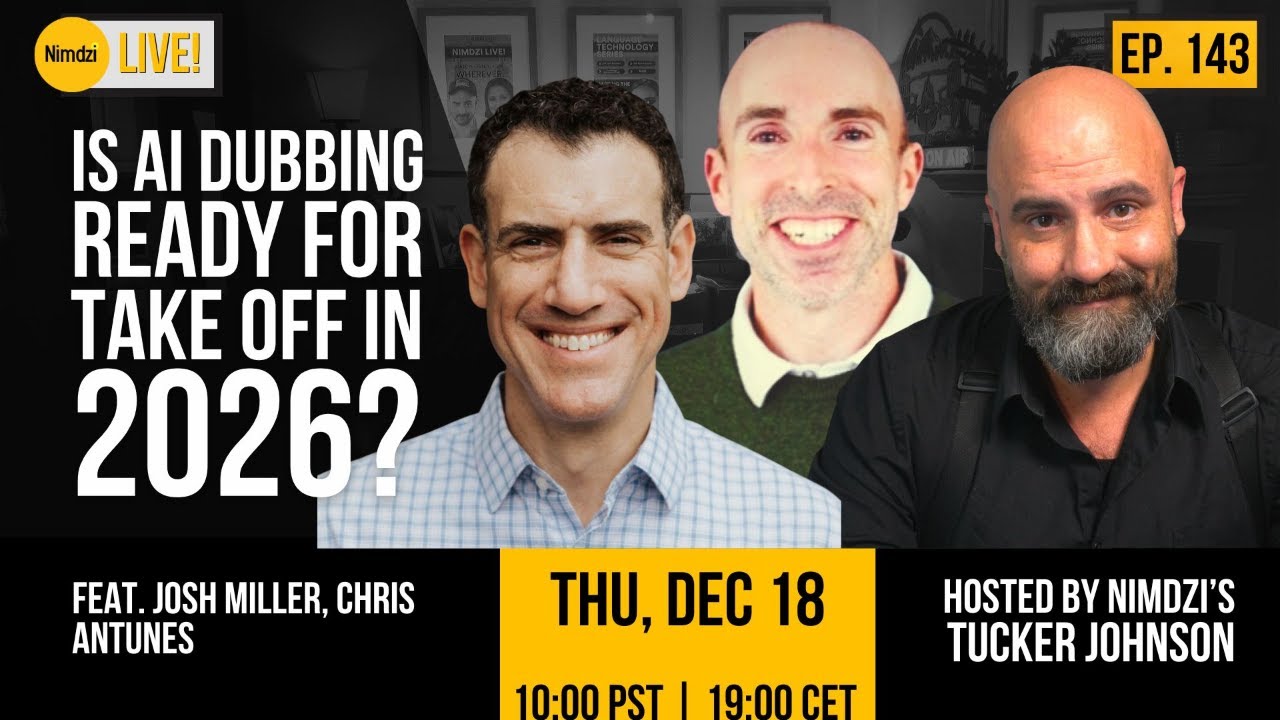
By December 2025, Antunes and Miller were discussing AI dubbing with Nimdzi host Tucker Johnson. The conversation addressed the distance between a short demonstration and sustained production. Voice selection, speaker identification, timing, translation, performance and mixing all enter the workflow. Changing the language of a video involves decisions about how its people should sound.
The operational question is familiar from captioning, even though the output is different. Which parts can be automated? Where should a person intervene? How much review does this particular piece of content require? The company’s approach offers different levels of automation and expert involvement. Antunes’s focus on the relationship between technology and people now extends into the production of new soundtracks.
In April 2026, 3Play launched a dubbing service built for YouTube creators. It paired production with channel analytics, helping teams choose videos and languages using information about their audiences. Human-reviewed scripts, cultural adaptation and voice production were part of the offering. The work continued beyond handing over an audio file.
“The AI makes the workflow fast and scalable.”
Chris Antunes · April 2026
His wider point was about accountability: creators need help determining what to localize and whether the investment is working. In August 2026, he returned to that theme when discussing audience engagement data. Performance in a language could guide whether a creator kept investing there. Faster production creates more options; the next decision is which options to pursue.
Another 2026 launch, Pulse, addressed a different part of the same production problem: understanding what needs attention across a video library. The product audits and scores material, then routes work for remediation. For Antunes, it offered a way to bring visibility and coordination to a collection that might otherwise be handled video by video. A large library can contain many separate decisions about captions and audio description. Organizing those decisions is a product problem in its own right. The work expands from making one file usable to helping an organization manage the files it already has.
Somewhere beyond the next release
Away from work, Antunes is a father of three boys and a competitive distance runner. His introduction for the Nimdzi conversation also made room for coffee. It is an appealingly ordinary detail in a career concerned with speech technology: all that automation, and the person still appreciates a cup.
Running gives the portrait another dimension without requiring it to explain every business decision. He competes, trains for races and has a family alongside the company he has helped build since Sloan. These are commitments with their own demands on time. The public version of Antunes contains room for each.
His professional story has a particularly durable thread. It starts with an imperfect transcript and a person correcting it. It continues through an engineering integration, a shared executive role, acquired production teams and the choices involved in dubbing a creator’s video. Across those settings, Antunes keeps working on the conditions that let people finish something well. The machine’s first draft has improved considerably. His attention remains on what happens next.