In 2010, a stenographer named Mirabai Knight captioned 30 videos in 30 days using a new tool called Universal Subtitles. It was a small, wonderfully concrete demonstration. Here was someone taking videos that some people could not follow and making them usable. The software supplied a place to work. Knight supplied the attention.
Universal Subtitles became Amara. The relationship between those two ingredients has occupied the organization ever since. Video travels cheaply. Understanding it still takes work.
- Make it yourself: edit, synchronize and translate subtitles in a browser.
- Make it together: coordinate contributors and review before publishing.
- Buy the expertise: order professional captions and translations.
- Mind the change: the old public workspace retired in 2026.
The crowd needs somewhere to sit
Amara is a project of the Participatory Culture Foundation, a US nonprofit. Co-founders Nicholas Reville and Dean Jansen helped build a platform around a deceptively awkward problem: a video can be publicly available and effectively inaccessible at the same time. A viewer might be deaf, hard of hearing, or perfectly able to hear a language they cannot understand.
A caption captures speech and relevant sounds in the original language. Translated subtitles bring the dialogue into another language. Both need timing. Both need someone to consider what a viewer can read while the picture keeps moving. A technically accurate paragraph, flashed on screen for a second, is a rather expensive way of saying nothing.
Amara’s editor breaks the job into typing, syncing and reviewing. Keyboard controls let contributors pause playback and mark when lines begin and end. A beginner mode plays four seconds, then pauses. The modest detail matters: it gives someone learning the task a manageable piece of work.
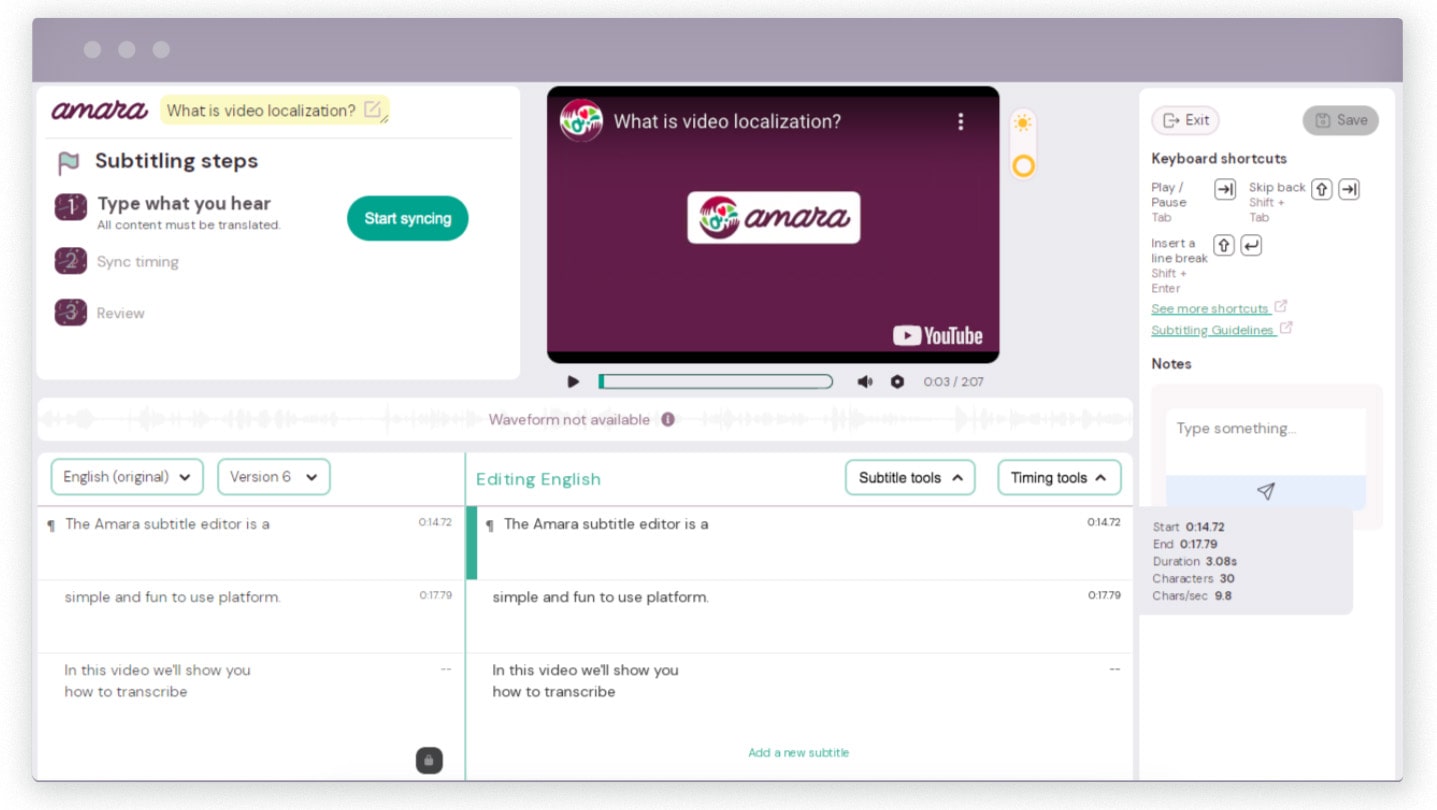
The organizational insight was just as useful. Volunteers often care about a particular subject or publisher. In the 2012 election cycle, PBS NewsHour attracted more than 800 participants who translated more than 200 videos. Amara could give each interested community a common workspace, rather than assume that one general-purpose crowd would handle every request.
“We’re trying to create a Wikipedia for subtitling”Nicholas Reville · 2013
The bill behind the mission
The customers now range from individual creators to education and cultural organizations. Amara highlights NOWNESS, the arts and culture video publisher, as an On Demand client. Net in Nederland, serving refugees and immigrants with translated information about Dutch society, is an enterprise example. Their audiences differ. Their production problem is recognizable: someone must get the right language onto the right video.
Amara sells subscriptions, customized enterprise arrangements and professional services. Its On Demand operation adds linguists and project coordination to the software. Captioning, subtitle translation, transcription and text translation are separate jobs, with different economics. The organization says revenues support PCF’s mission and operating costs.
At research time, Plus is advertised at $24 a month for two users, with additional users at $12 each. It includes 60 minutes of AI captions monthly. The March 2026 ordering guide lists professional captions from $2 per video minute and translated subtitles from $9. These are starting prices, subject to the actual project.
The low price of an automatic draft can be misleading if the buyer forgets to budget for checking it. Amara’s October 2026 writing explicitly advocates combining machine translation with professional judgment. Its argument concerns meaning, terminology and cultural context, the things a plausible sentence can quietly get wrong.
There is another cost hidden in a translated subtitle: the decisions that do not fit neatly into a rate card. Does a joke depend on a local reference? Will a longer translation leave enough time to read it? Does the viewer need a speaker identified or a sound described? Amara’s October explanation of language services treats these as production questions. A project manager can gather the answers once and carry them across languages.
Two doors close
The nonprofit’s history includes uncomfortable choices. In January 2020, PCF announced it would close Amara’s source code. It said cloud software had changed who benefited from open distribution, and described a venture-funded organization using its code in ways PCF considered inconsistent with its values. Commercial reuse threatened the earned revenue supporting its work.
That announcement documents a judgment about sustainability, rather than a technical failure. Amara’s team concluded that unrestricted code sharing and financing its mission were pulling against each other. Readers building nonprofit software can recognize the dilemma without pretending the decision was cost-free.
A second change arrived in 2026. Amara announced that public-workspace uploads would end April 30, with existing subtitle viewing and downloading extended to May 15. Users needed to migrate material or save their files. Volunteer teams continued, alongside personal and private-team options.
Amara described the change as a way to concentrate limited resources on human-led accessibility tools. Its announced directions included audio description, dubbing and a more capable player. Those were development intentions, not a list of finished features. For an archive owner, the immediate lesson was more prosaic: keep your own subtitle files.
Hire the judgment. Organize the handoffs.
Amara occupies the space between an editing tool and a managed language service. Rev and 3Play Media are service alternatives; Subtitle Edit offers free, open-source editing. Amara’s particular proposition combines collaborative production with optional professional help and a nonprofit purpose. Which option fits depends on who will actually do the work.
Scale makes this less glamorous work more consequential. PCF reports over a million completed subtitles across Amara and Amplifying Voices, with contributors from 107 countries. That is an output measure, not a customer total. It describes many small acts of editing accumulating into an international body of work.
For a publishing team, the portable idea is to define the handoffs before increasing volume. Pick one video. Establish the source transcript, assign a translator who knows the language, name a reviewer, and watch the result at normal speed. Export the finished files. Then repeat the process across a series.
That approach needs available speakers, time for review and a reason for volunteers to participate. A tight deadline without contributors calls for paid capacity. A sensitive subject calls for relevant expertise. Buying a workspace cannot supply either automatically. Amara’s enduring insight is that accessibility depends on arranging these human contributions so the next viewer can simply press play.
Amara · Plans · Professional services · News & ideas
Editor tutorial (2014) · Mary L. Gray talk, with Dean Jansen Q&A