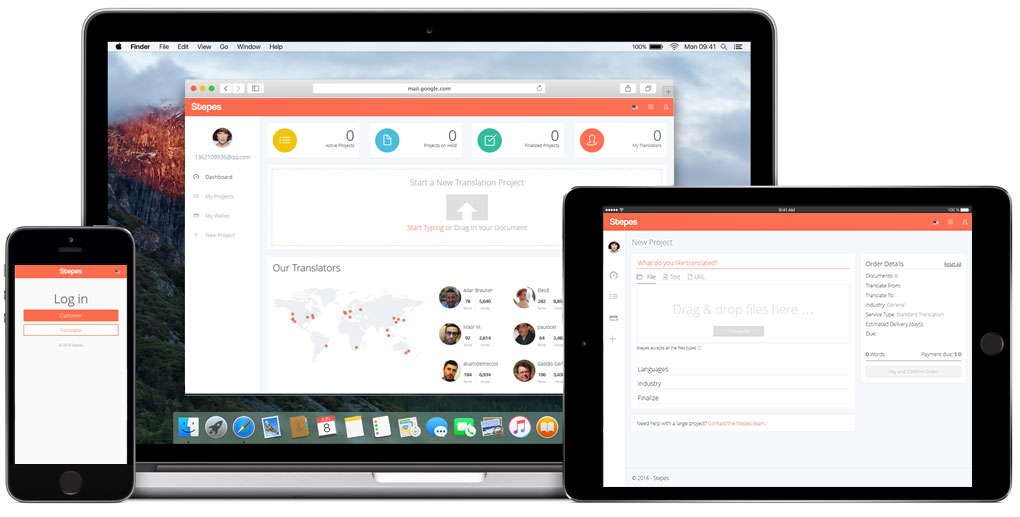
A phone is a peculiar place to put a translation business. The screen is small. The document may be enormous. A legal agreement arrives wearing its formatting like armor: clauses, tables, references, little pieces of meaning that cannot simply fall off. In 2015, Stepes tried to squeeze that work into the place where people were already comfortable writing: a conversation.
- The original idea: turn translation into message-sized tasks on a phone.
- The business today: language services, AI, human review, and enterprise workflow tools.
- The useful lesson: make work easier to access while preserving the context that makes it accurate.
The desk was the first obstacle
Stepes, pronounced “steps,” emerged from localization company CSOFT International. Its creator, Carl Yao, was looking beyond the established professional translator’s workstation. Bilingual specialists already had phones. Could the software bring appropriate work to them without requiring a complicated desktop setup?
The snag was the interface. As Yao explained at launch, people did not write dissertations on phones. Existing translation tools also asked users to handle formatting tags. The problem preceded any grand ambition about market size: a long document was an awkward thing to operate with two thumbs.
The solution was to change the unit of work. Stepes divided text into smaller segments and presented them like messages. Translators could type or dictate a response. Swiping revealed neighboring text, helping a sentence retain its connection to the document around it. The chat bubble made the task approachable; access to context made it more useful.
“Using your smartphone, you can translate anytime, anywhere.”
Carl Yao, launch announcement, December 2015
A chat bubble grows a back office
That origin explains Stepes’ distinctive starting point. It also makes the current business more interesting. The company now sells an extensive set of language services: document and certified translation, website and software localization, medical and legal work, financial content, eLearning, video, and interpreting.
Customers include teams responsible for international products, technical documentation, marketing, and regulated material. Its homepage displays names including Deloitte, Netflix, Zoom, and Abbott. Those logos indicate the company’s claimed customer relationships; they do not tell us the size or scope of each engagement.
Buyers also have alternatives: TransPerfect for language services, LILT for AI-assisted enterprise translation, and Phrase or Lokalise for localization platforms. Stepes competes through its combination of managed linguistic work and connected production tools.
The recurring problem is coordination. A product team changes a feature name. Documentation follows. Training follows later. Different countries request revisions. Someone must decide which wording is approved and carry that decision forward. Stepes’ enterprise proposition connects those requests, language assets, specialist linguists, and review steps.
- 01BriefAudience, language, risk
- 02TranslateAI, human, or both
- 03ReviewMeaning, terms, context
- 04ReuseApproved language assets
The word that needs a picture
Consider “Open.” In a software interface, it might be an instruction, a status, or part of a longer label. A list of strings can conceal those differences. In October 2019, Stepes introduced StepesIT, which mapped software strings to interface screenshots so translators could see where words belonged.
Its video service, announced that same month, addressed a different handoff. Automated transcription produced editable text and time codes. Professional linguists reviewed and translated the material; translated subtitles could then be applied against those time codes. Voice-over was another option. Automation handled parts of production while language specialists handled meaning.
By March 2022, Stepes was announcing continuous terminology management. A glossary might sound like administrative furniture. For a company naming the same component across manuals, training, and support pages, it is an agreement about what things are called. Keeping that agreement current can prevent the next project from reopening the same argument.
The meter runs by the word
Stepes earns money from translation services and enterprise programs, with separate subscription pricing for machine translation. Its published human-service rates put standard work at $0.09 to $0.20 per word. Marketing and legal/medical work are listed at $0.12 to $0.24. These rates are based on translating from English; actual pricing depends on the language pair.
Published standard rate × 1,000 words. A calculation, not a project quote.
The separate machine-translation page advertises plans starting at $95 per month on annual billing, covering 5,000 words or 20 documents. These are different services with different limits. Buyers should define the review, formatting, and delivery requirements before comparing totals. An inexpensive draft and publication-ready specialist work do different jobs.
For ongoing users, the purchasing question becomes broader than the rate card. Which approved terms carry into the next release? Who reviews changes? Where do completed files return? Those answers shape the amount of repeated work a company buys. A pilot using representative files can expose friction before a larger translation program inherits it.
The human job changes shape
Stepes’ early pitch emphasized mobile access to human translation. Today its website promotes DomainAI, domain-tuned workflows combining terminology, translation memory, and appropriate human validation. That is an observable change in positioning. It suggests a broader role for automation, without establishing a single moment when the company changed its mind.
Translation memory matters here. It stores approved source-and-translation pairs for reuse. Similar content can be offered to a linguist for adaptation; an apparent match still needs the right context. Enterprise Cloud Translations, launched in 2017, also targeted surrounding tasks such as quotations, translator provisioning, quality checks, and billing.
Stepes therefore occupies the space where a managed language service meets translation software. Its appeal rests on combining access to specialists with tools for organizing repeated work. A buyer choosing among service providers should test that combination on actual content, including ambiguous strings and awkward file formats.
Make the task smaller. Keep the meaning.
The lesson worth borrowing is practical. Establish a vocabulary owner. Collect approved translations. Give translators screenshots and audience information. Connect recurring requests to the systems where content changes. Stepes offers APIs for that connection, alongside its customer portal and managed services.
The same discipline applies to AI. Stepes describes selecting workflows according to content, audience, and business risk. That puts a useful decision before production begins: which material can use an accelerated draft, and which requires specialist translation or deeper review? The choice belongs in the brief, where customers and linguists can act on it.
The approach depends on usable source material and deliberate review. Breaking text into pieces can obscure relationships. Old approved language can preserve old mistakes. Sensitive content needs an agreed workflow and qualified judgment. A smoother interface helps people begin; the quality of the surrounding information determines what they can finish.