A translation can read beautifully and still be the wrong thing to submit. The missing piece might be a signed statement, a reviewed technical term or a page whose labels survived the trip into another language. MultiLingual Technologies has built a business around those practical details. Now it is packaging more of that work into software, while keeping professional linguists in the picture.
The Santa Clara company, known as MLT, provides written translation and live interpreting alongside localization, publishing and training. Its customers operate in places where communication has consequences: public agencies, healthcare organizations, legal practices and technology businesses. The interesting question is how an established language provider makes itself useful when an AI tool can produce a plausible translation almost immediately.
MLT’s answer is becoming visible in its product lineup. BabelBee helps teams produce and review translated documents. CertiDoc handles certified paperwork. InterpretManager organizes live interpreting. MLT Academy trains people to do the human work. Read together, the offerings suggest a company selling the entire assignment, from the incoming request to the finished, usable result.
The county contract tells a better story than a logo wall
Consider Clackamas County, Oregon. Its public agreement with MLT covers interpreter services ordered as needed, including work for county departments and specified affiliated entities. An assignment requires an executed task order. The contract sets an annual payment ceiling of $250,000 and an expiration date of June 30, 2028, unless terminated or extended.
That ceiling describes purchasing capacity, not guaranteed sales. The agreement explicitly leaves the amount of work uncertain. This is an institutional service business with assignments to fulfill, records to maintain and invoices to submit. A supplier does not get paid merely for being available on the list.
Annual payment ceiling in the county agreement.
A spending limit, not reported revenue.
Actual payments offer a smaller, more revealing view. County records dated January 5, 2026 list December 24 payments to MLT including $683.99 for interpreting labeled “DD” and $309.60 for housing interpreting. Other entries record additional interpretation services. These are everyday administrative transactions, the kind that make language access an operating expense rather than a ceremonial promise.
MLT competes for that practical work. The county’s July 2023 agenda also lists interpreter agreements with Language Link, Verbio, Homeland Language Services and other providers. Its presence in that field does not establish an exclusive franchise. Buyers have alternatives, and delivery on ordinary assignments is part of the contest.
A technical company with a linguist’s instincts
Founder and chief executive Frank Wei brings a professional identity rooted in translation. His public career profile also lists leadership of Master Translation Services in China. MLT’s trade association description emphasizes high-tech industries, particularly information technology, electronics and life sciences, alongside healthcare and other institutional work. That mix helps explain why the company talks about engineering as well as language.

Its website displays customers including Dell, Siemens, Adobe and Blue Cross Blue Shield of Louisiana. Those are company-presented relationships, rather than a measure of current contract size. More useful than the collection of logos is the range of deliverables: the same broad language business can encompass a software interface, a technical manual and an appointment that needs an interpreter.
MLT describes its operating values in terms of integrity, accuracy and lasting customer relationships. Its account of exhibiting at the 2017 Association of Language Companies conference adds a less polished detail: much of the professional conversation concerned sales, staffing, contracts and management. Translation expertise still has to be organized into a functioning business.
BabelBee puts a second reader in the workflow
On May 29, 2026, MLT announced BabelBee, a document translation platform that uses AI for an initial draft and a different model for quality checking. Its launch description says questionable segments enter a workflow for linguist review. Shared glossaries and translation memory help teams reuse agreed terminology across assignments.
The company’s stated motivation was customer demand for a practical way to incorporate AI. It described two unsatisfactory outcomes: automated output with errors and traditional processes whose cost or turnaround did not suit the assignment. That is the problem BabelBee is meant to address, rather than a disclosed story of a failed product or an overnight conversion.
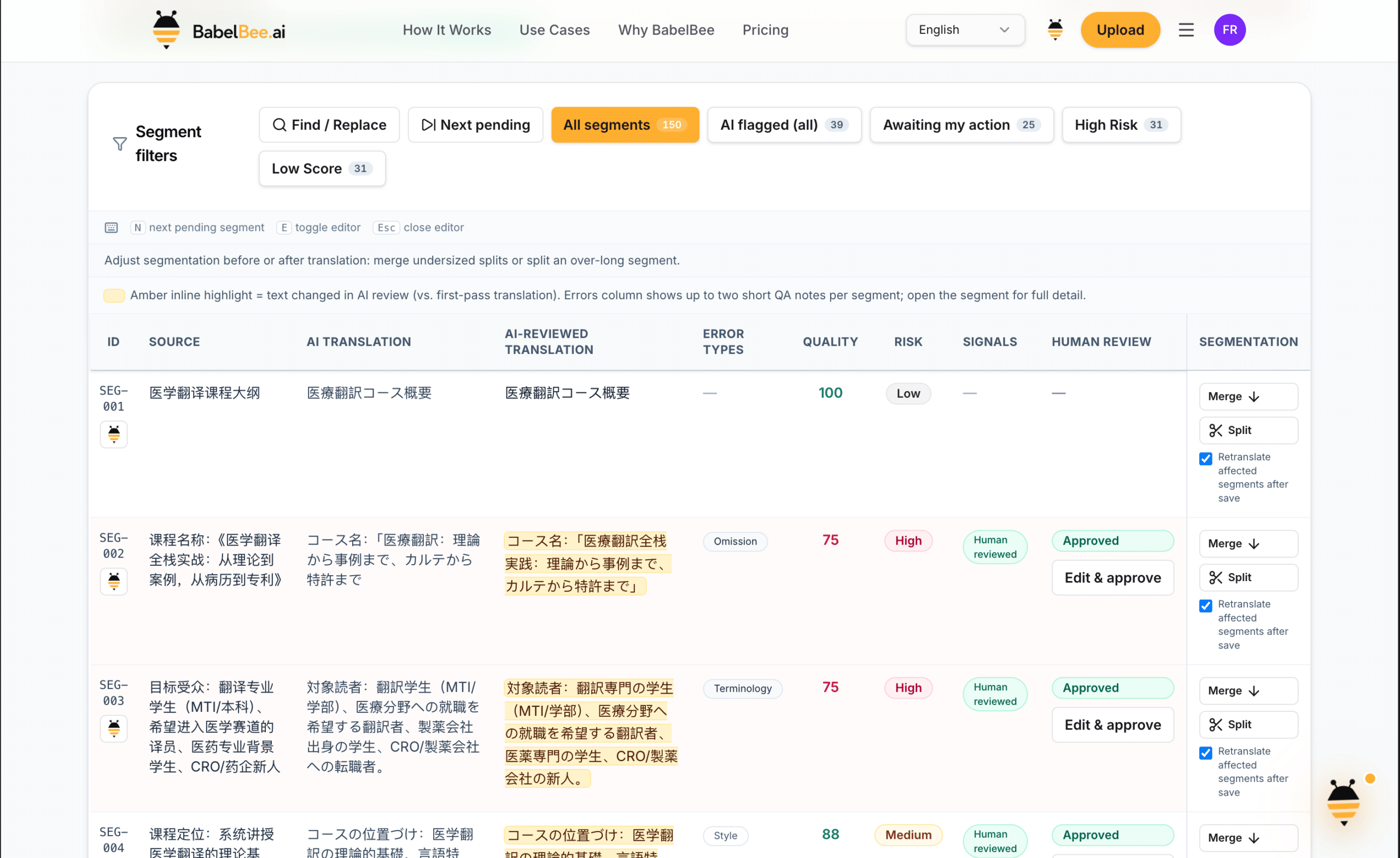
The product’s significance lies in where review happens. A team can work with machine output while assigning human attention inside the production process. For a buyer, the useful follow-up is specific: which passages receive professional review, who approves delivery and what is included in the quoted service?
- 01AI draft
- 02Second-model check
- 03Flagged text to linguists
- 04Approve and export
Live conversation needs a different machine room
A document can wait for another pass. A spoken exchange has its own clock. MLT offers phone, video and on-site interpreting, with both scheduled assignments and on-demand service. It also advertises sign-language support by video. The company says its wider services span more than 300 languages; availability for a particular assignment remains something to establish when booking.
InterpretManager addresses the organization around the conversation. MLT’s product page describes matching requests by language, skill and availability; managing interpreter qualifications; scheduling appointments; and tracking usage for billing. Reports cover demand and utilization. These functions matter to a manager trying to connect the right person and account for the work afterward.
The public page also lists integrations with meeting and business tools, including Zoom, Microsoft Teams, Stripe and QuickBooks. The operational appeal is easy to understand: fewer disconnected steps between requesting help, delivering it and reconciling an invoice. The advertised interface is evidence of the intended workflow, not a published measurement of a customer’s savings.
MLT’s account of the April 2025 Ohio court technology conference describes interest from administrators dealing with rural coverage and difficult-to-fill language pairs. The company demonstrated remote capabilities and came away arguing for continued human responsibility as courts explored automation. Its position was explicit:
“AI should support, not replace, professional interpreters.”MLT Editorial Team · May 2025
In a separate interview article with Boostlingo’s Dieter, MLT discussed scheduling, remote work and the technical skills interpreters increasingly need. Together, these accounts show its thinking developing in public through professional conversations. They support a story of adaptation, without requiring a dramatic founder epiphany.
The signature, the screen and the stubborn text box
CertiDoc serves a more tightly defined task: getting an official document translated through an online ordering process. MLT describes uploads, per-page pricing, status tracking and typical 24-hour delivery, with rush options. The audience includes people handling immigration paperwork, academic records and legal or business documents.
MLT’s certified translation service includes a signed statement of accuracy, attention to seals and signatures, and review. It also distinguishes self-service orders from managed projects with an editor and quality assurance. The point for a customer is to match the delivery to the receiving institution’s requirements. A promised translation turnaround does not promise an institution’s decision.
Elsewhere, the job can be less bureaucratic and more visual. MLT’s localization offering covers website content and navigation, software interfaces and testing, and multimedia such as voice-overs and subtitles. A translated menu has to fit the interface. A voice-over has to function inside a piece of media. The language assignment reaches into the product.
Desktop publishing is where this becomes delightfully literal. Text changes length. Scripts change direction. A file that behaved in one language can spill out of its boxes in another. MLT offers layout reconstruction, script-appropriate typesetting, font checks and repositioned graphics. It works across design, office and technical documentation formats.
That service reveals something easy to miss in an AI translation demonstration. Producing words is one stage; returning a usable publication is another. Buyers who budget only for the first may still have production work left. MLT’s combination of translation and publishing gives them a way to commission both in the same brief.
A $289 investment in the human part
MLT Academy makes the company’s attention to people tangible. Its 40-hour medical interpreter course was listed at $289 when reviewed on September 9, 2026. The published curriculum includes professional boundaries, ethics, terminology, remote technology and scenario-based practice, followed by a final examination.
The distinction between training and certification deserves care. MLT describes the course as meeting the 40-hour education requirement toward CCHI and NBCMI eligibility, and awards a completion certificate. Taking the course is a training step, not automatic national professional certification. Its Academy says enrollment includes a year of course updates.
For the business, training adds another paid offering beside project work and institutional contracts. For the student, it exposes how much interpreting involves beyond speaking two languages: judgment about role boundaries, confidentiality, preparation and handling a difficult exchange. Software does not make those subjects disappear from the syllabus.
Buy the finished assignment
The lesson a reader can copy is in the purchasing brief. Name the document’s destination, its format, the audience and the person responsible for approval. For live interpreting, specify the setting and required expertise. Ask how review, scheduling and finished-file preparation appear in the price. MLT’s service menu makes those separate tasks visible.
The fit depends on the assignment. Someone seeking only a rough understanding of a casual text may have little use for managed review and publishing. A team without an available reviewer cannot assume that a review workflow completes itself. Remote service also depends on a workable connection and an appropriate setup. These are reasons to choose the service deliberately.
MLT’s market position rests on combining language professionals with the tools and administration around their work. BabelBee makes that proposition newly explicit. The draft may arrive faster. The customer still needs an answer to the older question: is this ready to use?