Ittai Dayan has spent years trying to sell people an arrangement that sounds, on first hearing, rather improbable. They can work together on their data. They can learn from one another. They can build a shared AI model. And they can keep possession of the information that made the collaboration worth attempting. In a business accustomed to asking where everything should be stored, he asks where the work should happen.
The distinction has occupied a considerable part of his working life. Dayan is the Boston-based co-founder and CEO of Rhino Federated Computing, which he started with Yuval Baror in 2020. Its proposition puts computation close to the information it needs, inside environments controlled by the organizations that hold it. The resulting collaboration asks participants to agree on a process without first agreeing to hand over their filing cabinets.
There is an appealingly practical quality to this ambition. Companies already have data, software, security teams and reasons to be protective. A founder can regard those arrangements as obstacles to be demolished. Dayan has built his business around accommodating them. The locked door becomes a design requirement. The person holding the key gets to keep it.
A consultant gets his hands dirty
Before Rhino, Dayan worked at Boston Consulting Group. His assignments involved strategy, corporate development, organizational change and operations for Fortune 500 companies. That is useful preparation for discovering how many people have a vote in a technology purchase, including people who would be perfectly content if the purchase never happened.
He later moved from advising organizations into leading AI development and deployment. In describing that transition, he used the phrase “get my hands dirty.” It is a revealing choice of words for someone whose eventual product would concern itself with permissions, infrastructure and the unglamorous business of making different systems cooperate. A demonstration can impress a room. A working service has to survive the room’s IT department.
A distributed research collaboration in 2020 gave him a practical view of federated learning. The experience exposed coordination problems alongside the technical possibilities: participating sites needed to understand their data, organize the work and support unfamiliar software. Dayan saw an opening for a platform that would make these collaborations repeatable. That distinction between a successful experiment and a usable product became the basis of a company.
Two founders, one awkward question
Baror brought experience building AI production systems and a history of entrepreneurship. When Dayan announced their venture, he described Baror as his friend as well as his co-founder. Their pairing joined someone who had spent time negotiating institutional complexity with someone practiced in turning AI into commercial software. Rhino was founded in 2020 and launched in 2021.
The early sales conversation still required explanation. People repeatedly asked Dayan how it was possible to use data without sharing it. The question is sensible. Most familiar collaborations begin with a transfer: send the spreadsheet, upload the archive, give someone access. Rhino asked prospective users to imagine a different set of movements.
The model goes to each participant. It learns locally. Updates return for aggregation. The underlying records stay within the participant’s environment. This leaves plenty to arrange, from permissions to consistency, but it changes what the parties must surrender before work can begin. A shared model can emerge from separate stores of information. Ownership need not follow the model out of the door.
The bank keeps its records
Financial services gave Dayan a setting in which the proposition could be explained without much abstraction. A suspicious payment can cross institutions and borders. An individual bank sees its own part of the journey. Other institutions may hold useful clues, while also having obligations to protect the people and businesses in their records.
By 2023, Dayan was discussing applications including fraud detection, credit scoring, risk management and trade settlement. These were possibilities for the architecture, rather than a claim that every application had already been delivered. His commercial argument concerned the ability to collaborate while retaining control of sensitive information. Privacy was part of the purchasing decision from the beginning.
In December 2024, Google Cloud described work with Swift, Rhino and Capgemini on a federated fraud-detection initiative. Rhino’s assignment was the core federated learning platform; Capgemini would handle implementation and integration. The announced next step was a synthetic-data sandbox involving 12 global financial institutions. That sequence matters: it describes a development program, with partners and a defined testing environment, rather than declaring financial crime solved.
For Dayan, a project of this kind makes the organizational challenge visible. Several institutions must trust the same process without collapsing into a single institution. Security, auditability and implementation all become part of the product. The algorithm may be the exciting guest at the meeting. Everyone else still needs somewhere to sit.
A company scattered across the map
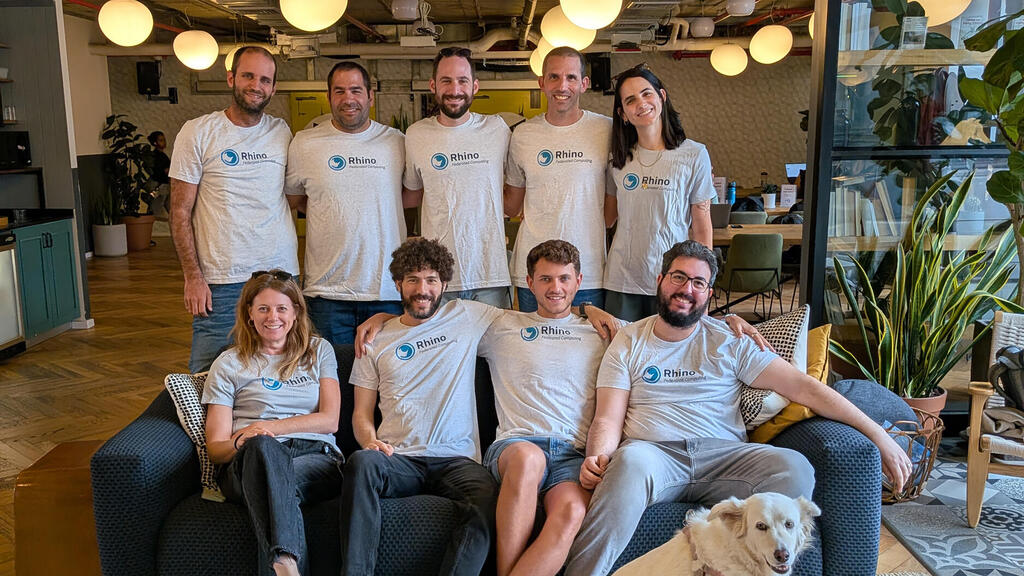
Rhino’s own geography reflects some of the coordination questions it sells software to address. The company is headquartered in Boston and has an R&D center in Tel Aviv. Dayan has also spoken about the deliberate effort required to build a remote team’s sense of community. In 2023, he said some colleagues had never met each other in person.
That admission gives the enterprise language a human scale. A distributed company still needs relationships, even when its software is designed to work across boundaries. The missing corridor conversation does not spontaneously reappear because everyone has a video link. Dayan described investing effort in maintaining contact and building team spirit. Connection, in this account, takes work at both the technical and personal level.
His account of life outside work supplies a less complicated collaboration. In 2023, he described making a vanilla ice cream cone for his then three-year-old son, followed by one for himself at the end of the day. He included his son’s pronunciation of vanilla: “vallillila.” The second cone, he said, arrived whether deserved or otherwise. Founders usually provide an achievement when asked for a revealing detail. An ice cream cone is a welcome change of scale.
What $15 million was meant to buy
On May 22, 2025, Rhino announced a $15 million Series A led by AlleyCorp, taking its announced cumulative funding above $30 million. Existing institutional investors participated alongside new backers. For Dayan and Baror’s venture, the round provided resources to expand the business beyond the original proving ground for its technology.
The spending priorities were concrete: reach more customers in regulated industries, expand the partner ecosystem and support additional federated AI uses. At the time, Rhino also reported more than 100 active edge nodes connecting data centers, private clouds and other secure environments. A node is infrastructure participating in the network; it should not be mistaken for a separate customer or a measure of company revenue.
The distinction is useful when following Dayan’s progress. Funding measures capital committed. Nodes describe part of the deployed architecture. Neither, alone, establishes the experience of an individual user. His challenge as an operator is to turn resources and connections into work that organizations will run again. The interesting number eventually becomes the next project a customer can complete without rebuilding the machinery.
May 2025
reported May 2025
The second project is the test
Dayan’s public conversations about entrepreneurship have included a recurring concern: getting a product into users’ hands and learning from what they actually do. In a 2023 podcast appearance, the discussion covered product usage, customer problems, focus and the timing of sales hires. Those are ordinary startup questions. They become particularly consequential when a company is selling infrastructure that customers must first learn to imagine.
By July 2026, Dayan and chief commercial officer Chris Laws were describing a broader idea called a Federated Intelligence Network. Their argument extended beyond training a shared model. A participant could contribute to a network, use its capabilities and retain its own data, taking several roles at once. The aspiration was an ongoing arrangement among organizations, with governance and coordination supplied by a common layer.
That ambition places a demanding condition on the software. A network must continue to be useful after the first demonstration. Partners change, models change and new work arrives. The ability to repeat a process reliably becomes as significant as the ability to perform it once. Dayan’s story keeps returning to this gap between seeing a possibility and operating it.
“get my hands dirty”Ittai Dayan, on moving from consulting into building and deploying AI
Getting invited back
Two announcements in 2026 show what that operating ambition looks like in practice. On August 26, Rhino announced availability through Microsoft Marketplace, giving Microsoft customers another route to discover and deploy its platform. Distribution is a prosaic subject compared with model intelligence, but it matters to a founder selling into enterprises with established procurement and cloud arrangements.
On October 22, the company introduced Trusted Integrations and Workflows. The former connects Rhino clients to systems organizations already use, including Snowflake, Databricks, MongoDB and Amazon Bedrock. The latter packages several steps into a versioned pipeline that can run across sites. The launch description emphasized records of runs, task status, logs and outputs. These are the details that allow a team to return to work without first reconstructing what happened last time.
Taken together, the announcements trace a recognizable direction in Dayan’s choices. Make the technology easier to buy. Connect it to existing systems. Make the work repeatable. Keep the arrangements reviewable by the organizations whose cooperation is required. The ambition is substantial, while much of its execution lives in details that rarely get a standing ovation.
Dayan’s proposition began with accepting that useful things might need to stay where they were. Records behind a firewall. Expertise in another organization. Colleagues in another city. His business depends on making those separations workable, one agreed process at a time. Somewhere beyond the permissions and pipelines, an evening ice cream cone offers a rather good reminder that a shared undertaking can also be simple.
Follow the work
- Rhino Federated Computing - platform and company updates
- Ittai Dayan on LinkedIn
- Dayan’s banking and federated computing interview
- The May 2025 funding announcement
- Dayan and Chris Laws on federated networks
- October 2026: integrations and repeatable workflows
- Watch: Flower AI Summit 2025 recordings - event playlist; Dayan was a featured speaker