At Bill Jackson’s, an outdoor retailer in Florida, a point-of-sale system has an unusual assignment: help schedule an indoor skiing area. It also handles bookings for a dive tank and a firing range. A shopping basket is only part of what moves through this business. Time slots move through it, too. Any software that understands the merchandise but misses the appointments understands only half the shop.
- Celerant joins store sales, eCommerce, inventory, and customer records.
- Cumulus serves smaller retailers; Stratus adds advanced workflows and customization.
- The useful test: can it handle your store’s oddest transaction?
That makes Bill Jackson’s a useful introduction to Celerant Technology. Retail software sounds like a tidy category until you meet an actual retailer. Then come the repair counter, the unusual product variations, the supplier catalog, and the customer who wants to collect an online order before lunch. Celerant builds for that untidiness.
The ski slope in the software
Bill Jackson’s adopted Celerant in 2021 after using its previous system for more than twenty years. According to Celerant’s case study, support for the old software was unavailable, reporting was limited, and accounting required manual work. The replacement, Stratus Enterprise, connected QuickBooks and electronic acquisition-and-disposition records for firearms alongside inventory and service scheduling.
“It’s like going from using an abacus to an iPad.”
Bill Jackson’s, in Celerant’s customer story
The comparison is exuberant. The underlying problem is ordinary: a checkout can keep ringing up purchases while the rest of the business accumulates work around it. The case suggests that the buying decision turned on those surrounding jobs. Celerant’s pitch becomes more persuasive when the conversation leaves the payment screen.
The second sale is the hard one
Brothers Ian and Robert Goldman co-founded Celerant in 1999. Ian leads the company as president and CEO; Robert is vice president and CTO. Their stated aim was to bring retail management into a single solution. Today that means connecting the shop floor, online storefront, stock records, customer history, and back office.
Consider the last pair of shoes in a particular size. A store assistant sells it while an online shopper is looking at the same item. This hypothetical problem captures the point of shared inventory: both channels need the same answer about availability. Without it, someone eventually has to explain why a confirmed order cannot be filled.
STORE + WEB02
INVENTORY + CUSTOMERS03
BUYING + FULFILLMENT
A conceptual map of Celerant’s connected retail approach.
BC Surf and Sport provides a concrete example. Its published customer story describes nine storefronts, eCommerce, Amazon, and eBay connected through Stratus Enterprise. Founder Bruce Cromartie credits the common provider with making those pieces easier to coordinate. The attraction is less repetitive reconciliation for staff whose actual job is helping people buy things.
Two clouds, different baggage
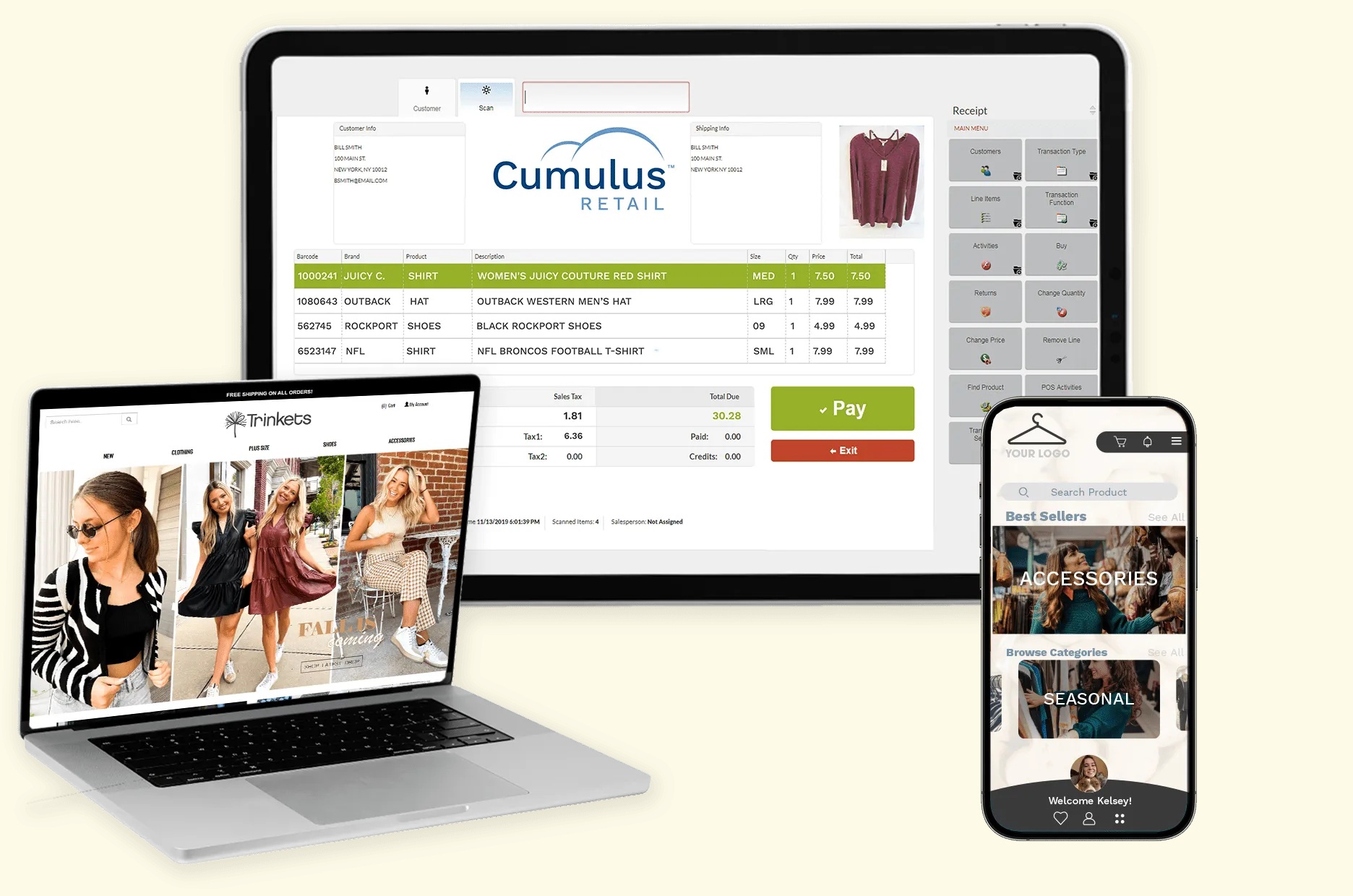
Celerant’s established product split follows operational complexity. Cumulus Retail is the lighter option for independent businesses. Stratus Enterprise supports more advanced requirements, including custom software changes. Its documented features include gift registries, embellishment workflows, and an optional system for routing online orders to the best store to fulfill them.
Published Cumulus pricing starts at $125 a month for one POS license and five back-office licenses. POS plus eCommerce starts at $350. Stratus requires a custom quote and offers both purchase and subscription models. These starting prices describe software packages; hardware, training, optional modules, and other upfront charges can change the bill.
Published starting prices. Configuration and additional costs vary.
Implementation is part of the purchase. Celerant assigns an implementation manager, and its FAQ describes data conversion and training work. That is a useful corrective to the idea that changing retail systems resembles downloading an app. Someone must decide how the old product records, staff habits, and new software will meet.
A supplier joins the conversation
Some of Celerant’s useful expertise sits upstream of the checkout. Its Sports South integration shares on-hand inventory, sales information, and minimum-and-maximum stock settings with the distributor’s Smart Order program. The resulting purchasing recommendations can be accepted, edited, or saved by the dealer. Automation supplies a starting point; the buyer retains a decision.
This is the practical appeal of industry-specific software. A sporting-goods retailer needs more than a generic list of products. Catalog imports, replenishment rules, and supplier connections can remove repeated entry from the working day. Celerant also offers digital marketing services, adding SEO, content, and email work to its software business.
Across the Atlantic, into the back office
In April 2025, Celerant announced its acquisition of Saledock, a UK retail software company with experience in sectors including cycling and equestrian retail. In August 2026, Saledock announced the Celerant ONE name for its platform. The UK announcement described a gradual branding transition with existing accounts, data, and support arrangements continuing.
Meanwhile, Celerant’s May 2026 Dallas conference showcased Skylar IQ, an AI retail agent, and a Customer Engagement Suite connecting email, SMS, social media, reviews, and live chat. Attendees also previewed a redesigned POS interface. Celerant describes Skylar as a way to question business data conversationally and inspect the underlying SQL. Availability deserves confirmation for a retailer’s chosen setup.
Bring your strangest transaction
Celerant competes for attention in a market that includes Shopify POS, Lightspeed Retail, and Square. Its case rests on the depth of its retail workflows and the coordination of multiple business functions. That combination deserves a close look when a merchant has several stores, complicated stock, specialist services, or suppliers that already connect to the platform.
A simpler shop may find that breadth unnecessary. A business committed to other systems should test the exact integrations it needs. And shared software still depends on sound stock records and sensible ordering rules. The useful lesson is portable: bring your strangest transaction to the demo. Ask the vendor to follow it from purchase order to sale to return. Watch where somebody reaches for a spreadsheet.